
Understanding the History of Harms within EDOW
In the Diocese of Washington, the process of uncovering our histories is ongoing. Since 2019, white congregations like St. Columba’s, DC, and Grace, Silver Spring have been researching their histories with race. Franklin Robinson, member at St. Thomas’ in Croome, MD, has researched the history of the eight “root parishes” that became the Diocese of Washington when it split from the Diocese of Maryland in 1895. The Committee on Diocesan Reparations has reported on the cumulative financial effect of financial harms. While there is much research yet to be done, the histories linked on this page describe specific harms of white supremacy and anti-black racism in our church family.

During the colonial era, congregations were funded by the tobacco tax. Specifically, the act establishing the Church of England as the state religion for Maryland geographically defined the thirty original parishes and instituted a tax of forty lbs. of tobacco for each taxable person to support payment of the incumbent priest. This tobacco was gathered in large part from plantations with enslaved labor. More details about enslavement in EDOW are available in this brief 2022 video with Franklin Robinson as well as his full-length research project, Bindeth Up Our Wounds.

In 1930, the property on which the lively Black church of St. George’s, at Fort Reno in Tenleytown, was built was condemned as part of the District government’s plans to build a new junior high school there for white students only. As St. George’s had been designated a mission of St. Columba’s Parish, the $9,029.70 condemnation award came to St. Columba’s. In 1929, prior to the condemnation of St. George’s Chapel at Fort Reno, a gathering of Black Episcopalians had the Bishop of Washington’s blessing to form a mission in the LeDroit Park/Bloomingdale neighborhoods. The first service of this mission was held on January 12, 1930 at 85 R Street, NW. This new mission also took the name St. George’s based on the Diocesan Executive Council’s statement that using that title would give St. George’s certain unspecified “needed benefits”. In July of 1930, St. Columba’s Vestry voted to allocate just $500 of the award for the condemnation of St. George’s at Fort Reno to the new St. George’s chapel. St. Columba’s kept the remaining $8,529.70 of the condemnation award to itself, despite having told the diocese that it agreed “in principle” that the proceeds should go to St. George’s. Consequently, in today’s dollars, St. Columba’s kept $138,000 of the funds and gave only $9,000 to St. George’s.
This is part of a larger history of St. George’s Mission, St. Columba’s, and the District, which can be read in more detail in the Racial History of St. Columba’s.

Many congregations in EDOW, like St. Paul’s Waldorf, were built with balconies for the enslaved – a concrete symbol of the immeasurable harm done to African Americans by our parishes. This historic harm, however, lives long after enslavement has ended, as the Rev. Dr. Maria Kane describes in Parish History: The Stories That We Tell. The denial of racialized history has a current day impact on Black members, revealing harm that is not only monetary in nature, but social, cultural, and personal.
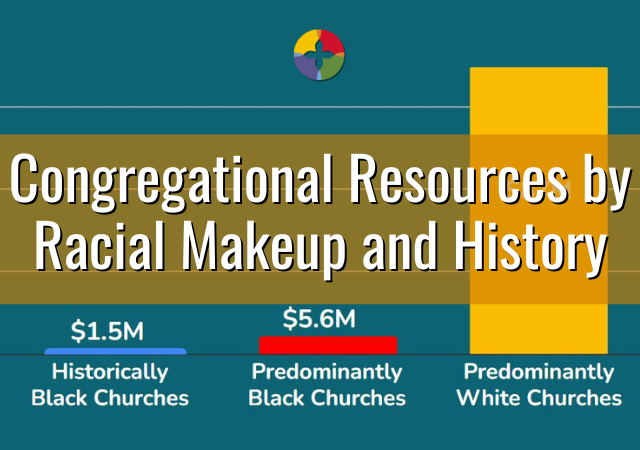
Today, partly as a result of choices made by diocesan leadership, along with the consequences of racism more broadly, Black congregations have less investment/endowment income but equal pledged giving. This places extra pressure on these congregations for operating and maintenance needs. For example, in 2021, the average attendee of a majority Black congregation in the Diocese gave $3,550 to their congregation, annually, as compared to $3,480 for the average attendee of a majority white congregation. But the average white congregation reported $721 of investment income per attendee, more than three times the $230 of investment income per attendee reported by the average Black congregation. This contributes significantly to vast disparities in revenue, whereby white congregations report almost twice the operating income of Black congregations, which in turn, generates disparities in staffing. Whereas 76% of white congregations in the Diocese have a full time staff clergy person, a majority of Black congregations have no staff clergy person at all. For more information on financial disparities between congregations, see Repairing the Breach: Congregational Resources by Racial Makeup and History.

Congregations around the diocese continue to research and share their race-related histories. The list below will continue to grow as more of our truth comes to light and we better understand our collective story.
- Grace Church, Silver Spring takes pride in its diversity. But their historical research identified over 70 people enslaved by Grace’s founders. “The land and resources we enjoy today come from that legacy of discrimination. We are learning about our past to move toward repentance and restorative justice.” Learn about Grace Church’s story.
- We learned about our history from an unexpected source: Henry the Church Mouse. He described when the people who were “brown like me” left St. Mary’s balcony for their own chapel, St. Philip’s Aquasco. And, when that chapel burned, he journeyed with them to their new church, St. Philip’s Baden. Learn about St. Philip’s story.
- For several years, this Cathedral has worked to contend with this nation’s original sins of racism and white supremacy. Now, we are called to do the same with our own history, because we believe we cannot be in right relationship with God until we are in right relationship with one another. Learn about the Cathedral’s story.
- The Archives of St. John’s Norwood are made up of voices from the past with a very interesting story to tell. Looking back, some of the story makes us feel very proud, other parts not quite so proud, but it is our history nonetheless, and in some ways, the history of Bethesda. Learn about St. John’s Norwood’s story.
- Although Ascension was founded by Christ Church, Rockville, as a mission in the 1880s, we have discovered ties to slavery through our land, early rectors, and founding lay leaders. We also uncovered truths about our “us-and-them” mindset in the 1960s and our transition to engaging in racial justice since then. Learn about Ascension’s story.
- This history of Black people at St. John’s, Georgetown parish, located at 3240 O Street, N.W., was written as a part of a Diocesan-wide effort, called the Congregation History Partners, to encourage individual parishes to develop their racial histories. Learn about St. John’s Georgtown’s story.
- Calvary is one of seven historically Black Episcopal churches in the Diocese of Washington. In researching our history, we learned how the issues of white supremacy and segregation were embedded in our founding in 1901, in everything from our location to our finances to our status in the Diocese. Learn about Calvary’s story.
- St. Margaret’s DC seeks to recount their history truthfully, acknowledging both the contributions we’ve made toward dismantling racism, as well as our complicity in furthering racism, so as to inform our ongoing journey toward God’s vision of what the Rev. Dr. Martin Luther King, Jr., called the beloved community. Learn about St. Margaret’s story.
