
SOUTHERN AFRICA LINK COMMITTEE
The Southern Africa Link Committee was formed in early 2004 to coordinate the Episcopal Diocese of Washington (EDOW)’s partnership with the Anglican Church of Southern Africa (ACSA) Anglican Church of Southern Africa. When the partnership began, then-Archbishop Njongonkulu Ndungane said, “We cannot choose our human family and we cannot choose our Christian family either. Our job is to recognize that we belong to God and we belong together.”
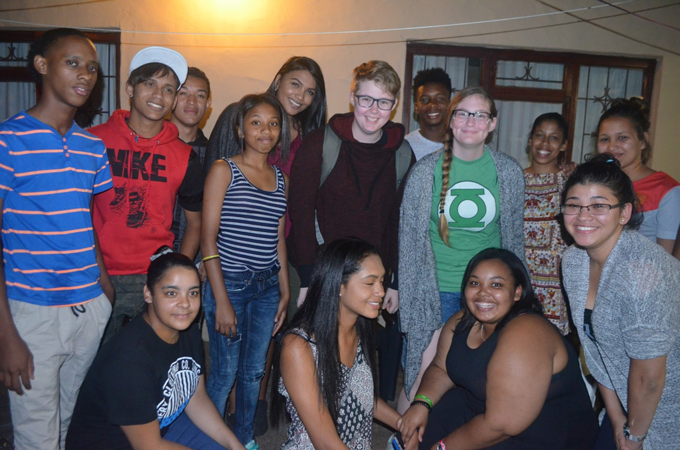

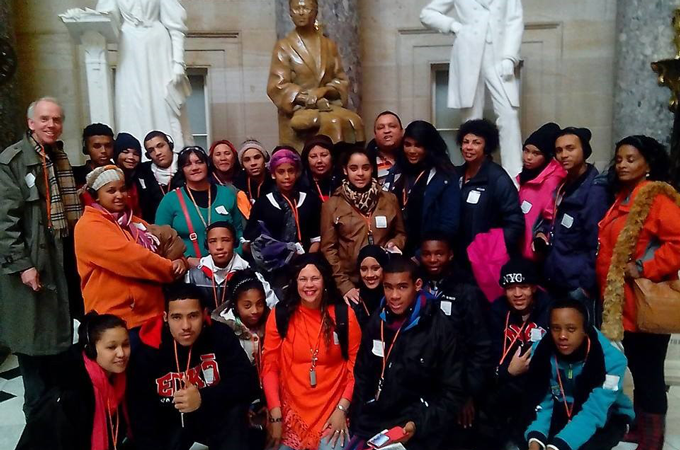
THE ENDURING FRIENDSHIP BETWEEN THE EPISCOPAL DIOCESE OF WASHINGTON AND THE ANGLICAN CHURCH OF SOUTHERN AFRICA
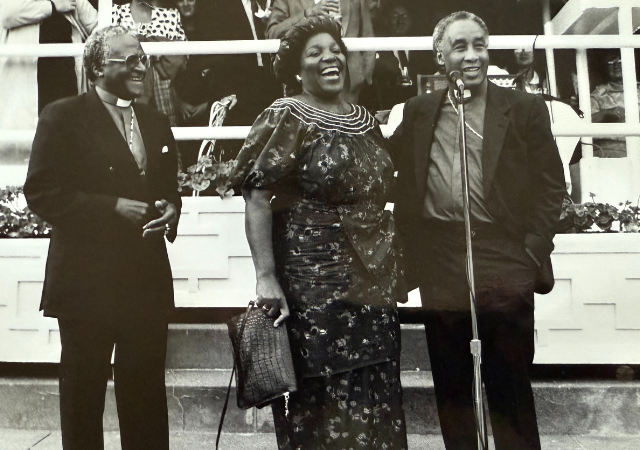
Archbishop Desmond Tutu, Leah Tutu, and Bishop Walker
In the mid-1980s, Desmond Tutu and John T. Walker formed a close personal friendship that eventually led to the current link between the Episcopal Diocese of Washington and the Anglican Church of Southern Africa. Desmond Tutu was then Bishop of Lesotho and John Walker, Bishop of Washington. They first found common cause in the fight against apartheid in South Africa and in pursuit of a democratic, multi-racial government. Their successors continued the struggle and further worked toward racial reconciliation, a loving response to the HIV-AIDs epidemic, environmental justice, and caring for all God’s creation
Desmond Tutu and John Walker first met in 1978 when Desmond was Bishop of Lesotho.1 Thereafter, Desmond and John became lifelong friends. During this early period in their friendship, Bishop Walker invited Bishop Tutu to Washington to preach about the human suffering of government-imposed apartheid in South Africa. While in Washington, Desmond had greater freedom to speak out against apartheid than when in South Africa.
Bishop Tutu relished being in community with Bishop John Walker and the Diocese of Washington. Addressing the Episcopal Diocese of Washington’s annual convention in January 1984, Desmond said that he was
“exhilarat[ed] to belong to the church of God! We belong to an extraordinary fellowship one that transcends all those barriers and distinctions which human beings have [made] for separation—time, space, race, culture, sex, color — all are transcended in this fellowship, in this ‘koinonia,’ which is the body of our Lord and Savior Jesus Christ.”2
Bishop Tutu reciprocated by inviting Bishop Walker to South Africa. Then Desmond welcomed Bishop Walker and others from Washington at his consecration as Bishop of Johannesburg in February 1985. Following the consecration, Desmond expressed again his joy that the Diocese of Washington was walking with him in the struggle against apartheid. In a note of thanks, Desmond wrote to Bishop Walker, your visit, “was important for us and for others as well to have the world church so impressively represented.”3
Following the consecration, Bishop Walker and a group from the Diocese traveled around South Africa to see firsthand the inhumanity of apartheid. Their movements around South Africa were partially blocked because the Diocesan delegation included African Americans. Upon their return to the U.S., the delegations’ reports of the human suffering present in South Africa back up Bishop Tutu’s own accounts of the ongoing terror in South Africa against non-whites.
Shortly thereafter in March 1985, Bishop Walker led a public protest in Washington in support of Desmond and to show compassion for the oppressed in South Africa. Bishop Walker and over 75, including other Diocesan clergy, were arrested at the protest in front of the South African Embassy in Washington. At the time of arrest, Bishop Walker said:
I’ve now decided to offer this gesture in support of a friend of all of us, a fellow Bishop in the Church of God, Desmond Tutu, Bishop of Johannesburg and for all the black people of South Africa. . . . . I believe that my ministry . . . demands that I show my love for the oppressed peoples at home and abroad by some concrete, although in this case, symbolic action.4
Bishop Walker later returned to Cape Town to join Desmond for his enthronement as Archbishop of the entire Anglican Church of Southern Africa in September 1986. At Desmond’s invitation, Bishop Walker spoke at an outdoor Eucharist at a Cape Town stadium celebrating Desmond’s enthronement.5 Desmond expressed his appreciation to Bishop Walker for attending, saying “[t]hank you very much for everything you and Marie (Bishop John Walker’s wife) gave us.”6
Following the celebration of Desmond’s consecration as Archbishop in Cape Town in September 1986, Archbishop Tutu and Bishop Walker spoke about possibly forming a link relationship between the Episcopal Diocese of Washington and the Anglican Church in Southern Africa.7 In May 1988, Desmond sent a note, “I hope that we can do something about diocesan links. It would be good.”8 Bishop Walker responded favorably, telling Desmond that he would study how best to organize a link relationship. Bishop Walker saw a relationship revolving around parish-to-parish connections, a Diocese prayer cycle including South Africa, and reciprocal visitor exchanges.9
Unfortunately, Bishop Walker passed away unexpectedly soon thereafter in September 1989. Archbishop Tutu traveled to Washington to attend the funeral.10
Thereafter in late 1989, Bishop Walker’s successor, Bishop Ronald Haines, endorsed a relationship between EDOW and the Anglican Church in South Africa.11 Both church leaders envisioned a supportive companion relationship around issues of justice.12
Successor bishops to Archbishop Tutu and Bishops Walker and Haines have given new life to the link relationship. In June 2002, Bishop John Chane was consecrated the new Bishop of Washington. Desmond’s successor as Archbishop in Cape Town, the Most Rev. Njongonkulu Ndungane, attended the Washington consecration. On that occasion, Archbishop Ndungane, invited Bishop Chane to visit South Africa.
In December 2002, Bishop Chane with a delegation traveled to South Africa to meet with the Archbishop Ndungane. Their meetings included a visit in Cape Town to see Desmond, then Archbishop Emeritus.
Bishop Chane and Archbishop Ndungane agreed to expand the link into a partnership between the Diocese and the entire Anglican Church of Southern Africa. The plan was for the two church bodies to develop person-to-person links. The plan for person-to-person sharing reflected Desmond’s own learning that you cannot love people without visiting and knowing them.
Finalized in 2004, the new link agreement gave particular attention to the HIV/AIDs epidemic and women’s and children’s abuse. The agreement committed both church bodies to a mutual partnership to work together to pursue justice, reconciliation and peace in their communities.
The partnership opened the door for a range of parishes and schools in the Diocese of Washington to engage with parishes and schools in the Anglican Church of Southern Africa. Many of those relationships are now continuing. The collaboration also currently includes working together for environmental justice and caring for all God’s creation.
1See Bishop John Walker letter, dated September 28, 1984.
2Washington Diocese News at 1, Feb. 1984.
3See Bishop Tutu letter to John Walker, dated March 6, 1985.
4See Bishop Walker Statement—South African Demonstration (March 13, 1985).
5Note from Desmond to John Walker, dated September 24,1986.
6See note from Archbishop Tutu to John Walker, dated September 24,1986.
7The church body headed by Archbishop Tutu was then known as the Province of Southern Africa.
8See note from Archbishop Tutu to Bishop John Walker, dated June 7, 1988.
9See letter from Bishop Walker to Archbishop Tutu, dated March 16, 1989.
10At that time, Archbishop Tutu said that Africans are “devastated by the loss of someone we loved so dearly. . . . . Having been touched by him we’ll never be the same again.” See “5,000 Mourn Bishop Walker,” The Washington Post, Oct. 5, 1989. Desmond later agreed to become Honorary Chair of the Advisory Committee of the Bishop John T. Walker School for Boys, a boys school established in Anacostia by the Diocese of Washington in memory of Bishop Walker.
11See Interim Report of Committee on South Africa (Jan. 14, 1991). The EDOW Jan. 1991 Convention adopted resolution committing to a companion relationship in January 1991.
12See Interim Report, supra, at 8.
ARCHBISHOP TUTU'S LEGACY TO THE EPISCOPAL DIOCESE OF WASHINGTON
“Do your little bit of good where you are; it’s those little bits of good put together
that overwhelm the world.” – Desmond Tutu
We in the Episcopal Diocese of Washington remember Archbishop Emeritus Desmond Tutu’s many contributions to Washington and join the world in reflecting on his distinguished life and gifted ministry.
Desmond’s message of faith and reconciliation found a home in Washington. During the anti-apartheid struggle in South Africa, the former Bishop of Washington, the Rt. Rev. John T. Walker, and Desmond formed a lifelong friendship. Thereafter, Desmond was welcomed in Washington throughout his life. On many occasions, the Washington National Cathedral offered Desmond its pulpit to share his soft but Godly voice against social injustice at home and around the world.
We in Washington listened to Desmond and saw his faithfulness. We watched Desmond fearlessly wade into a hostile crowd in South Africa to save a poor victim from “necklacing.” We witnessed his inspired leadership of the South Africa Truth and Reconciliation Commission seeking to transform a nation beset by racial strife to a nation that embraces diversity – to a rainbow nation. We prayed with Desmond as he underwent medical treatment in NYC.
The earliest collaboration between Archbishop Tutu and Bishop Walker forged a lasting bond between the Anglican Church of Southern Africa and the Diocese of Washington. They united first in a common resolve against racism. This shared ministry later grew to develop a model for the compassionate response to those suffering from HIV/AIDS in Southern Africa and the United States. Today, this same shared ministry has evolved to combat climate change and its devastating impacts on communities in need throughout the world.
Washington also has been blessed by Desmond’s deep conviction to safeguard children and ensure their education. Desmond served on the first Advisory Board for the Bishop John T. Walker School for Boys, established in memory of Bishop Walker. The tuition-free elementary school serves young boys living in underserved communities of Washington and seeks to nurture their intellectual, spiritual and moral foundations as exemplified by both Desmond and Bishop John Walker.
For these many blessings, we give thanks for Archbishop Emeritus Desmond Tutu. His immeasurable gifts have lifted up Washington to make us better people of God.
God Bless Africa and her native son Desmond and give comfort to his wife Leah and their four children during this difficult time.
Southern Africa Link Committee
Episcopal Diocese of Washington
Washington, D.C.
December 26, 2021
IN LOVING MEMORY OF THE RT. REV. ELLINAH WAMUKOYA, DIOCESE OF SWAZILAND
Our Southern Africa Link Committee of the Episcopal Diocese of Washington feels blessed by the loving ministry of the Rt. Rev. Ellinah Wamukoya, who died on January 19, 2021, in eSwatini, formerly Swaziland.
Bishop Ellinah nourished us with her quiet charm, gentleness, and firm commitment to the needs of others and for caring for God’s creation. She warmly welcomed visitors to eSwatini from the Diocese of Washington. She also delighted us in 2018 by visiting Washington to share her devotion to protecting the environment for the benefit of everyone around the world.
We particularly remember Bishop Ellinah’s leadership in response to the Covid pandemic. In a letter to the Diocese of Washington, she recently lamented the severe hardship unfolding in her Diocese and recommitted herself to caring for her faith community during these most difficult of times. She wrote that, while the Covid restrictions are painful, “we have not allowed the restrictions to interfere with our faith. We remain united emotionally and spiritually by providing opportunities to care for each other.”
May God bless her and care for her family and all whom she loved in her Diocese of Swaziland.
LEADERSHIP
We invite you to read reflections from these leaders:
The Rt. Rev. Charles May, Bishop of the Diocese of the Highveld, South Africa
The Rt. Rev. Ellinah Wamukoya, the Bishop of Swaziland
The Rt. Rev. Andre Soares, the Bishop of Angola
The Rt. Rev. Vicente Msosa, Bishop of the Diocese of Niassa, Mozambique
Members
Abbott McCartney, Chair
The Rev. Elizabeth Hague
The Hon. Cynthia Efird
Sigrid Block
Ian Glenday
Mary McCarthy
Jonathan Miller
Gregory Morrison
Adelle Simmons
Juanita White
