
 Fifty years ago, at the 1976 General Convention in Minneapolis, The Episcopal Church took its first official step toward the full inclusion of LGBTQIA+ people. General Convention passed a resolution declaring that “homosexual persons are children of God who have a full and equal claim with all other persons upon the love, acceptance, and pastoral concern and care of the Church.”
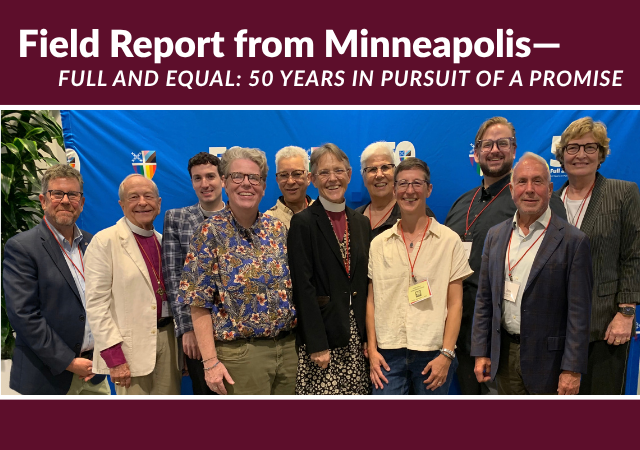
This year, from September 3–5, nearly 200 Episcopalians returned to Minneapolis for Full and Equal: 50 Years in Pursuit of a Promise. Eleven people from the Episcopal Diocese of Washington attended the gathering, including Bishop Mariann Budde.
Returning to Minneapolis was significant. We were back in the city where, 50 years earlier, the Church first put into words a promise that would take decades to fully realize. The conference brought together lay and ordained Episcopalians from across the Church to worship, tell stories, hear and document our history, and reflect on what comes next. Many of those present had lived through that history and helped make it. Their stories were reminders that the inclusive Church many of us experience today is relatively new—and that it did not simply happen.
Throughout the 1980s and 1990s, questions about the place of gay and lesbian people consumed much of the oxygen in the Church. There was pain, conflict and division. LGBTQIA+ Episcopalians heard messages of condemnation from our own pulpits. At the same time, faithful people continued to challenge the Church they loved to become more fully what it proclaimed itself to be.
Slowly, inclusion began to prevail. In 2003, V. Gene Robinson was elected Bishop of New Hampshire, becoming the first openly gay bishop in the Anglican Communion. His election brought celebration, but also deep division within The Episcopal Church and across the Anglican Communion. In the years that followed, barriers to the ordination of gay and lesbian people continued to fall. Later, in 2015, General Convention authorized marriage rites that could be used by same-sex couples.
That was only 11 years ago. These freedoms and our Church’s inclusive stance toward LGBTQIA+ people are new, and they are precious. And while I believe the Holy Spirit has been at work leading the Church toward greater inclusion, the changes did not just happen. People worked, prayed, protested, argued, persevered and, in many cases, suffered to bring us to this place.
One of the most powerful moments of the weekend came at the closing Eucharist at St. Mark’s Episcopal Cathedral. The cathedral was packed and the atmosphere was joyful. Bishop Robinson preached, and five gay and lesbian bishops joined Presiding Bishop Sean Rowe in the celebration of the Eucharist. To witness that in Minneapolis, 50 years after the 1976 resolution, was extraordinary.
The presence throughout the gathering of Presiding Bishop Rowe and of our own Bishop Mariann also mattered. Their presence as allies offered a visible reminder that LGBTQIA+ inclusion is not simply the concern of LGBTQIA+ Episcopalians. It is part of who we are called to be as a Church.
And yet, this was not a victory lap. As Bishop Robinson reminded us in his sermon, the dream of full inclusion has not yet been fully realized. LGBTQIA+ people still experience rejection and discrimination, in the Church and beyond. Transgender people in particular are facing profound hostility today. Presiding Bishop Rowe spoke directly about that reality, calling such treatment contrary to the Gospel.
There is much to celebrate after these 50 years. We are a better Church because of the people who pushed us toward a fuller understanding of God’s love. But we’re not done. Jesus’ command is simple, if not easy: “Love one another. As I have loved you, so you must love one another.”
A love that knows no bounds will always call us farther than we have already gone. The Holy Spirit is still at work. Our task is to keep listening, keep loving, and keep moving toward the day when “full and equal” is not simply a promise we made, but a description of the Church we have become.
The Rev. Thom Sinclair
Chief Operating Officer
