by Bishop Mariann | Dec 24, 2023
In that region there were shepherds living in the fields, keeping watch over their flock by night. Then an angel of the Lord stood before them, and the glory of the Lord shone around them, and they were terrified. But the angel said to them, ‘Do not be afraid; for see—I am bringing you good news of great joy for all the people: to you is born this day in the city of David a Saviour, who is the Messiah, the Lord. This will be a sign for you: you will find a child wrapped in bands of cloth and lying in a manger.’ And suddenly there was with the angel a multitude of the heavenly host, praising God and saying, ‘Glory to God in the highest heaven, and on earth peace among those whom he favors!’
Luke 2:8-14
Keep watch, dear Lord, with those who watch, or work, or weep this night. And give your angels charge over those who sleep. Tend the sick, Lord Christ; give rest to the weary, bless the dying, soothe the suffering, pity the afflicted, shield the joyous; and all for your love’s sake. Amen.
There are moments in life when we are given eyes to see, in some small way, as God sees; we are given ears to hear something of what God hears; and our hearts are opened to love, in our modest sphere of life, the way God loves.
In one of the stained glass windows of the Cathedral there is a depiction of the universe, created by the artist Rodney Winfield and installed in 1974. Embedded within it is a moon rock estimated to be over three billion years old, a gift from NASA and the Apollo 11 astronauts.
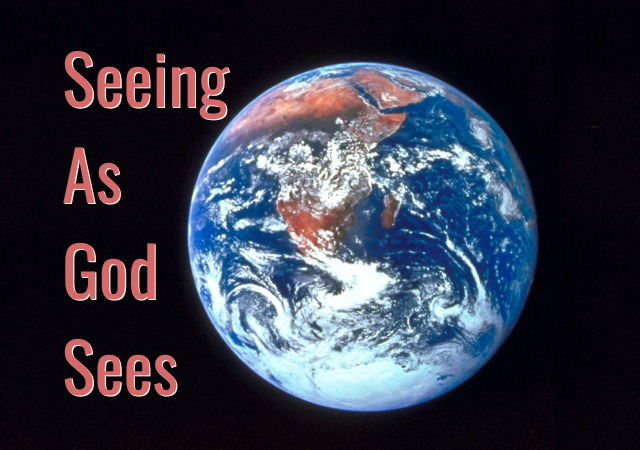
It’s fascinating to read the accounts of those who have traveled in space. While they are filled with awe at the vastness of the universe, what’s most striking about their reflections is what it was like to see the earth from outer space.
“We have the most beautiful planet in our solar system,” said Sunita Williams, a NASA astronaut. “None other can sustain life as we know it. None other has blue water and white clouds covering colorful landmasses filled with thriving, beautiful, living things like human beings.”
“The Earth was small, light blue, and so touchingly alone,” said Aleksei Leonov, Russian cosmonaut and first person to conduct a spacewalk. “Our home that must be defended like a holy relic. The Earth was absolutely round. I believe I never knew what the word ‘round’ meant until I saw Earth from space.”
“I realized up there that our planet is not infinite,” said Alan Shepard, the first American to go to space. “It’s fragile… We look pretty vulnerable in the darkness of space.”
From Neil Armstrong, the first person to walk on the moon, describing the view of earth from a window of the Apollo 11 spacecraft: “It was a tiny pea, pretty and blue, I put up my thumb and shut one eye, and my thumb blotted out our planet. I didn’t feel like a giant. I felt very, very small.”1
And this from Leland Melvin who traveled to the International Space Station: “I had that moment of, ‘Oh my God, we’re all connected. Oh my God, the planet is so beautiful. Oh my God, what can I do to make it better when I get home?’ And in coming home, the things that bothered you? They don’t bother you.”2
There’s a name for what the astronauts describe. It’s called “the Overview Effect,” a cognitive shift that forever changes how they see themselves and our world. Some say they no longer identify with a specific nationality or culture after seeing earth from outer space. Instead they see themselves, and all citizens on earth, as one people, living on one world.
We might call the Overview Effect as seeing in part the way God sees.
We don’t need to leave the planet to be graced with such vision. It can happen to us right where we are, in the most unpredictable moments. The monk Thomas Merton writes of such a time when he stood on a busy street corner in Louisville, Kentucky, in the center of the shopping district:
I was suddenly overwhelmed with the realization that I loved all these people, that they were mine and I theirs, that we could not be alien to one another even though we were total strangers… It was as if I suddenly saw the secret beauty of their hearts, the depths of their hearts where neither sin nor desire nor self-knowledge can reach, the core of their reality, the person that each one is in God’s eyes. If only they could all see themselves as they really are. If only we could see each other that way all the time. There would be no more war, no more hatred, no more cruelty, no more greed… But this cannot be seen, only believed and ‘understood’ by a peculiar gift.”3
And surely the most universal of moments of being given eyes to see as God sees is when we hold in our arms a newborn child.
‘And this will be a sign for you: you will find a child wrapped in bands of cloth and lying in a manger.’
Small wonder that for Christians the definitive way that God invites us to see with new eyes is through the birth of a child.
And what does God want us to see?
The Irish singer Bono writes in his memoir of how he became involved in addressing the global AIDS epidemic, and specifically in 2002, in the effort to convince the Bush Administration to dedicate massive financial resources to combating AIDS on the African continent where the devastation was most severe. This was when antiviral drugs largely were available in the United States and elsewhere, but denied to the millions of people dying in African countries.
Bono knew that US public opinion was critical to swaying reluctant politicians in Washington, so as part of a national tour, he appeared on Oprah Winfrey’s talk show, the most popular daytime television program in the country at the time. Characteristically, in her interview, Oprah cuts to the chase asking Bono: “What does AIDS in Africa have to do with my ten million viewers, a lot of them women at home worried about their own children?” Bono replies, “The way I see it, this is about the value you put on the life of a child… I don’t think you have to explain to any mother that the life of a child in Africa has the same value as her child.”4
Seeing as God sees.
Where you live should not decide whether you live or whether you die.5
The angel said to the shepherds, “Do not be afraid—I am bringing you good news of great joy for all the people.” Not for some people, the most deserving people; not for one racial or ethnic group, or for those who hold to one set of religious beliefs, or citizens of one nation.
Then the heavenly chorus joined in:
Glory to God in the highest heaven and on earth, peace, goodwill to call.
God wants us to know, wants us to see that it is God’s desire, God’s will, God’s intention that there be peace on earth and goodwill for all people. Jesus’ birth is a sign of God’s desire, not its fulfillment. Fulfillment of God’s desire is still in play.
But Jesus’ birth is more than a sign. Jesus came to show us the way, God’s way to the peace and goodwill we long for. God’s way is the way of love and forgiveness, hope and joy.
Rest assured that ours is not the first generation that struggles to reconcile the beautiful, hope-filled promise that we celebrate tonight with our lives as they are and the world as it is. Even the beauty of this Cathedral cannot shield us from what we know.
Over four hundred years ago, William Shakespeare gave words to our struggle In the opening scene of Hamlet. He has one terrified night watchman say to another:
Some say that ever ’gainst that season comes
Wherein our Savior’s birth is celebrated,
This bird of dawning singeth all night long…
And then, they say, no spirit dare stir abroad,
The nights are wholesome; then no planets strike,
No fairy takes, nor witch hath power to charm,
So hallowed and so gracious is that time.
To which his equally frightened comrade replies, “So I have heard and do in part believe
it.”6
The poet Maya Angelou once described Christmas as “the halting of hate time.”7
So, too, we have heard, and do in part believe it.
Or do we?
Maybe we believe but aren’t sure what difference it makes, for while Christmas has come this as it has every year since Jesus’ birth, in far too many places on the planet we call home, the hating time is alive and well.
If you’re like me, believer or not, you’re grateful to have this yearly occasion to remind us of God’s promise, inspire us with songs and stories of hope, and invite us to see ourselves and one another through God’s eyes of love.
But the disparity between the promise of Christmas and the pain we see is heartbreaking.
I wonder if God is grateful for our broken hearts at Christmas. And I suspect that it’s just fine with God if we can only believe in part at Christmas, because the distance between the hope of Jesus’ birth and the unrelenting pain breaks God’s heart, too.
Could it be that in our broken hearts, united with God’s, lies the hope of the world?
Jesus’ birth is also a sign of God’s determination not to give up on us, to make a home within us and to be Emmanuel—God with us. And that is a promise fulfilled. God is with us. Our lives matter to God. What’s more, God needs us to help bring a halt to the hating time, to help in ways both large and small to realize the promise of peace.
So hold your broken heart before God this Christmas. Hold before God whatever belief you have, or don’t have, or long for. Hold whatever glimpses of joy, love, forgiveness and generosity you have known. For they, too, are God’s signs for you, that the promise is real and worth living your life by. In our broken, yet still beating and joyful hearts, united with God’s, lies the hope of the world.
I leave you with the words of a Gospel song that’s been in my head since I heard it here on Friday night:
Mary magnified the Lord in her soul and she cried
For this baby she would bear,
Born for all people to be free and redeemed.
And He lives today within us,
Though we don’t always see.
We are Christmas.
We are God’s hands.
To care for another
In these war-torn lands.
We are Christmas.
The love that we share,
Will carry one another
Until we understand.
So this Christmas, please remember
What the true meaning is.
Remember we are Christ among us,
And for his cause we live
We are comfort for the hurting
We are friendly to the lonesome
We’re His hands who touch the sick
We are water for the thirsty
And speak peace to every soul.
He lives in you.
He lives in me.
It is Christmas.8
See with God’s eyes. Hear with God’s ears. Love as God loves as if the world depended on it. Because it does. It does.
Amen.
1How Astronauts Change After Seeing Earth from Space
215 Astronauts Share Their Perspective on Planet Earth
3Thomas Merton, Conjectures of a Guilty Bystander (New York: Image Books Edition, 2009).
4Bono, Surrender: 40 Songs, One Story (New York: Alfred A Knopf, 2022), 419.
5U2 Song, “Crumbs From Your Table.”
6The Tragedy of Hamlet, Prince of Denmark
7Amazing Peace: A Christmas Poem by Maya Angelou
8“We are Christmas,” by Kevin P. Johnson and Sarah Stephens.

by Bishop Mariann | Dec 14, 2023
The Light shines in the darkness, and the darkness did not overcome it.
John 1:5
Nearly 20 years ago, the associate rector of the church I served in Minneapolis proposed that we offer a service in Advent for those grieving the death of a child. We put candles throughout the sanctuary, arranged for beautiful music, and did everything we could think of to create an environment where mourning families might experience God’s presence in their pain.
The following Advent we expanded the circle to include all those grieving the death of any loved one. The next year we expanded further still, to encompass all manner of grief. Thus we took our place amid a growing movement in Christian communities that make space in Advent for grieving hearts.
I give thanks that several EDOW congregations are offering such services as a source of solace for those for whom Christmas is a painful time. For some, it is the only service that they can bear to attend. For others, it’s a relief to be with others for whom no explanation is needed for their tears. For all of us, it’s a reminder that Jesus is not afraid to make his home in our grief, and that what we celebrate at Christmas is large enough to hold the full range of human experience.
We don’t need a special service to acknowledge that sorrow and joy are intrinsically linked at Christmas. Given the suffering of this world and the grief we may carry, it can be hard–if not impossible for some–to join in the season’s festivities. There are times to dramatically scale back the exuberance, as Palestinian Christians in Bethlehem understandably have done this year in solidarity with those suffering in Gaza.
From the beginning, Christians have insisted that in the darkest times–and especially in those times–the light of Christ still shines. The light may seem to flicker like a candle in the wind; for a time, it may lie beyond our sight. But it’s here. He is here. The stories of Jesus’ birth in the most precarious of times and humblest conditions are meant to help us trust his presence in the places we feel least equipped to receive him, and for us to show up where love is needed most.
There’s an intentionality about celebrating Christmas that opens us to receive gifts of peace, joy and hope that we might otherwise miss. Just as the Sabbath comes each week, no matter if we have completed our work, Christmas comes each year, no matter our circumstance. Theologian Howard Thurman, himself no stranger to suffering, exhorts us to find space at Christmas for those fleeting moments of penetrating beauty and meaning when
the commonplace is shot through with new glory, old burdens become lighter, deep and ancient wounds lose much of their old, old hurting. A crown is placed over our heads that for the rest of our lives we are trying to grow old enough to wear. Despite all the crassness of life, despite all the hardness of life, despite all the harsh discords of life, life is saved by the singing of angels.1
Where might you go to hear the angels sing for you and all who suffer?
I also think of Christmas as a time to join with God in the holy work of shielding joy. Much of the season’s joy is vicarious–doing what we can to embody peace, hope, and love for others. Not only are we to cherish and savor joyful moments, but also to protect them, let them be the gift that they are, the means through which God comes to us in love.
Perhaps it’s as great a gift at Christmas to delight in another person’s happiness as it is to be in solidarity with another in their grief. Enjoy every minute my mother will say to me as I prepare to spend the week after Christmas with my children and grandchildren, even as she must remain in her small assisted living apartment, far from family, As I do, I will hold her in prayer, grateful for her generous love and sincere desire for me to be happy in ways now denied her.
To live as if the promises of Christmas are true–that God is with us, that Jesus makes his home in our world as it is and our lives as they are–is an act of courageous faith.
I pray that you may receive a palpable experience of Jesus’ loving presence with you this Christmas and join in ways of embodying his love for others.
I pray that we might be given ears to hear the angels sing their song of good news and great joy for all people. For to us is born a Savior, who is Christ the Lord.
1Howard Thurman, Deep Is the Hunger (New York: Friends United Press, 1970)
by Allen Fitzpatrick | Dec 7, 2023
Join Bishop Mariann and diocesan colleagues at Christ Church Kensington for a day dedicated to courageous discipleship. Learn about available resources for deepening discipleship at the congregational level and have the opportunity to work on articulating a path of discipleship for your local context. Registration, check-in and coffee is available beginning at 9:30 a.m. The program begins at 10:00 a.m. and will conclude at 3:00 p.m.

by Bishop Mariann | Dec 3, 2023
Almighty God, give us grace to cast away the works of darkness, and put on the armor of light, now in the time of this mortal life in which your Son Jesus Christ came to visit us in great humility; that in the last day, when he shall come again in his glorious majesty to judge both the living and the dead, we may rise to the life immortal . . .
Collect for Advent 1
From ages past no one has heard, no ear has perceived, no eye has seen any God besides you, who works for those who wait for him.
Isaiah 64:4
I give thanks to my God always for you because of the grace of God that has been given you in Christ Jesus, for in every way you have been enriched in him, in speech and knowledge of every kind–just as the testimony of Christ has been strengthened among you–so that you are not lacking in any spiritual gift as you wait for the revealing of our Lord Jesus Christ. He will also strengthen you to the end, so that you may be blameless on the day of our Lord Jesus Christ. God is faithful; by him you were called into the fellowship of his Son, Jesus Christ our Lord.
1 Corinthians 1:3-9
I give thanks to God for the gift of being with you, good people of Trinity Church, on this first Sunday of Advent, a season of hopeful expectation, with its invitation to prepare ourselves for whatever awaits beyond the horizons of our sight.
I’ve been looking forward to today, so glad that my scheduled visitation would be in the first weeks after your loving send off for Bishop-elect Harmon and his family. The Harmons are preparing for their new life of faithfulness and service to God, and so are you, as a community of faith, as you wait and wonder and pray for what the future holds.
No matter where we are in life, and what life asks of us now, the season of Advent comes along once a year to remind us all to put our trust and hope in God. And to wait for God. To wait for God. God is faithful, we’ve just heard the Apostle Paul remind one of the earliest communities of Jesus followers, those gathered in Corinth, Greece–a community, by the way, facing considerable external pressures and a boatload of internal dysfunction. Things were not going well in Corinth. Nonetheless, Paul is unwavering in his faith that because of the grace of God that has been given then in Christ Jesus, because of the ways they had been enriched in him, they were not lacking in any spiritual gift as they waited for the revealing of Jesus among them. He would strengthen them to the end as they waited on Christ.
His words to them we can take as our own: God is faithful, even when life is hard. God is faithful even when we cannot see the way. God is faithful, even when we are not.
I remember once talking to my mother about Advent as a season of watching and waiting for God, watching and waiting for what God longs to give us. At the time she was an active lay leader in her small, struggling Episcopal Church. “I’ve never thought about Advent like that before,” she said. “Every December, all I can think of is what I need to get done.”
I knew what she meant, and one reason that I remember our conversation from many years ago now is that I also have a long to-do list every December. Which is why the spiritual practices associated with Advent are so helpful, because they aren’t a heavy lift, yet another thing to check off our daily list. Rather what Advent invites us into is a posture of attentiveness–paying attention, watching for how God might come to us, or, like an unborn child, is already here in ways we cannot as yet see.
Here is a simple spiritual practice that might help you pay attention to the workings of grace in your life this Advent. It’s a practice you do on your own, or in conversation with others.
At the end of each day, or at the beginning if your mind is clearer in the morning (as mine is), take a few moments to review the past 24 hours. You can also do this at the end of a week–simply allow your mind’s eye to review the events, conversations, thoughts, dreams, longings, regrets of the past day or week. Then ask yourself “What was the heart of my day?” Or “What was the heart of my week?” In other words, what moment or event or conversation or dream or thought do I want to remember and take with me as the gift of the past day, or past week? Which is another way of asking, “Where did I feel most alive? When did something happen that I could easily forget or overlook that is worth savoring for the gift that it was?”
Over Thanksgiving weekend, as I prayed for a word of encouragement to share with you this morning and with others across the diocese throughout Advent, the stories of Joseph, the man who would accept Mary’s baby as his own, kept coming to mind. We don’t know very much about Joseph. Unlike Mary, Jesus’ mother, who stays with Jesus all through his life and is present at his death–Joseph disappears from the stories of Jesus early on. The last we hear of him is in the Gospel of Luke, Chapter Two in the story of Jesus’ parents taking him to Temple in Jerusalem for the festival of Passover when he was twelve years old. You may remember this story: on the return home, Mary and Joseph assumed that Jesus was with the group of travelers they were with, but in fact, he had remained in the Temple to sit among the teachers there. Joseph isn’t mentioned in the story. Mary refers to him when she asks Jesus why he didn’t stay with the group. “Your father and I have been searching for you in great anxiety,” she tells him. Jesus responds with a foreshadowing of his adult life: “Did you not know that I must be in my Father’s house?”–referring to God as his father, not Joseph. He remained obedient to his parents, Luke tells us, and grew in wisdom and in years. Mary treasured all that was happening to her son in her heart. Joseph is never mentioned again.
Yet in other stories of Jesus’ birth and his early childhood, Joseph is an icon of faithfulness, without whom Jesus would not have lived to see his second birthday.
Let me read to you from the text:
Now the birth of Jesus the Messiah took place in this way. When his mother Mary had been engaged to Joseph, but before they lived together, she was found to be with a child from the Holy Spirit. Her husband Joseph, being a righteous man and unwilling to expose her to public disgrace, planned to dismiss her quietly. (Matthew 1:18-19)
Here’s the situation Joseph finds himself in: his fiancée is pregnant with a child that is not his. He is a righteous man, meaning he strives to live according to the teaching of his faith. He doesn’t want to shame Mary, but he feels he can no longer marry her. The text doesn’t delve into a lot of emotion here, but we can surmise that this was a devastating turn of events for them both. What on earth was he supposed to do with Mary’s insistence that the child was from the Holy Spirit–in other words, that she had not been unfaithful to him, despite the evidence suggesting otherwise?
The story continues:
But just as he had resolved to do this (to break off their engagement), an angel of the Lord appeared to him in a dream and said, ‘Joseph, son of David, do not be afraid to take Mary as your wife, for the child conceived in her womb is from the Holy Spirit. She will bear a son, and you are to name him Jesus, for he will save his people from their sins.’ All this took place to fulfill what has been spoken by the Lord through the prophet: ‘Look, a virgin shall conceive and bear a son, and they shall name him Emmanuel,’ which means, God with us.
When Joseph awoke from sleep, he did as the angel of the Lord commanded him; he took Mary as his wife, but had no marital relations with her until she had borne a son, and he named him Jesus (Matthew 1: 20-25)
That same angel would come to Joseph in his dreams two more times–first instructing him to flee with his new family to the neighboring country of Egypt when King Herod, crazed by fear from the rumors of a child Messiah, orders all male children under the age of two to be killed. Then again, when the danger had passed, the angel spoke to Joseph again in his dreams, telling him that it was safe for them to return to Nazareth. All three times that the angel appeared in his dreams, Joseph obeyed the instructions he was given.
I was speaking to my spiritual director about Joseph’s matter-of-fact obedience–that no matter what he was feeling or thinking, he simply did what he heard was asked of him in his dreams. He did, as the poet W. H. Auden writes of Joseph, “What was hard as if it were easy,” which is one of the most compelling descriptions of a life of faith doing what is hard as if it were easy.
My spiritual director, a wise Jesuit priest, told me that the word we translate as obedience from the Scriptures is, in Greek, hyp-akouō –akouō, from which we get other words associated with listening, such as acoustic, and hyp, as an intensifying descriptive: hyper-listening, intensive, focused listening. Joseph was obedient in the sense that he was listening intently, paying attention to the small bits of insight that come to us, however they come.
Joseph can only glimpse the larger purpose of what’s being asked of him. All he knows is that he and Mary are to parent the child whose existence evokes fear among the most powerful in the land. He receives bits of insight through his dreams, just enough for him to do the next, most necessary thing to protect his family. Joseph’s example of trust and courage is an encouragement for us, as we pray for clarity and guidance.
Because like Joseph, we’re rarely given “the big picture,” or absolute clarity about the path ahead, at least that’s true for me. For the most part, my life of faith is more like walking in the dark with a flashlight, or as the novelist E.L. Doctorow describes the process of writing a book, “driving at night with your headlights on.” You can’t see very far ahead, he said, “but you can make the entire journey that way.”
I also love the idea of God speaking to us in our dreams, that luminous place of consciousness we cannot control or fully understand.
Our sleeping dreams are such a mystery–confusing, at times frightening, yet often so wonderful we reluctantly wake from them. My mother is now 92-year-old and she reports having the most vivid dreams now, filled with memories of her childhood and family members who have long since died. She wakes from them filled with joy, and longing for home. Listening to her, I can’t help but think that God is preparing her for her next journey, whenever that may be.
Our waking dreams are equally mysterious. They hold the losses we grieve, the desires of our hearts, and all that we hesitate to say out loud. My spiritual director always encourages me to know my heart’s desire and offer my dreams to God. While their fulfillment is not promised, the fact that they are mine matters to God. So I say the same to you: that your dreams, and the desires of your heart, matter to God. In fact, I suspect they are of God, that God, in some way, is speaking to you through them.
Let me leave you as I began with an invitation and gentle encouragement to pay attention, asking yourself where in your days you feel your heart moved; what you hear and see in your dreams. Give yourself permission to savor bits of quiet reflection amid all that needs to be done, and dare to believe that God is with you now and calling you forward toward a future beyond your sight. Think of Joseph rising from dreams, willing to do what was hard as if it were easy because he sensed that God was with him, and though he couldn’t see the entire path ahead, he trusted enough to take the next faithful step.
by Bishop Mariann | Nov 30, 2023
When Mary had been engaged to Joseph, but before they lived together, she was found to be with child from the Holy Spirit. Her husband Joseph, being a righteous man and unwilling to expose her to public disgrace, planned to dismiss her quietly. But just when he had resolved to do this, an angel of the Lord appeared to him in a dream . . .
Matthew 1:18-20
Now Advent begins, this brief and beautiful Christian season with its invitation amid the heartache of this world for us to cast our gaze toward the day when God “will wipe every tear, and death will be no more.” (Revelation 21:3-4) Yet perhaps because that promised future is so beyond our imaginings, Advent also hearkens back, as we will pray this Sunday, to when “in this mortal life God came to visit us in great humility.”
As followers of Jesus, we live our mortal lives in between past and future, in the only time we’ve been given. The spiritual practices associated with Advent help ground us where we are now, for they are about attentiveness–paying attention, watching for how God might come to us, or, like an unborn child, is already here in ways we cannot as yet see.
I love the biblical stories associated with Advent, for each person chosen to take part in the great miracle of Jesus’ birth is a study in courage. Elizabeth and Zechariah, the elderly couple who give birth to John, the one who will prepare the way for Jesus. Mary, the young woman who consents to bearing the Christ Child. Joseph, her betrothed, who accepts the baby to be born as his own. The wise ones from a distant land who begin a long journey, following a distant star. Each receives a divine message that no one else hears; still, they decide to trust it enough to walk by its light.
I find myself particularly drawn to Joseph this year, the man who will raise Jesus as his son. We know so little about him, yet he is an icon of matter-of-fact faithfulness. Surely devastated by the news of Mary’s pregnancy, in kindness he resolves to break off their engagement quietly. But when an angel speaks to him in a dream, he changes his mind. According to the Gospel of Matthew, an angel would come to Joseph on three separate occasions, and each time he would rise and do as the angel instructed.
Like us, Joseph can only glimpse the larger purpose of what’s being asked of him. All he knows is that he and Mary are to parent the child whose existence evokes fear among the most powerful in the land. He receives bits of insight through his dreams, just enough for him to do the next, most necessary thing to protect his family.
Joseph’s example of trust and courage is an encouragement for us, as we pray for clarity and guidance. I also love the idea of God speaking to us in our dreams, that luminous place of consciousness we cannot control or fully understand.
Our sleeping dreams are such a mystery–confusing, at times frightening, yet often so wonderful we reluctantly wake from them. My 92-year-old mother reports having the most vivid dreams now, filled with memories of her childhood and family members who have long since died. She wakes from them filled with joy, and longing for home.
Our waking dreams are equally mysterious. They hold the losses we grieve, the desires of our hearts, and all that we hesitate to say out loud. My spiritual director, a Jesuit priest, encourages me to know my heart’s desire and offer my dreams to God. While their fulfillment is not promised, the fact that they are mine matters to God.
This Advent, I wonder if courageous discipleship might involve taking our dreams seriously. I wonder how God might speak through them, with words of encouragement, consolation, or, as in the case of Joseph, explicit instruction. What might it look like for us to offer our dreams to God, listen for whatever bits of insight and instruction we receive, and trust enough to take the next step in faith?
In preparation for our diocesan conversations about courageous discipleship, I’ve been reading the works of the Rev. Sam Wells, vicar of St. Martins-in-the Fields Anglican Church. St. Martin’s introductory course to the Christian faith, Being With is one we plan to highlight for EDOW congregations. I came across an article Wells wrote entitled The Better Part of Faith. The entire article is worth your Advent reading, but for today I leave you with these hopeful words that harken back to Joseph’s steadfast faith:
When we think faith is all about belief, we beat ourselves up for not being able to hold together all the mysteries and contradictions and far-fetched ideas. But that’s not what Christianity is really about. The Christian faith is really about trust . . . It’s about facing the unknown and seeing Jesus turn around, offer us his hand, and say, “We’re going to walk across the unknown together.”
May God bless us in our dreams and give us the courage to walk with Jesus toward what lies ahead.

