by Allen Fitzpatrick | Nov 14, 2023
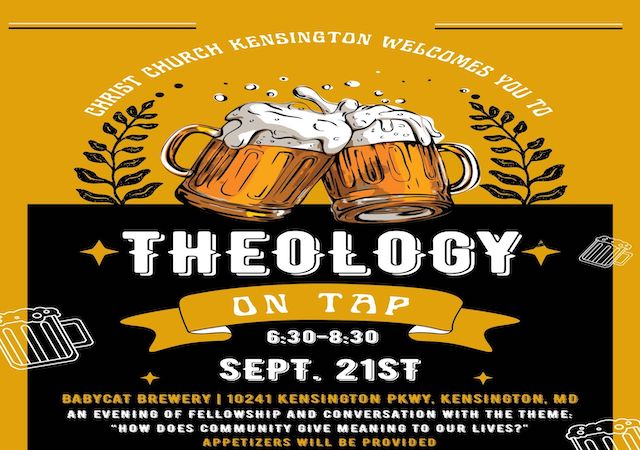
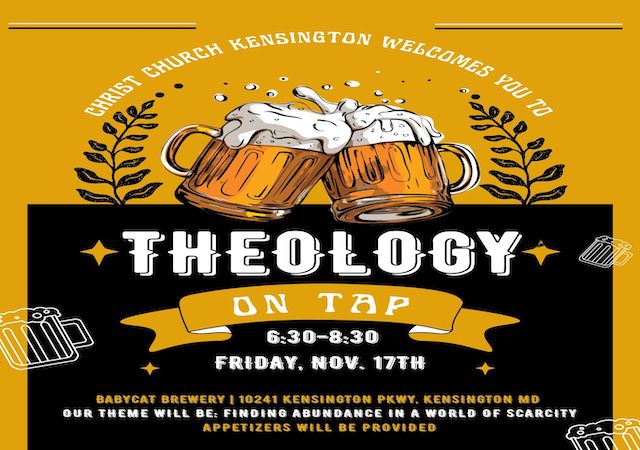
Theology on Tap is a monthly meet-up for young adults (21+, including those young at heart) sponsored by Christ Church Kensington. Join us for an evening of fellowship and discussion at the intersection of faith, life, and the world we live in. This month our theme will be “finding abundance in a world of scarcity.” Please note, this month we will gather on a Friday evening! Appetizers will be provided. No RSVP is necessary. All are welcome!
Please feel free to share the attached flyer with your church community and friends. We hope to see you there!

by Amanda Akes-Cardwell | Jun 8, 2023
Over the last nine months the Episcopal Diocese of Washington has partnered with Fuller Youth Institute, to assist our congregations in intentionally focusing on rising generations. Six parishes participated in a “Growing Young” cohort, facilitated by Fuller, in order to better meet the needs of young people and accompany them as partners in faith.
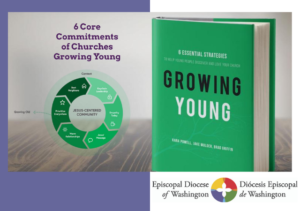
The cohort focused on six core commitments, outlined in the book Growing Young, that churches need in order to grow young. These commitments are: key chain leadership, empathy, Jesus’ message, warm relationships, priority everywhere, and being best neighbors.
St. George’s Episcopal Church in Glenn Dale is one of our Growing Young parishes dedicated to strengthening these six core commitments. Mary Frances Bruce, St. George’s team leader, shares this about St. George’s journey to grow young:
Being part of the Growing Young cohort helped us to identify our needs. We held listening sessions, one parish-wide and one for our teens facilitated by a college student, which provided a great opportunity for honest discussion. We distributed the Growing Young Survey to the whole parish and had a good response. We learned that most adults of all ages in the parish cherish our young people and want closer connections. We also learned from our teens, while they felt supported, we needed to do more to help them feel seen and heard.
To that end, we developed goals. We plan to improve our communications and messaging. We want to leverage new ways of using tech tools, especially to keep in touch with our younger members. We hope to build upon the intergenerational relationships in the parish to create an intentional mentoring program that connects all ages in support of one another. We want to develop a way to bring young voices into leadership roles.
Our listening sessions told us we should consider quick changes too. Just taking time to really talk to our young people can make a difference, so we are encouraging those chats. We are creating “table talk” cards for coffee hour with topics generated by our children and teens. We’ll send “care packages” to young adults for exam weeks or other life events. Volunteers will make sure we send notes for special events or just to say hello. We’re planning parish game nights and other intergenerational social events. We’ll keep our traditional youth events and build upon them as we go forward.
Our main take-away from the Growing Young program is that we can make a difference if we commit to keeping our young members in the foreground of our parish life. We are excited about the possibilities as we move forward with a Growing Young mentality. The value, we found, was not just in the information and guidance we received through the cohort, but in the chance to really focus on our young parish members with the time and energy to be creative in imagining for our future together.
This Growing Young mentality is also flourishing among the other parishes in our Growing Young cohort. Growing Young teams are dedicated to living out the six core commitments in their congregations with the intention of building up rising generations. This mentality is something we hope to strengthen throughout our diocese, beyond the parishes in the official cohort.
For more information about Growing Young or how to support rising generations, contact the Rev. Amanda Akes-Cardwell, Missioner for Faith Formation and Development.

by Bishop Mariann | Jan 27, 2022
The 6 Commitments of Churches Growing Young
All churches grow old. Strategic churches grow young.
–Kara Power, Jake Mulder, and Brad Griffin, authors of Growing Young
The most common sentiment I hear on congregational visitations is a desire to reach young people, as if they were on a far off planet. But in fact there are young people in our congregations, in our families, and in our neighborhoods.
It’s true that most of our congregations have a median age much older than their neighborhoods. And that the pandemic and its consequences have hit young people and families with children particularly hard. Thus as we turn our collective gaze as a diocese to ministry with and among rising generations, we have some listening and praying to do.
Where better to begin than with the young adults in our congregations? This Friday evening, as the start to our Diocesan Convention, we will listen to the testimonies of four young adults in our diocese. The conversation will be guided by our guest speaker, Mark Yaconelli, Founder and Executive Director of The Hearth, who has 20 years’ experience working with young people and the people who serve them.
All are welcome. If you haven’t registered yet, you can do so here. My hope is that Friday’s gathering will inspire us to listen anew to the thoughts, feelings and life experiences of the young people we know and love, and then imagine how our congregations can become communities that serve rising generations well. It is one of the top priorities of our strategic plan that we begin to address in earnest this year.
In addition to listening to the young people in our lives, we can learn from congregations whose efforts among rising generations are bearing fruit. An excellent resource is from a national study of over 250 congregations that are successfully engaging young adults (ages 15-29) and as a result are growing spiritually, missionally and numerically. Its findings are captured in the book Growing Young: 6 Essential Strategies to Help Young People Discover and Love Your Church.
It is an encouraging study, because the congregations highlighted are diverse in size, denomination, geography, and cultural/racial identity (over half were congregations of color).
More good news: the strategies identified do not require us to become something we are not. They do, however, require a commitment to invest in young people. For those of us who are no longer young, they ask us to gracefully give up our primacy in congregational life. As the authors write, “Making the intentional decision to disproportionately prioritize young people is the inflection point between growing young and growing old.”
The 6 strategies are:
- Unlock keychain leadership to empower others, especially young people.
- Empathize with today’s young people, stepping into the shoes of this generation.
- Take Jesus’ message seriously and welcome young people into a Jesus-centered way of life.
- Fuel a Warm Community and aim for meaningful peer and intergenerational experiences.
- Prioritize Young People (and Families) everywhere and look for creative ways to tangibly support, resource and involve them in all facets of your congregation.
- Be the best neighbors and equip young people to serve others, both locally and globally.
Here is an invitation: if you would like to gather a small group or sponsor a congregation-wide study of Growing Young, the School for Christian Faith and Leadership will provide up to four free copies of the book. Our only stipulation is that you identify the group in advance, identify your goals in reading, and when finished, let us know what you’ve learned and intend to do as a result. Please email the Rev. Jenifer Gamber for more information.
I realize that our congregations that enjoyed ministries with lively youth, young adults and families before COVID have seen a dramatic decline in their engagement. It’s been discouraging, but that doesn’t mean we should give up. Surely there are ways we can learn to reach out, with open and listening hearts.
As with the strategic goals we addressed thus far, our focus on rising generations will not be an item to check off, but a sustained investment toward a preferred future. Nor are we starting from nothing, for we are blessed with many gifted and passionate young leaders. What is new is the level of our intention, commitment, and measures of accountability. May 2022 be the year we remember as our inflection point and shift toward growing young.