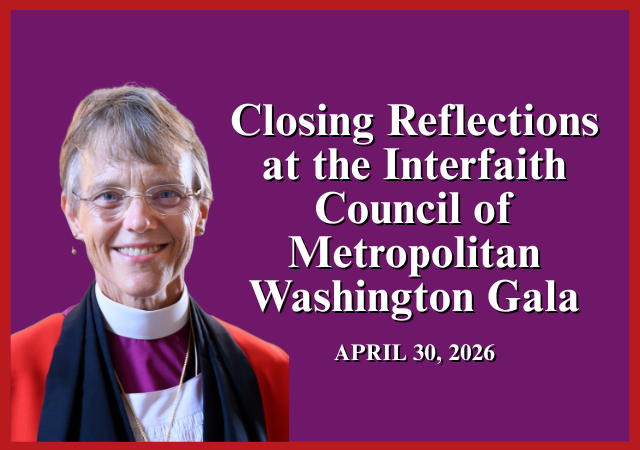
Closing Reflections at the Interfaith Council of Metropolitan Washington Gala
We are here this evening not only because we envision a community strengthened by its diversity, where people of all faiths and cultures are welcomed and appreciated and together build a better society for all, but because we have experienced it. We’ve experienced it through expressions of everyday kindness, and we’ve experienced it through friendship.
My religious upbringing was uneven. As a young person drawn to faith, I bounced around between different expressions of Christianity. The tradition in which I came to faith, in the sense of making a conscious commitment to be a follower of Jesus, had clear lines of who was saved and who wasn’t, by which they meant, as far as I could tell at the time, that there was only one acceptable religious path that God had established for humankind and lucky for us, we were on it.
The people of this church were loving and kind. They supported me during a difficult time in my life, and I grew in faith under their guidance. Even so, I could never accept such a narrow view of God and of other human beings, and eventually, I needed to leave that church. Making the decision to leave at age 17—not only the church, but everything I knew and loved—was one of the most life-changing moments of my life. By God’s providence, I found my home in a Christian tradition with a more expansive and generous view of God. The minister who guided me, a benevolent Episcopal priest who was like a father to me, also had strong prejudicial views against Roman Catholics, which he expressed often and came to the fore years later when I told him that I planned to marry a Roman Catholic.
When I went to college, my closest friends were members of a Catholic Worker community and Zionist Jews, two of whom moved to Israel after graduation. We often reflected on the fact that though we were of different faith traditions, we had more in common with each other than with the indifferent members of our own communities. One of my Jewish friends and I have a hard time talking about certain topics now, because we see the world so differently. Yet we remain friends.
When I first became bishop, I confess that as I faced the overwhelming responsibilities of my work, I didn’t have time or energy to devote to friendships of any kind, much less establish new ones. I had nothing to invest in other institutions, no matter their importance. Yet over the years, many in this room kept reaching out to me, and we met each other in endeavors of common concern. We became friends.
For your friendship, I am deeply grateful.
While we can’t know what the future holds for any of us, what we can say for certain, from our experience, is that communities are stronger, people are healthier, and children are safer when we extend the hand of friendship to one another.
The opposite of that vision should give us pause: when a community is taught to fear diversity, when people of all faiths and cultures are not welcomed and appreciated, and we stop working together to build a better society for all, everyone suffers.
May tonight renew our commitment to friendship.
Four months into the pandemic lockdown of 2020, Rabbi Bruce Lustig of Washington Hebrew Congregation invited me to be part of a virtual interfaith panel with the author Bruce Feiler, to discuss Feiler’s most recent book, Life Is In the Transitions: Mastering Change at Any Age.1
In the book, Feiler argues that life transitions are not linear nor predictable as sometimes described in modern psychology and self-help books. Rather transitions can come at any time, and with greater frequency than we realize. He introduces the concept of a “lifequake” to describe transitions of such magnitude that they fundamentally change the meaning, purpose or direction of our lives. As we’re going through a lifequake, Feiler suggests we are acutely aware that it’s happening. But it takes time for us to absorb its impact, as we realize that there’s no going back to life as it was before. Our only choice is to look ahead and walk toward an unknown future.
The panel discussion was lively, given all we were dealing with at the time. In closing, Feiler asked each of us on the panel to speak personally about a lifequake from our past. I told the story of how at age 17 I felt called to leave the church I loved—what brought me to the decision, what it felt like as I made it, and what changed as a result. As soon as I started speaking, I wished that I had thought of a different example. I felt embarrassed and exposed sharing my adolescent angst with a group of seasoned religious leaders. But after a moment of silence, each of the other panelists told a story from adolescence or early adulthood. Mine was not the only wavering voice.
One person who spoke on that panel is here tonight: Imam Mohamed Magid, Executive Imam of All Dulles Area Muslim Society (ADAMS) Center in Sterling, Virginia. Imam Magid is known around the world for his commitment to interfaith dialogue and addressing the dangers of religious extremism in the Washington region and across the globe.
Imam Magid shared what it was like for him to come to America as a young man. He accompanied his father, a renowned religious leader in his homeland, who was in urgent need of medical care. He was in awe of the doctors he met. “Some were Jewish,” he said. “Others were Christian. It didn’t matter to them that my father was Muslim. They cared for him as they would their own father.” Seeing such kindness and concern from those whom he had been raised to distrust changed the course of his life and led him to his life’s vocation as a Muslim leader in the United States committed to interfaith understanding and religious tolerance.
The next day Bruce Feiler emailed to thank us. “I was especially struck,” he wrote, “that each of you described a pivotal moment from your youth or young adulthood.”
I am an elder now, and from what I can tell, so are most of you. Those of us who share the vocation of eldership have a particular responsibility to rising generations. We are in the midst of a collective lifequake, with far-reaching implications that we will not live to experience, but the children and young people in our lives and communities will.
Our job is to invest ourselves and our resources into meaningful endeavors that will outlast us; to pour everything we have into those coming up behind us, to be wind in their sails.
Let me leave you with a word from the Interfaith Council of Greater Washington’s Executive Director, Sousan Abadian:
Many are increasingly disillusioned with religion, seeing it as a divisive force and a source of suffering. But the disenchantment actually reflects the profound hunger we have for meaning, healing, belonging, and inspiration that religions can also provide. The “interfaith enterprise” draws out some of what’s best in our religions—the recognition of our common humanity gloriously expressed in a myriad of ways, like the rainbow of colors that appear when light is shone through a single prism.
We are blessed by friendship that brings out the best of who we are. We have important, holy work to do together. In accepting the award you give me tonight, I rededicate myself to that work, and to all of you.
Thank you.
1Bruce Feiler, Life Is In the Transitions: Mastering Change at Any Age (New York: Penguin Press, 2020).