by Amanda Akes-Cardwell | Aug 28, 2024
God is calling the Episcopal Diocese of Washington to loving ministry with rising generations. It is a priority within our diocesan strategic plan. It is also a ministry that diocesan leadership is committed to and passionate about.
During the 2023-2024 program year, a Youth Ministry Visioning Committee was hard at work creating a mission and vision for diocesan youth ministry that would enhance parish based ministries and meet the needs of today’s rising generations. You can learn more about the Committee and their work in the December 2023 article, A Vision for Diocesan Youth Ministry.
Throughout last year, the committee worked closely with a consultant to determine the needs and desires of folks in our diocesan bounds. Our consulting partner, Katie Glover with Open Gate Solutions, consolidated the findings in a Report and Recommendations to the Youth Ministry Visioning Committee; an Executive Summary of the Report is accessible for review.
Ultimately, the report finds that young people (ages 11-18) in our area are hungry for community and belonging. In theory, our churches are well positioned to meet youth where they are and to help them know the love of Christ and Christ’s Church. The report suggests that the diocese can support this ministry in two key ways — serving as a resource for community-led youth ministry and providing reliable quality programming to enhance this community-based ministry.
Based on these findings and their overall work, the Committee developed the following statements to guide diocesan youth ministry into the future.
Diocesan Youth Ministry Mission Statement
We support youth and their Episcopal communities to nurture flourishing faith in Christ.
Diocesan Youth Ministry Vision Statement
We facilitate connections, create opportunities, and share resources that foster empowerment of young people in their Christian discipleship.
In the 2024-2025 program year, we will begin to live into these newly developed statements and shape a flourishing diocesan youth ministry. In the fall and the spring, diocesan wide events focused on service and formation will be offered. The first of these offerings is a youth service learning opportunity on Saturday, November 16, 2024 focused on service in the community. The second offering will be a confirmation retreat on April 25-26, 2025, prior to the May service of confirmation at the Washington National Cathedral on May 10.
To learn more about these events or diocesan youth ministry, email the Reverend Amanda Akes-Cardwell, Missioner for Faith Formation and Development, or the Youth Ministry Committee.
by Rondesia Jarrett-Schell | Nov 9, 2023
Our vision is to be a diocese that draws on the gifts of all God’s people to serve Christ together and live Jesus’ Way of Love. One path we’re exploring to make this vision a vital reality is the development of new faith communities – otherwise known as church planting.
In August the Diocese of Washington hired the Rev. Rondesia Jarrett-Schell to lead our efforts in Bowie, Maryland, the first location we identified to begin this deeply hopeful and exciting work. Here, Rev. Rondesia describes just what goes into church planting.
Recently, I attended the Genesis Gathering, a workshop for Episcopal church planters. There were over 60 people present, which I learned was only 1/6th the total number of Episcopal church planters in the United States. I was able to hear and experience the different approaches and styles of church planting. I was able to learn a few tools and strategies.
Best of all, I was able to see the Holy Spirit moving. With all the diversity and creativity, there was a core of good practices stemming from everyone’s experiences. Church planting relies on community presence, connection, and sharing the Good News.
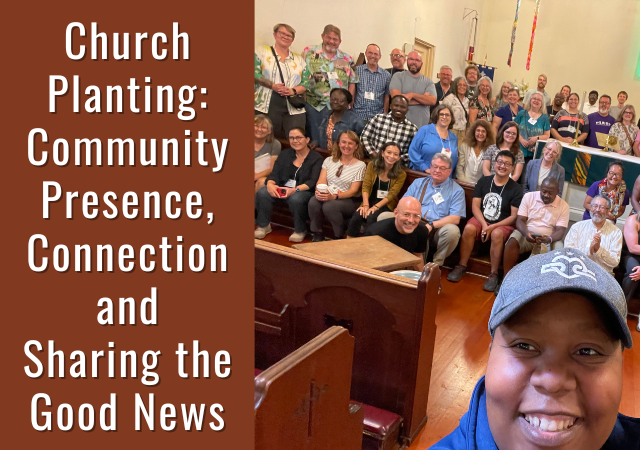
Photo caption: The Rev. Rondesia Jarrett-Schell, Bowie Church Planter, with participants at the Genesis Gathering 2023 at St. Mary’s Episcopal Church in Los Angeles, California.
Presence:
We find our labor where Jesus taught us: among people. Community presence is a church planter’s most important work. We listen to people’s stories, hopes, and dreams. We learn the community’s spiritual needs so we can provide safe space for faith sharing. Church planting begins where the people are. I visit festivals, community centers, local businesses, and community forums. I wear a t-shirt that says “You are not alone. Can I pray with you?” along with my clergy collar when I go to community events and coffee shops. Some people stop to ask me about my shirt, some want to pray, and others want to know more about the church plant! One church planter at the Genesis gathering started with inviting neighbors to poetry slams.
Connection:
The hardest part is building relationships. Think of how long it takes to build trust. People will be curious about being part of a new faith community but most will not be interested. Those who are not interested most likely already have what they need spiritually. The church planter is there for the seekers. We build trust with seekers when they see that we truly care about them and their community. They recognize the plant’s vision and mission, and understand it can do lasting good in their lives and in the lives of others. Shared vision, dreams, hopes and the intentional implementation of them, draws people together. I am always amazed when people ask about the Bowie church plant. They are excited to know more. I am excited that the Holy Spirit has led them to what they have been searching for.
Sharing the Good News:
As people finally find what they are looking for in a faith gathering they can’t help but share the Good News. If it is a place that welcomes their unique ways, follows their passions, understands their needs; if they sense the Holy Spirit moving; they will sing its praises to their friends. The church plant will grow. The growth is slow and steady, requiring patience, dedication, and trust in the process.
As we listen, build connections, and share the Good News, a community forms. Where, how and when we worship depends on what we learn about the community’s needs. It may be humble at first. I recently attended a praise and worship service with over 200 young adults. It started as a bible study in the pastor’s living room.
Planting is a dynamic ministry rooted in the sacrament of the present moment, led by the Holy Spirit towards the needs of our world. It’s true what they say in The Field of Dreams, “If you build it, they will come.” But only if you build what the people need.
The Rev. Rondesia Jarrett-Schell
Bowie Church Planter
by Amanda Akes-Cardwell | Jun 22, 2023
There are over 35 colleges and universities in the geographic bounds of the Diocese of Washington. Each of these institutions are centers of learning where students, faculty, and staff seek purpose and belonging. The Episcopal Diocese of Washington wants to meet our university neighbors, provide a loving embrace, and cultivate community in which faith can be explored and nourished.
Traditionally, this sort of community was tended by an individual chaplain who was employed by the diocese or a congregation to minister to students on campuses. This model of Episcopal chaplaincy is no longer in place at most universities within the diocese. Parishes and worshiping communities geographically close to college campuses have sought to fill the gap and minister to their university neighbors. The diocese has also sought to form creative partnerships with ecumenical partners like our neighbors at the Lutheran Humble Walk ministry at the University of Maryland, in order to support Episcopal students. These types of ministry present both blessings and unique challenges.
Given the challenges and great potential for meaningful ministry that colleges and universities possess, we are eager to discern how we might best spiritually support our university neighbors. To this end, we are excited to announce our partnership with The Vinery to reimagine how we do campus ministry. The Vinery’s mission is to awaken Faith and Flourishing at the intersection of Church and University through deep listening and purposeful design. Their vision is to be an incubator for thriving congregations who are ministering faithfully and effectively with young adults and members of nearby universities and supporting vibrant local communities. Working with The Vinery, we hope to refocus our efforts on campus ministry and discern a life-giving way forward to serve our university neighbors.
The first step in our partnership with The Vinery is to complete a survey to provide our new partners with information about our collective experience of campus ministry in the diocese. This brief survey has been shared with key leaders in the diocese to gather their feedback. Additionally, we welcome all people to complete the survey.
Help us, and our Vinery partners, have a better understanding of your experience of, and hope for, campus ministry throughout the diocese. Complete the survey by July 21.
The second step in our partnership with The Vinery is for diocesan and parish leaders to meet for an all-day, in-person, Vinery facilitated workshop in early September at the University of Maryland. This workshop will prompt us to ask ourselves how we can cultivate relationships with our university neighbors and enable greater mutual thriving. If you are passionate or curious about campus ministry and believe you (and/or your community) have gifts to offer this discussion, complete this form and inform us of your interest. We’ll see what energy the workshop generates and discern next steps.
We believe that God calls us to awaken Christian faith and flourishing. We have a vital role to play in supporting our university neighbors in this way. And they have gifts to offer us. I hope that you will consider joining the conversation as we discern next steps for campus ministry in the Episcopal Diocese of Washington.
For more information, contact the Rev. Amanda Akes-Cardwell, Missioner for Faith Formation and Development.

by Amanda Akes-Cardwell | Jun 8, 2023
Over the last nine months the Episcopal Diocese of Washington has partnered with Fuller Youth Institute, to assist our congregations in intentionally focusing on rising generations. Six parishes participated in a “Growing Young” cohort, facilitated by Fuller, in order to better meet the needs of young people and accompany them as partners in faith.
The cohort focused on six core commitments, outlined in the book Growing Young, that churches need in order to grow young. These commitments are: key chain leadership, empathy, Jesus’ message, warm relationships, priority everywhere, and being best neighbors.
St. George’s Episcopal Church in Glenn Dale is one of our Growing Young parishes dedicated to strengthening these six core commitments. Mary Frances Bruce, St. George’s team leader, shares this about St. George’s journey to grow young:
Being part of the Growing Young cohort helped us to identify our needs. We held listening sessions, one parish-wide and one for our teens facilitated by a college student, which provided a great opportunity for honest discussion. We distributed the Growing Young Survey to the whole parish and had a good response. We learned that most adults of all ages in the parish cherish our young people and want closer connections. We also learned from our teens, while they felt supported, we needed to do more to help them feel seen and heard.
To that end, we developed goals. We plan to improve our communications and messaging. We want to leverage new ways of using tech tools, especially to keep in touch with our younger members. We hope to build upon the intergenerational relationships in the parish to create an intentional mentoring program that connects all ages in support of one another. We want to develop a way to bring young voices into leadership roles.
Our listening sessions told us we should consider quick changes too. Just taking time to really talk to our young people can make a difference, so we are encouraging those chats. We are creating “table talk” cards for coffee hour with topics generated by our children and teens. We’ll send “care packages” to young adults for exam weeks or other life events. Volunteers will make sure we send notes for special events or just to say hello. We’re planning parish game nights and other intergenerational social events. We’ll keep our traditional youth events and build upon them as we go forward.
Our main take-away from the Growing Young program is that we can make a difference if we commit to keeping our young members in the foreground of our parish life. We are excited about the possibilities as we move forward with a Growing Young mentality. The value, we found, was not just in the information and guidance we received through the cohort, but in the chance to really focus on our young parish members with the time and energy to be creative in imagining for our future together.
This Growing Young mentality is also flourishing among the other parishes in our Growing Young cohort. Growing Young teams are dedicated to living out the six core commitments in their congregations with the intention of building up rising generations. This mentality is something we hope to strengthen throughout our diocese, beyond the parishes in the official cohort.
For more information about Growing Young or how to support rising generations, contact the Rev. Amanda Akes-Cardwell, Missioner for Faith Formation and Development.

by Allen Fitzpatrick | Mar 2, 2023
Join the Rev. Billy Kluttz and church musician Abby Madden for a demonstration of Common Threads: An Intergenerational Worship Series, now available as an on-demand course through the School for Christian Faith and Leadership. This hands-on workshop will introduce stations worship, paperless music and liturgy, and accessible worship design. It will also show how music, storytelling, and the arts fit together in this age-friendly worship series. Attend for a rare opportunity to learn directly from the creators of Common Threads!


