
All parishes in the Diocese of Washington are encouraged to examine their histories from the perspective of race and racism. Over the next few months, we will spotlight parishes that are engaging in this work of truth telling through a racial lens.
In 2022, St. Columba’s Episcopal Church embarked on a quest to understand how pervasive racial segregation shaped the parish, located in northwest Washington’s Tenleytown neighborhood.
Parishioners have been researching St. Columba’s ties to the former African American community known as Reno City, which developed on Fort Reno near Tenleytown after the Civil War. Formerly enslaved persons settled on the land formerly occupied by the Union Army and built homes, community organizations, and churches, including St. George’s Episcopal Chapel.
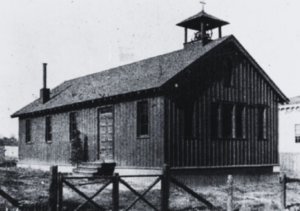

Initially established as a mission church for African Americans by St. Alban’s Parish, St. George’s later became a mission of St. Columba’s when it became a separate parish. St. George’s flourished under the leadership of its vicar, the Rev. Edward Douse, a Black Jamaican priest, who also served as vicar of the mission chapel for African Americans established by St. John’s parish in Georgetown. St. George’s Mission offered regular church services, baptisms, confirmations, adult education, and childcare for working mothers.
As the white population grew in Northwest Washington, however, real estate developers and government officials sought to clear the Reno community to build a school for white students, a park, and an all-white neighborhood on the surrounding land. In the late 1920’s, the city condemned the land where homes and St. George’s Chapel stood and built the Alice Deal Junior High for white students. In the years that followed, the rest of Reno City was demolished to create the Fort Reno National Park.
St. Columba’s research found that the parish did not join the African Americans who sought to prevent the condemnation of the Reno community and St. George’s Chapel there. In fact, St. Columba’s membership grew as the white population in Tenleytown increased. The research also revealed that St. Columba’s benefited greatly from gifts of land and money acquired by generations of the Murdock family, who relied on the labor of enslaved persons from the 1700’s until the Civil War. The research project motivated St. Columba’s to become more involved in public advocacy, including for affordable housing in Northwest Washington and throughout the city.
This research was made possible by gracious assistance from parishioners at St. Alban’s Parish, who provided records from their parish’s extensive archives, and from archivists at the Diocese of Washington. Parishioners gathered additional materials from public sources such as census and land records as well as research conducted by historians into Tenleytown and the Reno community. These materials enabled parishioners to understand St. Columba’s past within the broader context of racial segregation in Washington, including within The Episcopal Church.
For more information on parish history projects in the Diocese of Washington, visit Parish History Projects: Telling the Truth About Race and Racism.
