
East of the River Ministry
What the diocese is doing east of the Anacostia River—and what we’re learning
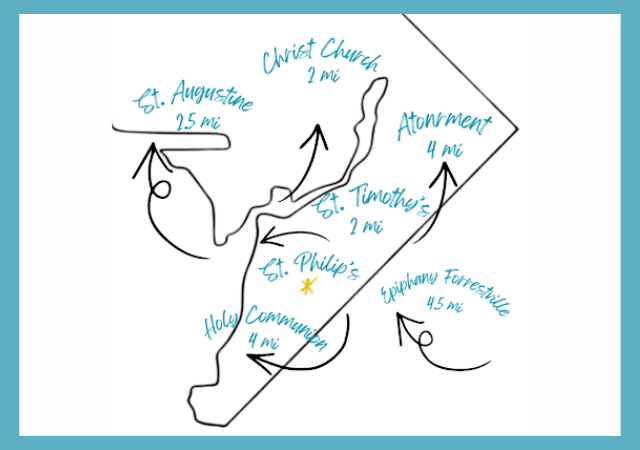
East of the River parish map
Show Up and Listen
Patricia Marshall manages a demanding career while leading one of DC’s most advanced food security efforts as a volunteer at the Episcopal Church of the Atonement in Ward 7.
This pantry is one of only three city-wide produce hubs for the Capital Area Food Bank. When pallets arrive, partner pantries gather shares for local neighborhoods. No ID is required; undocumented neighbors are welcome.
This effort wasn’t built by any large institution. Parishioners created it. The diocese’s role has been to show up and listen.
In October 2025, the Diocesan Council authorized the East of the River Ministry Initiative, a year-long experiment in how the Episcopal Diocese of Washington can engage differently with Wards 7 and 8, the Southeast DC neighborhoods east of the Anacostia River.
Authentic Support
This isn’t a new program or a top-down solution. Instead, it’s a deliberate commitment to listen first, discover who’s already leading, understand neighbors’ true needs, and find where the church can offer authentic support rather than serving its own interests.
Six parishes serve communities in and around the borders of Washington’s Wards 7 and 8: Atonement, Holy Communion, St. Timothy’s, St. Augustine’s, Epiphany Forestville, and Christ Church Capitol Hill. These congregations have been doing faithful ministry for decades, largely without the visibility or institutional backing their work deserves. The initiative exists to change that.
Months of listening across these communities tell of the ways that the most vital organizing in Southeast DC is already happening—in mutual aid networks, community pantries, neighborhood associations, and the kind of informal care that doesn’t get named in grant applications.
One of the most striking examples is the East of the River Mutual Aid Society (EORMA), a unique regional, citizen-based mutual aid network in Washington, DC. Their model of neighbors caring for neighbors, with training and accountability built in, reflects a theology the church has articulated for centuries but doesn’t always practice.
The diocese has begun asking: what would it mean to learn from them, not simply to support them?
To Envision Differently is the Whole Point
On a corner in Anacostia stands a building the diocese is beginning to envision differently. St. Philip the Evangelist Episcopal Church was founded in 1887 by and for the formerly enslaved community of Barry Farm and Hillsdale. For 137 years in various incarnations, it served as a Black Episcopal anchor in one of Washington’s oldest African American neighborhoods.
Although it closed in 2024, the building is not an afterthought. It is a reparative asset—property whose history creates a moral obligation to return its benefits to the community from which it came. If handled well, reparative assets can become something the neighborhood controls and benefits from. The direction EDOW is exploring is adaptive reuse: stabilizing and transforming the space into a community anchor, shaped by people who know Wards 7 and 8 with the depth that comes from living and working there.
This spring, the work continues. We are having conversations with community advisors about St. Philip’s and exploring historic preservation grant opportunities. There is continued listening across the East of River parish network. We are also talking about an MLK Eco-Justice Bike Ride along the Anacostia River Trail, connecting the river’s history with the justice work happening along its banks.
This year-long experiment will guide our next steps. The diocese is not rushing to permanent decisions before it knows what a good permanent structure should look like. That kind of institutional humility is harder than it sounds—and it’s the whole point.
The Rev. Melanie Mullen
