
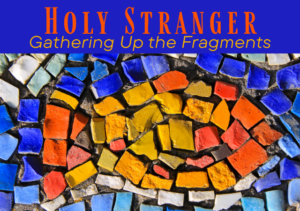
Holy Stranger: Gathering Up the Fragments
Holy Stranger began with a simple hope: that traditional prayer book worship could help gather up the fragments of a rapidly changing and growing neighborhood.
If you look at a map of our Diocese, you will notice a blank space in Northeast Washington, DC where an Episcopal parish—or any mainline church—might otherwise be expected. Over many years of staring at that spot on the map and walking through the surrounding neighborhoods, a conviction emerged among a handful of like-minded Episcopalians in their 20s and 30s: the people of Eckington, Edgewood, NoMa, Brentwood, and Union Market deserve a local, LGBT+ affirming Anglican presence.
Gathering on a weekday evening in our local community room, we share space with other new and growing community groups that reflect the evolution of the neighborhood. As the population swelled during and after COVID, so too did the civic life of the neighborhood. We believe a spiritual presence should grow alongside it.
Over the past three years of slow and prayerful experimentation, we have adjusted strategies for outreach, invitation, cadence, and even the ways we embellish or simplify our worship together. What has remained constant is our commitment to the simple beauty of a BCP Service of Light with Evening Prayer and Holy Eucharist.
Echoing my role as a deacon chanting the Exsultet at the Easter Vigil, I open and close the service with evening hymns, as well as the Phos Hilaron (“O Gracious Light”), while worshippers light personal candles and those on the altar. A visiting priest guides us through the liturgy, presides at the Eucharist, and occasionally preaches, while opportunities for participation are offered to the laity through the psalms, lessons, and Prayers of the People.
And, quite crucially, we pray for LGBTQ+ refugees overseas, sometimes reading their messages of hope and faith during the service itself and collecting offerings for their relief. Because this pattern of worship feels timeless—and, as some visitors have remarked, even ancient—people from both liturgical and non-liturgical traditions seem to find something meaningful in our brief forty-five minutes together. For some, there is the familiarity of tradition; for others, a gentle rhythm of worship that feels unthreatening and yet uniquely compelling.
While Holy Stranger has a long way to go before it resembles a traditional parish—or even a formal church plant—our hope is that it continues to grow as a kind of chaplaincy for this neighborhood: an outpost of the Good News of Jesus Christ where like-minded, though diverse, Christians can find one another. And from this small core group, we have created the conditions where others from across the city can safely reconnect with God and with their faith through traditional worship, even if they are not yet ready to reenter a traditional church building. Not surprisingly, this has included many LGBT+ friends and acquaintances who find our informal fellowship of fellow strangers a safe place to reengage with faith and discover what Christian community and mission can look like when lived out together. Those who gather may include Eastern Orthodox Christians, Roman Catholics, Lutherans, Baptists, Pentecostals, ex-evangelicals, and other seekers.
As we often pray during worship, “May we always recognize Christ in the holy strangers among us, within ourselves, and in every corner of creation.” In many ways, that prayer has become our mission. We gather strangers together, trusting that Christ is already present among them.
The Rev. Ethan Bishop-Henchman
Deacon, Holy Stranger
