
by Bishop Mariann | Jul 11, 2024
Do not be overcome by evil; but overcome evil with good.
Romans 12:21
On July 8, the Episcopal Diocese of Jerusalem announced that one of its most important ministries, the Al Ahli Hospital in Gaza City, was compelled to close by the Israeli army. The Israeli Defense Force ordered the evacuation of all in the hospital’s vicinity and began drone attacks, forcing vulnerable patients and medical staff to leave the compound. On July 10, the IDF ordered the evacuation of all civilians remaining in the entire city, telling them to go to designated “safe zones,” that are already severely overcrowded from previous displacements.
Throughout the Israel-Gaza war, diocesan hospitals and clinics have provided urgently needed medical care and shelter. The witness of the Diocese of Jerusalem is one of compassion, an unceasing call for peace, and a firm determination to overcome evil with good.
We of the Diocese of Washington have supported the Diocese of Jerusalem for years, with a particular focus on the Al Ahli hospital since the war began. The news of its closure is devastating amid a population in desperate need of care and safety.
Archbishop Hosam Naoum writes: We protest the closure of our hospital in the strongest possible terms. In a time of warfare and great suffering it is essential that emergency healthcare services are maintained to treat the injured and the dying. We appeal to the Israeli forces to permit us to continue our sacred ministry of medical care and healing. We plead for an end to the targeting of civilians and all vulnerable people and demand all parties agree to an immediate ceasefire.
The Al Ahli Hospital staff has responded with characteristic resilience. Several months ago, they opened a clinic in the city of Rafah, 35 kilometers south of Gaza City, and they are now redirecting resources and personnel there.
As a diocese, we will continue to support the heroic ministry of the Episcopal Diocese of Jerusalem.
As your bishop and colleague to Archbishop Hosam, I add my voice to the outcry throughout the Anglican Communion against the closure of Al Ahli Hospital. The targeting of medical facilities and staff is a clear violation of international humanitarian law. We grieve the never-ending challenges the hospital staff have endured, including multiple airstrikes, the detention (and torture) of medical staff, and this most recent evacuation order. Moreover, I will continue to urge our government to curtail its sale of weapons to Israel used against civilians in this war.
Thank you for continuing to pray for and support these suffering servants, and for all those longing for an end to this nightmare. May peace come to the war-torn land and its people. May evil be overcome by good.

by Bishop Mariann | May 30, 2024
Now the boy Samuel was ministering to the Lord under Eli. The word of the Lord was rare in those days; visions were not widespread.
1 Samuel 3:1
This summer I plan to begin a research/writing project on the spiritual dimensions of generativity, which the developmental psychologist Erik Erikson identified as an essential life task of middle adulthood. Erikson defined generativity as the “ability to transcend personal interests to provide care and concern for both younger and older generations.” More broadly, generative persons are those who find meaning and joy in the thriving of others.
I witnessed a beautiful example of generativity in April when our son and his young family came to visit. We went to see his godmother, Gail, who lives in an old country house in Hamilton, Virginia. When our grandchildren hesitantly got out of the car, Gail greeted them warmly, gently introduced them to her dog, and showed them around the property, all the while speaking as if they were the most interesting people she had ever met. Within minutes, they were romping through the yard like old friends.
Children blossom like flowers in the presence of generative elders.
Generativity is also revealed in acts of sacrificial love—consciously letting go of our own wants and preferences or another’s sake. Erikson identified the daily tasks of parenting and grandparenting as generative, but there are many ways we give of ourselves for others. Generativity is not age specific.
Over Memorial Day weekend, my husband and I rode our bikes on the Washington/Old Dominion trail. Every half mile, there was a poster of a young serviceman or woman killed in the Iraq and Afghanistan wars. How many of them died, I wondered, attempting to save the life of a comrade or civilian? I thought of the countless young men and women who choose to put themselves in harm’s way, be it in military service, as first responders, violence interrupters, or advocates for peace and the future of our planet.
As I rode by the smiling photographs, I felt such sadness for those who had died too soon. Is it possible that we ask too much of our young people, placing burdens upon them that rightfully belong to us? In too many situations, younger generations must pay the price for their elders’ lack of generativity.
But therein lies a path for hope, whenever any of us hear God’s invitation to choose the generative path. As elders, generativity includes befriending grief and accepting that we are no longer at the center of life’s drama. How we embody our new, supporting role is one of the most important spiritual decisions of our lives. The alternative, Erikson reminds us, is a life of stagnation.
One of the optional biblical texts for this Sunday offers a beautiful example of generative love. It tells the story of an old priest named Eli to whom a once-barren woman named Hannah had entrusted her son Samuel. This was a difficult time for the religious leadership of ancient Israel. As the text says, “The word of the Lord was rare in those days; visions were not widespread.” Eli was doing the best he could, but he was worried, and he didn’t know when or how God might speak.
One night as young Samuel lay sleeping, he heard someone call his name. Assuming that it was Eli, Samuel got up and went to him. “I did not call you, my son.” Eli replied. “Go back to sleep.” Later that night, Samuel heard the voice again and rose and went to Eli. “I did not call you,” Eli said. “Go back to bed.” When Samuel heard the voice a third time, Eli knew that it was the Lord.
Consider how Eli must have felt when he realized that the Lord had passed him by. He had dedicated his life as a Temple priest; he was the one to whom the people looked for holy guidance. But whatever his feelings of displacement, Eli gently told Samuel, “When next you hear the Lord call, say in response, ‘Speak Lord, for your servant is listening.’” (I Samuel 3)
Eli now understood that he was to help Samuel grow in confidence as a prophet, and he embraced his supportive role with graceful humility. I’m reminded of a similar moment in the life of John the Baptist. “He must increase,” John said of his cousin, Jesus, “while I must decrease.” (John 3:30)
Generativity is the hard-won fruit of the struggle to find our way when much of what had once defined our lives is gone. There is undeniable grief and sacrifice in generativity, but also joy, whenever rising generations find in us the support and encouragement they need to thrive. For those of us who strive to follow Jesus, there is also the affirming and empowering realization that this is what it feels like to love others as he loves us.
Throughout the Diocese of Washington, there are many generative leaders who are my inspiration. This summer, I’d like to begin interviewing some of our remarkable elders. If there’s someone in your congregation who embodies the gift of generativity, please let me know.
Should it be that someone suggests that I interview you, the first thing I will say is thank you. You are helping to make the world, and our church, a place where others can thrive. They blossom like flowers in your presence.
by Keely Thrall | May 18, 2024
The spirit of the Lord God is upon me, because the Lord has anointed me; he has sent me to bring good news to the oppressed, to bind up the brokenhearted, to proclaim liberty to the captives, and release to the prisoners; to proclaim the year of the Lord’s favor, and the day of vengeance of our God; to comfort all who mourn; to provide for those who mourn in Zion—to give them a garland instead of ashes, the oil of gladness instead of mourning, the mantle of praise instead of a faint spirit. They will be called oaks of righteousness, the planting of the Lord, to display his glory. They shall build up the ancient ruins, they shall raise up the former devastations; they shall repair the ruined cities, the devastations of many generations.
Isaiah 61:1-4
Each of us was given grace according to the measure of Christ’s gift. The gifts he gave were that some would be apostles, some prophets, some evangelists, some pastors and teachers, to equip the saints for the work of ministry, for building up the body of Christ, until all of us come to the unity of the faith and of the knowledge of the Son of God, to maturity, to the measure of the full stature of Christ. We must no longer be children, tossed to and fro and blown about by every wind of doctrine, by people’s trickery, by their craftiness in deceitful scheming. But speaking the truth in love, we must grow up in every way into him who is the head, into Christ, from whom the whole body, joined and knit together by every ligament with which it is equipped, as each part is working properly, promotes the body’s growth in building itself up in love.
Ephesians 4:7, 11-16
Jesus said to his disciples, ”I am the true vine, and my Father is the vine grower. He removes every branch in me that bears no fruit. Every branch that bears fruit he prunes to make it bear more fruit. You have already been cleansed by the word that I have spoken to you. Abide in me as I abide in you. Just as the branch cannot bear fruit by itself unless it abides in the vine, neither can you unless you abide in me. I am the vine, you are the branches. Those who abide in me and I in them bear much fruit, because apart from me you can do nothing. Whoever does not abide in me is thrown away like a branch and withers; such branches are gathered, thrown into the fire, and burned. If you abide in me, and my words abide in you, ask for whatever you wish, and it will be done for you. My Father is glorified by this, that you bear much fruit and become my disciples.” As the Father has loved me, so I have loved you; abide in my love. If you keep my commandments, you will abide in my love, just as I have kept my Father’s commandments and abide in his love. I have said these things to you so that my joy may be in you, and that your joy may be complete.
John 15:1-8
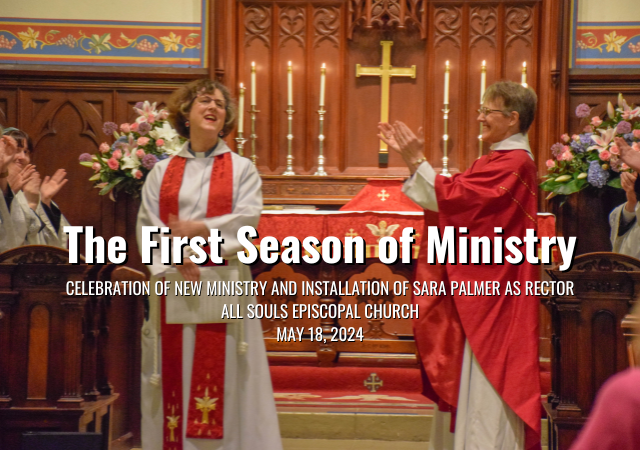
Good morning, friends of All Souls Church!
I love celebrations of a new season of ministry, for they are among the happiest occasions in the life of a congregation, and by extension, for the entire diocese. The joy is palpable, especially if the journey of transition has been long.
Thus I begin by giving thanks to God for the steady, clear-eyed, and ever-hopeful lay leaders of All Souls. At considerable cost to yourselves, you would not let go of the essential goodness of this congregation and your firm persuasion that God was guiding you to a preferred future. We in your diocesan family are in awe of you, and we overjoyed that Sara Palmer has come to be your spiritual leader.
Sara Palmer—how is it that we are so blessed to have found you? In the first months of your ministry at All Souls and as a priest in this diocese, you have brought joy, energy, confidence in Christ’s love and the possibilities for this community of faith. Thank you for saying yes and for jumping in so whole-heartedly.
As I pondered what I might say today by way of encouragement, my first thought was simply to lift up each of the Scripture passages we’ve just heard. For what more is there to say after Jesus’ invitation to abide in him, to find our home in him, and to trust we are already as close to him as branches are from the vine from which they have grown. And to ponder, as the passage from Ephesians encourages us to do, our innate giftedness and that when we join our gifts together the body grows stronger. And to remember that we follow a Saviour who saw himself in the ancient words of the prophet Isaiah as one sent to proclaim Good News to those who need it most, to set free those in every kind of bondage. In following him we have the potential to be like trees with sturdy roots, called to repair the devastations of ruined cities.
In this season of new ministry, imagine what would happen if you read these three passages aloud every time you gather, listening for how Christ might speak to you through these powerful words. What would change, do you suppose, in your perspective, in your sense of what’s important, in your orientation toward Christ and the Holy Spirit? What word or phrase might take on particular meaning when you are discerning the next faithful step, or are faced with a challenging situation?
You might try it.
In the thirteen years I’ve served as bishop, nearly every congregation in the diocese has gone through a clergy transition—some more than one, including All Souls. While each congregation is distinct and the context in which those transitions occur are very different, I’ve observed that there are a few universal principles. For example, there are essential spiritual, relational, and leadership tasks in the first season, a period of time usually lasting somewhere between one and two years. If these tasks are tended to well, the congregation has a solid foundation from which to move forward. If they are neglected, or passed over too quickly, the lack of foundation has an adverse effect on nearly everything else that follows.
I daresay you already know what these tasks are, but let me say them anyway. No doubt there are other tasks other than the four I’ll mention. As they occur to you, add them to the list.
Task Number One: Building Relationships (no surprise there)
It takes time for one who has been selected as a spiritual leader to become the spiritual leader, to earn the role that has been bestowed. There is no shortcut for the kind of relationship tending that is the foundation of every healthy church. The Apostle Paul uses an image in his letter to the Romans of a branch being grafted into a tree, and it’s like. That process takes time, as you become accustomed to Mother Sara’s voice in the pulpit, her way of leading. She, in time, comes to know and love you for who you are, and determines how best to lead.
As with any new relationship, the phenomenon of projection is at play—the tendency to see another person, or a group of people, through the lens of our assumptions and hopes. We can’t avoid projections, but it’s good to remember that they are only partially accurate. Thus we do well to maintain a posture of curiosity with one another, and as Canon Robert Phillips would say, lots of space for grace. For there’s bound to be a tiny bit of let down as time goes on, and then, by grace, a deepening commitment to one another rooted in the kind of love that is patient and kind; that bears all things, believes all things, endures all things, and hopes all things.
It is also a time when clarifying expectations is important, and over-communicating those expectations with one another, so as to close the gap between what we assume the other person knows, or should know, and what in fact they do. Managing expectations is much easier when you jointly establish priorities, because no church community, or church leader, can tend to all that needs to be done all at once.
Which brings me to…
Task Number Two: Taking Stock, with Gentle and Courageous Evaluation
If only you could do nothing else but get to know each other in this first season! But your ministry is not on hiatus. There are decisions to make, plans to put into action, budgets to manage. The days are full, but the second task asks that in the back of your mind, you can keep a bit of energy for asking the why question as you go about doing what you do.
Sara can’t help but do this, because she sees with new eyes what those of you who have been here for years have become accustomed to. That is a gift to harness in this first season; it’s what one author calls “Rookie Smarts”—all that’s fresh in a person’s mind in the first year. There’s also a lot that she doesn’t see, and which makes it a fruitful time for you to talk openly about not only what you do but why you do it.
Tom Berlin is a bishop in the United Methodist Church. Before becoming bishop, he served a congregation in Herndon, Virginia for many years, and he wrote a number of very practical books about church life. In one of them, entitled Bearing Fruit: Ministry with Real Results, he suggests a method for this process of taking stock and gentle evaluation. It couldn’t be more simple—all it takes is to add one simple phrase into our common vocabulary: so that. Those who learn to use these two words, he says, will discover a way to clarify the intended, fruitful outcome of every ministry endeavor.1
Here’s an example from Tom Berlin’s experience with a congregation that had for many years hosted a Vacation Bible School. In his first year as pastor he asked all those at the first planning session to complete the following sentence: “Next summer our church will have a vacation church school so that….”
Complete silence. At last, one person spoke up: “Next summer our church will have a vacation bible school so that the children of our church will experience a vacation bible school.” “Are there any other possibilities?” Tom asked. Another said: “Next summer our church will have a vacation bible school so that children will experience church as fun.” Tom responded, “I’m not sure we need a curriculum for that.”
With some time and deeper reflection, the group came up with this: “Next summer our church will have a vacation bible school so that our children will come to know and love God more and that we will reach children in the community with God’s love whom we have not reached before.”
That was a purpose they could be inspired by, get excited working toward and inviting others to join. It was also one that could afterwards be evaluated by a standard of fruitfulness: did the children of our church have an experience of love; were we able to reach children in the neighborhood? If not, why not? What might we do better next time?
The purpose wasn’t to have a vacation bible school. Vacation bible school was a means to a greater purpose. If it no longer fulfilled that purpose they were free to consider something else. The focus became less about the activity but the outcome.
Task Number Three: Weathering a Storm
This is the hardest task, one that we’d rather avoid, but it’s inevitable. I don’t know what the storm will be, and unless you’ve already experienced one, neither do you. But I know that one is coming, because they always do. There may well be more than one. The storm could be a crisis coming to you from outside your community; more likely it will be the result of a misstep or mistake on your part, a classic self-inflicted wound. It could be something that on the surface seems like no big deal, but somehow touches a nerve, a vulnerable part of the community that sets in motion a series of hurtful exchanges that you later come to regret.
Here’s the thing to remember: how we handle ourselves in a storm has a greater lasting impact than the storm itself while you’re going through it. There’s no choice, when the storm comes, but to go through it. But if you can keep in your mind that that’s what you’re doing, even that tiny bit of awareness can help create enough distance for prayer and reflection. It will also encourage, when the storm passes (for it will pass) a post-storm evaluation. What did we learn about each other? About ourselves? What mistakes did we make? How did Christ reveal himself to us in the storm? How have we grown?
Task Number Four: Drawing Closer to Christ
The last and most important task of this first season harkens back to our Gospel text for today: to deepen your with Christ. I cannot urge you strongly enough to create at least one new avenue devoted to helping one another grow spiritually, and think as broadly as you can about that, so that as many people as possible at All Souls have the opportunity to go deeper in faith. Identify something that can engage and signal to the people in your community that growing in faith and love is what being part of a church is all about. Because as one wise spiritual leader, Evelyn Underhill, once reminded the Archbishop of Canterbury, “God is the most interesting thing about us.”
I suspect that the Holy Spirit has already planted ideas and possibilities within and among you. Pay attention to them. Give time and energy to them, so that you might draw closer to Christ, hear his unique call for each one of you and as a community, and have something of spiritual value to invite others to share.
I am persuaded that the future of All Souls, and all our congregations, depends on that kind of spiritual renewal and deeper experience of God’s love in Christ. Without it, we are running on our own energies, and our energies aren’t enough. Without it, we create a church in our image, according to our preferences, rather than open ourselves to the call of Christ to join in his redeeming work. But know that you needn’t do this alone. We are all in this holy work together, so that The Episcopal Church we love may take its humble, fruitful place in God’s mission of reconciling, healing love.
Will you pray with me?
Loving God, we are grateful to be here, at this moment in the life of All Souls, and we pause to give thanks to all those whose faithfulness and love sustained this community over the years of its life. We thank you for Sara, for her love for you and the gifts you have endowed her with for leadership. Bless this moment, Lord. Guide Sara and the people of All Souls with your grace. Help them to embrace this first season of ministry with open and discerning hearts; be with them through whatever storms they might face, and through all that they do in worship, study, service, and times of quiet prayer, may they draw closer to you and serve your mission of love for others. In your name, Amen.
1Tom Berlin and Lovitt H. Weems, Jr., Bearing Fruit: Ministry with Real Results (Abingdon Press, 2001

by Bishop Mariann | May 16, 2024
When the Feast of Pentecost came, they were all together in one place.
Acts 2:1
One of the greatest compliments we can either give or receive is to name something either said or done as inspiring. Think of how you feel when someone says “What you have done is truly inspiring” or “You are an inspiration to me.” When we’re inspired, our actions and our words have an extraordinary quality to them, bringing out the best in people and making possible what seems impossible to others.
Similarly, when we use the language of giftedness, as in “You are gifted as a musician, or a tennis player, or a parent, or a doctor, or a listener,” we’re acknowledging an attribute or level of human accomplishment that isn’t available to everyone, but given to some with particular bounty.
This language of giftedness and inspiration underscores the unique creativity and potential of each one of us, for we are all gifted and inspired in different ways. It acknowledges the existence of a greater power and source of creativity that is beyond our ability to control and works in particular ways through each one of us.
In the Christian faith, we call this power the Holy Spirit, the part of God that is a source of energy, creativity, and power. The Holy Spirit comes to us as a gift. When we’re inspired, it’s not that the Holy Spirit takes over and makes us something we’re not, but rather that a gifted part of us is amplified, so that we are still ourselves, but more, somehow. Inspiration gives us first-hand experience of God at work in and through us and through other people.
This Sunday in church we’ll celebrate the Feast of Pentecost, and we’ll tell the story of the Holy Spirit coming to Jesus’s disciples in a divine/human experience that blew through them like wind and fire. In that moment, the disciples were given the ability to speak in languages that people from all parts of the ancient world could understand.
It’s important to remember that what the disciples said to the crowds was already in their hearts. They spoke of their experience as followers of Jesus, and about the events since Jesus’s crucifixion, the encounters with them that assured them that he was alive, with them still, and that God had revealed to them through him that love is stronger than hate, and life is stronger than death. The Spirit’s power took their words and amplified them, enabling them to transcend boundaries that divide with a unifying message of love.
If you want to find evidence of the Holy Spirit’s presence in your life, you needn’t look further than your own spirit and your own innate giftedness. For the Holy Spirit works in and through us, deeply respectful of our human spirit, moving with such grace and anonymity that if we wanted to, we could take all the credit for what the Spirit is making possible or accomplishing through us. The Spirit doesn’t demand our acknowledgement, but is content to let the light shine on us.
There are, I am certain, many times when the Holy Spirit works through us without our awareness. But there are those glorious moments when we are aware that something creative is happening through us for which, if we’re honest, we can’t fully take credit for or control. The Spirit’s presence gives us a heightened awareness and an energy that carries us for a time, so that we can do more than we can on our own, speak with greater facility, offer more of ourselves without exhaustion. It’s like that feeling you get when swimming in the ocean and catching a wave that carries you to shore. Every stroke you take is bigger and a larger momentum takes control for a time. It’s exhilarating—among the most affirming spiritual experiences a person can have.
They are also among the most humbling of experiences, because they do not last. The poet Christian Wiman, in one of most beautiful books on faith I have ever read, describes the thrill and its aftermath this way:
The memory of that momentary blaze, and the art that issued from it, can become a reproach to the fireless life in which you find yourself most of the time.1
Yet the experiences are real, and I am persuaded that Jesus longs for us to trust them, and integrate them into our lives of faith. That means finding a way to live in those long stretches when not much seems to be happening, and still trusting that God’s spirit is at work, in and through us—and if not through us at a given moment, then through someone else.
As Wiman writes, “To experience grace is one thing: to integrate it into your life is quite another.” The journey of integration, of finding a way to live in our own skin, open to the Spirit’s power yet rooted in the mundane and sometimes harsh realities of daily life, is the path of faith.
Being open to the Spirit isn’t a passive experience of simply waiting for the power beyond us to show up. Every day we can choose to give the Spirit the best of ourselves to work through, by investing in our own giftedness and showing up where help is needed.
The writer Anne Lamott said it this way,
“We see the Spirit made visible when people are kind to one another, especially when it’s a really busy person like you, taking care of a needy, annoying, neurotic person, like you.”2
This I know: when we’re willing to allow others their imperfections and accept our own, the Holy Spirit meets us in that in-between space, maybe not with overwhelming power but with a gentle reassurance that we are loved and somehow needed in the economy of grace.
1Christian Wiman, My Bright Abyss: Mediation of a Modern Believer (New York: Farrar, Status & Giroux, 2013), 4.
2Anne Lamott, “Let Us Commence,” in Plan B: Further Thoughts on Faith (Riverhead Books: New York, 2005, p. 306

by Bishop Mariann | Apr 28, 2024
Jesus said to his disciples, “I am the true vine, and my Father is the vine grower. He removes every branch in me that bears no fruit. Every branch that bears fruit he prunes to make it bear more fruit. You have already been cleansed by the word that I have spoken to you. Abide in me as I abide in you. Just as the branch cannot bear fruit by itself unless it abides in the vine, neither can you unless you abide in me. I am the vine, you are the branches. Those who abide in me and I in them bear much fruit, because apart from me you can do nothing. Whoever does not abide in me is thrown away like a branch and withers; such branches are gathered, thrown into the fire, and burned. If you abide in me, and my words abide in you, ask for whatever you wish, and it will be done for you. My Father is glorified by this, that you bear much fruit and become my disciples.”
John 15:1-8
Good morning, friends of Resurrection Parish! I’m grateful to God for the gift of being with you in worship today on this day of great celebration. Special greetings to families and individuals celebrating Baptism and Reception into The Episcopal Church. I hope you know how much I respect and admire your good rector Greg Syler, the deacons that serve you, and your lay leaders. I am proud to serve them, and all of you, as your bishop.
To begin this time of reflection, I wonder if you might think back on your life, or consider your life now, and identify for yourself those places and communities where you have felt, or feel now, at home. What does home feel like for you?
For some, that at home feeling harkens back to past memories and relationships. When I go to visit my 92-year-old mother, invariably the first thing she says to me now is “I am so homesick.” Her home, her native land, is Sweden, which she left as a young adult, and to which she returned to visit at least once a year for most of her life. That is home for her. Others find themselves at home in new places or communities that feel more like home to them than anywhere they’ve ever been before. My father was adopted into a strict, formal New Englad family that loved him, but never felt like home for him. As a young man, he hitchhiked across the country and wound up in Colorado. That became home for him. So when my parents’ relationship deteriorated and he left my mother, he took his new wife to Colorado where he remained for the rest of his life.
Home is also relational—there are certain people around whom we feel at home, in the sense of feeling accepted, even prized for who we are; those who are first to forgive our shortcomings, and who bring out the best in us. I wonder who those people are for you, and when perhaps you have provided the experience of home for another.
One final experience of being at home that I’ll mention here that’s related to our natural attributes and giftedness. In what realms of work, physical activity, or artistic expression do you feel most at home, in the sense when you are involved in whatever it is that you’re doing, you often lose sense of time or other sources of anxiety, where you don’t mind giving your all, even when it’s hard?
When we’re at home, we know that we belong.
The researcher and author Brené Brown points out in many of her writings that there is a world of difference between belonging and fitting in. She first defines “belonging,” as the universal human desire to be part of something larger than us. Because this desire is so deep, we often try to meet it by fitting in and seeking approval, which she argues are not only hollow substitutes for belonging but barriers to it. “Fitting in” she explains, “is about assessing a situation and becoming who you need to be in order to be accepted. Belonging, on the other hand, doesn’t require us to change who we are; it requires us to be who we are.”1
Brown once asked a group of eighth-grade students to come up with the differences between fitting in and belonging. They knew exactly what the difference was:
Belonging is being somewhere you want to be and others want you. Fitting in is being somewhere you really want to be, but others don’t care one way or the other.
Belonging is being accepted for you. Fitting in is being accepted for being like everyone else. I get to be me if I belong.
I have to be like you to fit in.2
True belonging not only gives us the freedom to be who we are; it inspires and challenges us to face our shortcomings and strive to become our best selves. It isn’t always smooth sailing—challenge, struggle, and doubt are part of the home experience too. Belonging doesn’t mean that we’re never called outside our comfort zones. But it’s one thing to face challenges and reach beyond our comfort in the context of a fundamental at-homeness in the world, as opposed to when we feel perennially like a fish out of water. Indeed, we’re less likely to reach out beyond ourselves if we’ve never found comfort in our own skin.
Here’s a truth to hold onto: Once we’ve found or felt a sense of home within ourselves, we can be at home almost anywhere. That, my friends, is where Jesus comes in.
Because there is no perfect home anywhere on this earth; there are no perfect relationships. And throughout life, we are often called away from the people and places that are most home-like for us. But when we know that we can find our true home, and our true selves in Him, we can go anywhere and be with anyone, and help create a home for ourselves and others.
In this morning’s passage from the Gospel of John, Jesus uses the word “abide” repeatedly: abide in me as I abide in you. It’s a word that we tend to use in reference to external authority: abiding by the law, for example, or abiding by the rules of a game.
But the meaning of abide here has nothing to do with conforming to outside expectations, but instead of feeling oneself at home. Abide in me, he says. Find your home in me, as I have found a home in you. Draw your strength from me, as a branch draws sustenance from the vine. This is a classic expression of the kind of personal experience and comfort we can experience in relationship with Christ. It is one of the great promises of the Christian faith. Being a Christian isn’t so much about following a set of religious rules, or adhering to a correct set of beliefs, but rather finding oneself at home in God and God at home in us.
What is that experience like? The hunger for it is universal, but where do we go to know God in a way that moves us beyond opinions to the rules to follow and beliefs to accept?
I was first introduced to the concept of having a relationship with God through Jesus Christ as a teenager, when the minister of the church I had stumbled into asked me if I was ready to invite Jesus into my heart. I didn’t know what he meant, but my heart was a lonely place, and so I said yes and went up to the front of the church so that he might pray for me. The earth didn’t move under my feet, and the pain inside me didn’t disappear, but something in me shifted with that ‘yes,’ through that small step of consciously opening myself to the presence and love of God.
Looking back, I now know that Christ was already inside me and has always been with me, as Christ has always been with each of you, but because He never forces himself upon us, our consent is important if we are to grow in faith and love. We cannot stop the God revealed to us in Jesus from loving us—we don’t have that power—but God doesn’t force us to love Him back. Our saying yes enables us to consciously respond and grow in God’s presence as revealed to us in Jesus, in and around us, and helps us to experience our home in Him, no matter where we wind up, no matter how many times we fail, or make mistakes, or hurt another, or when others hurt us.
When I try to give words to what my relationship with Christ is like now, I always come back to that moment, and the assurance it gave me that while I may struggle to feel at home in Christ, to abide in Christ, he never struggles to abide with me, to be with me in and through everything.
In full disclosure, my life of faith, and my sense of being at home in Christ, has had a lot of ups and downs in the 50-plus years since I first accepted Christ as my Lord and Savior. To this day, it never ceases to amaze me how consistently Jesus shows up in my life with a word of encouragement and consolation, or of necessary pruning—that is to say, of helping me to let go of the things I hold onto that are no longer life-giving or helpful anymore. I am always blown away whenever I’ve really messed up in some way—failed someone, or missed an opportunity to love, when Jesus’ word to me is something like, “Mariann, I know all about you, I know your history, everything that you’ve struggle with, all your weaknesses, and yes, I still love you and am pleased to make my home in you. What’s more I need you to trust me enough to set aside all those worries and be about the only life you have to live, and in so doing, help make one small corner of this world more home like for others.”
Because that experience hits me as a revelation every time, it makes it easier for me to know beyond a doubt that Jesus loves you in the same way.
This spiritual at-homeness is, in Jesus’ words from one the parables, “the pearl of great price.” We want it for ourselves and for those we love. We will soon pray for it for those who are to be baptized today, asking God to give the baptized ones “an inquiring and discerning heart, the courage to will and to persevere, a spirit to know and to love you, and the gift of joy and wonder in all your works.”
Whenever and wherever you struggle to feel at home in your life, because life isn’t turning out as you’d hoped or planned, remember that Jesus is still pleased to make his home in you and he invites you to find your home in him.
Speaking of struggle, I mentioned earlier my mother’s homesickness. Well, last summer my sister and I took our mother back to Sweden. And do you know what her initial response was? Disappointment. “Everyone is so old,” she whispered, with tears in her eyes. “It’s true, Mom.” I said. “We are all older now.” There was no way that reality could live up to her idealized memories of her childhood home, and of herself as a child. Perhaps my mother is homesick for another place—the place from which she came and will someday return, when God calls her home.
In the end, it was a good visit, with more than a few hard moments and much grace. But it was a reminder for me that there will always be a bit of emptiness in life, which we cannot fix but learn to accept as a part of being human. In our empty places Jesus is pleased to dwell. He makes His home in us, and assures that we belong with him.
1Brené Brown, Daring Greatly: How the Courage to be Vulnerable Transforms the Way We Live, Love, Parent and Lead (New York: Gotham Books, 2012) 231-32.
2Ibid, 232.

