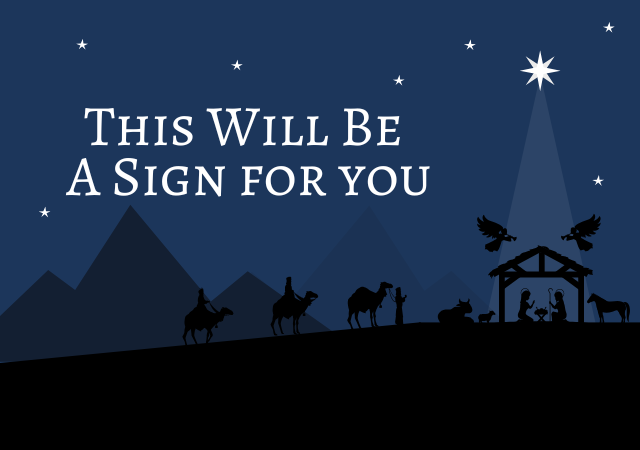
This Will Be A Sign For You
This will be a sign for you: you will find a child wrapped in bands of cloth and lying in a manger.’
Luke 2:12
In the name of the One who comes to us. Amen.
Good evening. Thank you for including this Cathedral worship service as part of your Christmas celebrations. Greetings to those joining us via technology from wherever you are. It is wonderful to be with you all.
This will be a sign for you, you will find a child wrapped in bands of cloth and lying in a manger
To call the child born of Mary a sign suggests that his birth points us to something. To say that the child comes to us suggests that he does so from another place, another realm.
We are of this world, and yet from time to time we are given glimpses of another. It comes to us in a variety of ways, breaking into our awareness, filling us with wonder that takes our breath away, grief that breaks our hearts, meaning that we cannot adequately express, or hope that we can’t explain. This other place is the source of all creativity, ingenuity, forgiveness and sacrificial love. And, quoting now the Anglican mystic Evelyn Underhill, “It is a determinative factor in our lives that we cannot rationally explain.”
The contact which proved decisive, the path unexpectedly opened, the other path closed, the thing we felt compelled to say, the letter we felt compelled to write. It is as if a hidden directive power, personal, living, free, were working through circumstances and often against our intention or desire; pressing us in a certain direction; moulding us to a certain design.1
The presence and power of this other realm, whenever and however it breaks in, affirms the ancient human intuitions that we live our lives inside a larger narrative, a bigger story of which our story is a part. We are guided by that story, often unconsciously. But when we feel it; when we recognize it for what it is and seek to live our lives in the light of that other realm, in a conscious relationship with God, the gift we give is our willing participation in something far bigger than our lives can hold—one loving act at a time.
Have you ever wondered why?
We tend to focus a lot of energy on the question of whether or not we believe in God. But what if we all decided on this Christmas Eve that we do, and that we’re sufficiently persuaded that God—however we imagine God—seems to want a relationship with us.
Can we think of a reason why? What possible motive could God have for making such efforts to be with us?
The answer, as best the Christian faith can discern, is love. Jesus is born as a sign to us that God loves us, and always has. God didn’t decide to love us when Jesus was born. God has loved us from the beginning.
Hundreds of years before Jesus’ birth, someone—perhaps King David—wrote a psalm that expresses the love of God that we celebrate tonight. The psalmist wrote in the first person, but I will recite it for us all:
Lord, you have searched us and known us;
You know our sitting down and our rising up;
You discern our thoughts from afar.
You trace our journeys and our resting places
And are acquainted with all our ways.
Indeed, there is not a word on our lips,
But you, O Lord, know it altogether…
… Where can we go then from your Spirit?
Where can we flee from your presence?
If we climb up to heaven, you are there
If we make the grave our bed, you are with us
If we take the wings of the morning,
and dwell in the uttermost parts of the sea
Even there your hand will lead us,
and your right hand hold us fast.
If we say, surely the darkness will cover us
and the light around us to turn to night
Darkness is not dark to you,
The night is as bright as the day.
Darkness and light to you are both alike.
Psalm 139:1-12
After Jesus’ death and resurrection, the Apostle Paul came to the same understanding.
For I am convinced that neither death, nor life, nor angels, nor rulers, nor things present, nor things to come, nor powers, nor height, nor depth, nor anything else in all creation, will be able to separate us from the love of God in Christ Jesus our Lord.
Romans 8:31-39
There is no place we can go where God is not willing to go in order to be with us.
And wherever we are, whatever the circumstances, we are part of a larger narrative being that involves both God and humankind, in which we belong and have a contribution to make,
I say these things to you fully aware, as are you, of the complexity and heartache of the world in which we live, the countless ways human beings are both the cause and recipients of great suffering, and that we subject to forces beyond our control from which this child, born as a sign of God’s love, does not spare us.
I wish it were otherwise. Perhaps you do, too. But this is the world we live in. We may want another world, but this is it, and we’re here. Maybe this isn’t the world God had in mind, either. But God is still here, too.
I was talking to someone recently who had dedicated his life to improvisational theatre—the kind where actors come on stage not knowing until someone begins what the story is or how it will evolve.
There are several core principles at the heart of improv, he told me, that are good life lessons as well. “One principle,” he said, “is to show up and act in the scene you’re in, rather than the one you want.” And I said, “That pretty sums up the Christian faith.”
Stay with me.
You see, the Christian faith, for all its biblical stories and theological arguments, will never provide a truly satisfactory answer as to why there is suffering in the world. Which, again, in Eveyln Underhill’s words, “remain a mystery beyond the reach of the human mind.”2 What Christian faith does provide is a way to deal with it, born of the conviction that God’s spirit is at work in and through us, bringing to fruition what Jesus told us to pray for—the coming of God’s kingdom, God’s realm of love, on earth, as it is in heaven. For reasons we also may never fully understand, God doesn’t work alone, but chooses to work in and through us. We’re part of the ensemble, and if it feels like improvisation, that’s because it is.
Consider the stories of Jesus’ birth. Amid the backdrop of danger, want, and foreign occupation, Mary and Joseph said yes. When the shepherds in the fields heard angels speaking to them from the heavens, they said yes. When wise men from a foreign land felt beckoned to follow a star to where the Christ child lay, they said yes. They all said yes when God asked them to do something big for something good. It was a costly yes for all of them, yet one they accepted gladly, because they knew that they had been summoned from another realm.
Not everyone said yes. They could have said no, but they didn’t. They said yes.
In every generation, every context, every situation no matter how hopeless it seems, there are people who don’t see themselves as particularly heroic or worthy, and still, they say yes. Yes, I will stay in the game. Yes, I will do my part. Yes, I will choose love until my last breath, no matter what.
Tonight we remember all those whose yes in response to God have kept the hope of love alive, as we remember the child whose birth is a sign for us, too.
Tonight God asks us all to say yes once again.
Say yes, and hold your precious life in your hands.
Say yes, trusting that there is more than what you see or understand.
Say yes, accepting all that you wish you could change, but you can’t.
Say yes, and change the things you can.
Say yes, and choose what is difficult when it’s the right thing to do.
Say yes, and reach out in kindness to a stranger.
Say yes, and be kind to yourself.
Say yes, amid all that is working against the good and refuse to give up on the good.
Never forget that Jesus’ birth is a sign for you, that God is with you, saying yes back, not in a passive way, but rather, borrowing another principle from improvisational theatre, “Yes, and.” Which is to say that God takes what we have—even when it seems our hands are empty, even when we’re made foolish choices, even when life hits us hard—and works with it for good.
The year that Dietrich Bonhoeffer was arrested by the Gestapo for his resistance to Adolf Hitler, he wrote this:
I believe that God can and will bring good out of evil, even out of the greatest evil. (No small conviction, staring down the Gestapo) For that purpose he needs men and women who make the best use of everything… I believe that even our mistakes and shortcomings are turned to good account, and that it is no harder for God to deal with them than with our supposedly good deeds.3
Bonhoeffer didn’t write those words from a place of safety. He didn’t know how his story would end. What he knew and entrusted himself to was the larger narrative in which his life was held, in which love would, in the end, prevail.
That is the hope we celebrate tonight: Not that everything will turn out as we want but that nothing we face, nothing we fear, nothing we endure lies outside the reach of God’s love.
We are part of a story far larger than ourselves, a story that does not deny suffering,
but insists that suffering does not get the final word. A story in which God keeps showing up, keeps calling forth courage, keeps drawing life out of what feels beyond repair.
The child born of Mary is a sign for us that God has chosen this world, as it is,
and has chosen us, as we are. God to us comes not because we are worthy, but because we are loved. God comes not after everything is set right, but right into the middle of what is broken.
Say yes tonight, not because you have it all figured out, but because God has already said yes to you.
Yes, and I am with you.
Yes, and your life matters more than you know.
Yes, and we are in this world together.
Amen.
1Evelyn Underhill, The Spiritual Life, (originally published in 1937), Kindle ed. 79.
2Underhill, The Spiritual Life, Kindle ed., 554.
3Dietrich Bonhoeffer, God is in the Manger: Reflections on Advent and Christmas. Compiled and edited by Jana Riess (Louisville: Westminster John Knox Press, 2010), 79.