by Keely Thrall | Nov 18, 2024
Find unique and special gifts while helping the children of Ukraine at St. John’s Ukrainian Christmas Shop on Sunday, December 1, from 8 am until 1 pm.
In partnership with St. Andrew’s Ukrainian Orthodox Cathedral, we will have a wonderful collection of hand-painted Ukrainian Petrykivka Christmas ornaments and Carpathian ceramics from Kosiv, both recognized by UNESCO as an Intangible Cultural Heritage of Ukraine. You’ll also find colorful Ukrainian textiles, socks, chocolate gift sets, and much more!
Of special interest will be an enchanting group of Ukrainian St. Nicholas figures and whimsical Santas! These collectible wood figures are completely hand carved, painted, and numbered by the artist. Each is a unique treasure and there will only be a few of these joyful characters!
100% of proceeds and donations will go to the Okhmatdyt Children’s Hospital in Kyiv, organized by St. Andrew’s Humanitarian Crisis Center.
Credit cards accepted.
by Bishop Mariann | Dec 24, 2023
In that region there were shepherds living in the fields, keeping watch over their flock by night. Then an angel of the Lord stood before them, and the glory of the Lord shone around them, and they were terrified. But the angel said to them, ‘Do not be afraid; for see—I am bringing you good news of great joy for all the people: to you is born this day in the city of David a Saviour, who is the Messiah, the Lord. This will be a sign for you: you will find a child wrapped in bands of cloth and lying in a manger.’ And suddenly there was with the angel a multitude of the heavenly host, praising God and saying, ‘Glory to God in the highest heaven, and on earth peace among those whom he favors!’
Luke 2:8-14
Keep watch, dear Lord, with those who watch, or work, or weep this night. And give your angels charge over those who sleep. Tend the sick, Lord Christ; give rest to the weary, bless the dying, soothe the suffering, pity the afflicted, shield the joyous; and all for your love’s sake. Amen.
There are moments in life when we are given eyes to see, in some small way, as God sees; we are given ears to hear something of what God hears; and our hearts are opened to love, in our modest sphere of life, the way God loves.
In one of the stained glass windows of the Cathedral there is a depiction of the universe, created by the artist Rodney Winfield and installed in 1974. Embedded within it is a moon rock estimated to be over three billion years old, a gift from NASA and the Apollo 11 astronauts.
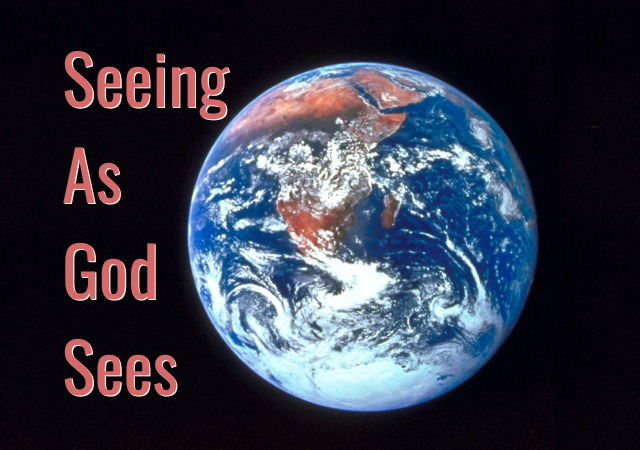
It’s fascinating to read the accounts of those who have traveled in space. While they are filled with awe at the vastness of the universe, what’s most striking about their reflections is what it was like to see the earth from outer space.
“We have the most beautiful planet in our solar system,” said Sunita Williams, a NASA astronaut. “None other can sustain life as we know it. None other has blue water and white clouds covering colorful landmasses filled with thriving, beautiful, living things like human beings.”
“The Earth was small, light blue, and so touchingly alone,” said Aleksei Leonov, Russian cosmonaut and first person to conduct a spacewalk. “Our home that must be defended like a holy relic. The Earth was absolutely round. I believe I never knew what the word ‘round’ meant until I saw Earth from space.”
“I realized up there that our planet is not infinite,” said Alan Shepard, the first American to go to space. “It’s fragile… We look pretty vulnerable in the darkness of space.”
From Neil Armstrong, the first person to walk on the moon, describing the view of earth from a window of the Apollo 11 spacecraft: “It was a tiny pea, pretty and blue, I put up my thumb and shut one eye, and my thumb blotted out our planet. I didn’t feel like a giant. I felt very, very small.”1
And this from Leland Melvin who traveled to the International Space Station: “I had that moment of, ‘Oh my God, we’re all connected. Oh my God, the planet is so beautiful. Oh my God, what can I do to make it better when I get home?’ And in coming home, the things that bothered you? They don’t bother you.”2
There’s a name for what the astronauts describe. It’s called “the Overview Effect,” a cognitive shift that forever changes how they see themselves and our world. Some say they no longer identify with a specific nationality or culture after seeing earth from outer space. Instead they see themselves, and all citizens on earth, as one people, living on one world.
We might call the Overview Effect as seeing in part the way God sees.
We don’t need to leave the planet to be graced with such vision. It can happen to us right where we are, in the most unpredictable moments. The monk Thomas Merton writes of such a time when he stood on a busy street corner in Louisville, Kentucky, in the center of the shopping district:
I was suddenly overwhelmed with the realization that I loved all these people, that they were mine and I theirs, that we could not be alien to one another even though we were total strangers… It was as if I suddenly saw the secret beauty of their hearts, the depths of their hearts where neither sin nor desire nor self-knowledge can reach, the core of their reality, the person that each one is in God’s eyes. If only they could all see themselves as they really are. If only we could see each other that way all the time. There would be no more war, no more hatred, no more cruelty, no more greed… But this cannot be seen, only believed and ‘understood’ by a peculiar gift.”3
And surely the most universal of moments of being given eyes to see as God sees is when we hold in our arms a newborn child.
‘And this will be a sign for you: you will find a child wrapped in bands of cloth and lying in a manger.’
Small wonder that for Christians the definitive way that God invites us to see with new eyes is through the birth of a child.
And what does God want us to see?
The Irish singer Bono writes in his memoir of how he became involved in addressing the global AIDS epidemic, and specifically in 2002, in the effort to convince the Bush Administration to dedicate massive financial resources to combating AIDS on the African continent where the devastation was most severe. This was when antiviral drugs largely were available in the United States and elsewhere, but denied to the millions of people dying in African countries.
Bono knew that US public opinion was critical to swaying reluctant politicians in Washington, so as part of a national tour, he appeared on Oprah Winfrey’s talk show, the most popular daytime television program in the country at the time. Characteristically, in her interview, Oprah cuts to the chase asking Bono: “What does AIDS in Africa have to do with my ten million viewers, a lot of them women at home worried about their own children?” Bono replies, “The way I see it, this is about the value you put on the life of a child… I don’t think you have to explain to any mother that the life of a child in Africa has the same value as her child.”4
Seeing as God sees.
Where you live should not decide whether you live or whether you die.5
The angel said to the shepherds, “Do not be afraid—I am bringing you good news of great joy for all the people.” Not for some people, the most deserving people; not for one racial or ethnic group, or for those who hold to one set of religious beliefs, or citizens of one nation.
Then the heavenly chorus joined in:
Glory to God in the highest heaven and on earth, peace, goodwill to call.
God wants us to know, wants us to see that it is God’s desire, God’s will, God’s intention that there be peace on earth and goodwill for all people. Jesus’ birth is a sign of God’s desire, not its fulfillment. Fulfillment of God’s desire is still in play.
But Jesus’ birth is more than a sign. Jesus came to show us the way, God’s way to the peace and goodwill we long for. God’s way is the way of love and forgiveness, hope and joy.
Rest assured that ours is not the first generation that struggles to reconcile the beautiful, hope-filled promise that we celebrate tonight with our lives as they are and the world as it is. Even the beauty of this Cathedral cannot shield us from what we know.
Over four hundred years ago, William Shakespeare gave words to our struggle In the opening scene of Hamlet. He has one terrified night watchman say to another:
Some say that ever ’gainst that season comes
Wherein our Savior’s birth is celebrated,
This bird of dawning singeth all night long…
And then, they say, no spirit dare stir abroad,
The nights are wholesome; then no planets strike,
No fairy takes, nor witch hath power to charm,
So hallowed and so gracious is that time.
To which his equally frightened comrade replies, “So I have heard and do in part believe
it.”6
The poet Maya Angelou once described Christmas as “the halting of hate time.”7
So, too, we have heard, and do in part believe it.
Or do we?
Maybe we believe but aren’t sure what difference it makes, for while Christmas has come this as it has every year since Jesus’ birth, in far too many places on the planet we call home, the hating time is alive and well.
If you’re like me, believer or not, you’re grateful to have this yearly occasion to remind us of God’s promise, inspire us with songs and stories of hope, and invite us to see ourselves and one another through God’s eyes of love.
But the disparity between the promise of Christmas and the pain we see is heartbreaking.
I wonder if God is grateful for our broken hearts at Christmas. And I suspect that it’s just fine with God if we can only believe in part at Christmas, because the distance between the hope of Jesus’ birth and the unrelenting pain breaks God’s heart, too.
Could it be that in our broken hearts, united with God’s, lies the hope of the world?
Jesus’ birth is also a sign of God’s determination not to give up on us, to make a home within us and to be Emmanuel—God with us. And that is a promise fulfilled. God is with us. Our lives matter to God. What’s more, God needs us to help bring a halt to the hating time, to help in ways both large and small to realize the promise of peace.
So hold your broken heart before God this Christmas. Hold before God whatever belief you have, or don’t have, or long for. Hold whatever glimpses of joy, love, forgiveness and generosity you have known. For they, too, are God’s signs for you, that the promise is real and worth living your life by. In our broken, yet still beating and joyful hearts, united with God’s, lies the hope of the world.
I leave you with the words of a Gospel song that’s been in my head since I heard it here on Friday night:
Mary magnified the Lord in her soul and she cried
For this baby she would bear,
Born for all people to be free and redeemed.
And He lives today within us,
Though we don’t always see.
We are Christmas.
We are God’s hands.
To care for another
In these war-torn lands.
We are Christmas.
The love that we share,
Will carry one another
Until we understand.
So this Christmas, please remember
What the true meaning is.
Remember we are Christ among us,
And for his cause we live
We are comfort for the hurting
We are friendly to the lonesome
We’re His hands who touch the sick
We are water for the thirsty
And speak peace to every soul.
He lives in you.
He lives in me.
It is Christmas.8
See with God’s eyes. Hear with God’s ears. Love as God loves as if the world depended on it. Because it does. It does.
Amen.
1How Astronauts Change After Seeing Earth from Space
215 Astronauts Share Their Perspective on Planet Earth
3Thomas Merton, Conjectures of a Guilty Bystander (New York: Image Books Edition, 2009).
4Bono, Surrender: 40 Songs, One Story (New York: Alfred A Knopf, 2022), 419.
5U2 Song, “Crumbs From Your Table.”
6The Tragedy of Hamlet, Prince of Denmark
7Amazing Peace: A Christmas Poem by Maya Angelou
8“We are Christmas,” by Kevin P. Johnson and Sarah Stephens.