
by EDOW | Oct 4, 2022
In 2 Timothy, the writer encourages Timothy and his second century Christian community to “guard the good treasures entrusted to you.” Amid increasing religious disaffiliation today, we may do well to consider doing the same.
But, what is this good treasure? Is the good treasure our buildings? The sacred items inside our buildings – tables, basins, and pews? Is it the grounds on which this building stands? The pandemic may have shifted our understanding of the place of these material things in our common life. Is our good treasure what we do as a faith community – praising God, sharing meals, baptizing, proclaiming, celebrating, burying, sharing, serving?
What if, as the writer suggests, the good treasures are the gifts God that has sown within you – a relationship with Jesus that presses you to go out into the world to share the good news of God in Christ? What if the good treasure is a way of life that witnesses the presence of God and God’s love for the people in your neighborhood?
The good treasures entrusted to your care begin with your faith – your relationship with Jesus and the trust you have placed in God.
“Guard the good treasures entrusted to you.”
Twenty-four congregations in the Episcopal Diocese of Washington have now embarked on a three-year journey to guard the good treasures entrusted to them called “Tending Our Soil.” These congregations have been challenged to name, and then steward their good treasures so that they will remain vital bearers of God’s love in this time and place in a rapidly changing world.
The word entrusted suggests two actions: passing down and caring for. Indeed, our faith is a gift from God passed down through the generations. Just as Timothy’s faith first lived in his grandmother Lois and then in his mother Eunice and finally in Timothy, we are inheritors of good treasure(s). We are the inheritors of faith from your own grandparents, parents, and those who built and stewarded this parish over the centuries.
Yet, because faith is transmitted from elders to younger generations, the good news of Christ is always one generation away from extinction.
Today, with declining religious affiliation in the United States, we are acutely aware of this possibility. Every Christian denomination in the United States is now declining. Younger generations in the United States are less and less religious. More than 40 percent of the Gen Z and Millennial generation (those born after 1981) have no religious affiliation compared to 25 percent of Baby Boomers and 20 percent of the Silent Generation.
Yet, we have been entrusted with good treasures – a gift of God that lives within us – that we are called to share.
Gen Z and Millennial generations have not stopped seeking the spiritual. Young people today continue to seek identity, purpose, and meaning beyond what can be seen and touched. They continue to ask questions and they do not need to answer life’s big questions alone.
Tending Our Soil is based on this belief – that local congregations will continue to be the primary form of Christian community… places where Christians gather regularly to worship, teach their religious traditions to their children and youth, extend care to one another, and proclaim love for their neighbors through acts of service and hospitality. Every congregation serves as a foundational building block of Christian community and a central carrier of faith.
Over three years, the congregations participating in Tending Our Soil will explore and understand the rapidly changing social and cultural context around them; gain greater clarity about their values and mission; and draw on Christian practices from the Episcopal tradition and theology to adapt their ministries to the concerns and gifts of their neighbors. The ultimate aim is to strengthen congregations so that they can better help people deepen their relationships with God, enhance their connections with each other and contribute to the flourishing of their communities and the world.
As Episcopalians, we have been entrusted with much to treasure: good news that our neighbors so desperately want to hear – that they are loved, have infinite value, are called to lives of purpose and meaning, and are not alone. God loves them with a love that endures all things. These are the treasures that are meant to be given away.
You can join by taking part of the many courses that School for Christian Faith and Leadership offers every congregation. Some of these courses feature the very same speakers in Tending Our Soil. The course “Pathways of Discipleship” by the Rev. Dr. Douglas Powe is just one live course. A whole suite of on-demand courses are available too, including these short-courses that focus on parish vitality.
Which course this fall will help you guard the good treasure that is entrusted to you?
by Allen Fitzpatrick | May 16, 2022
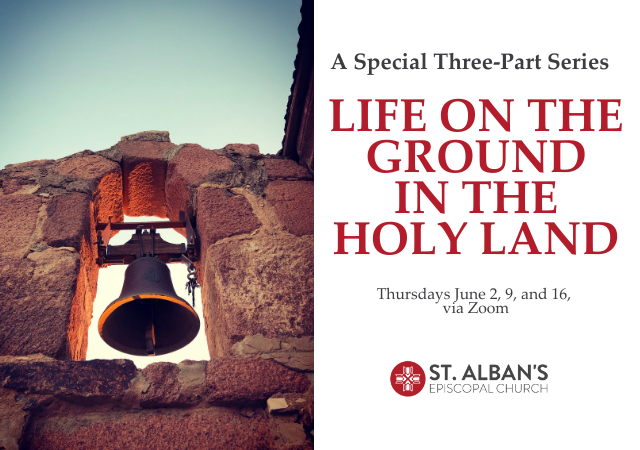
Toward the close of the annual convention of our diocese, Bishop Budde encouraged congregations to enter deep conversation about life in the Holy Land. In response, St. Alban’s is inviting respectful listening to the lived experience of a variety of voices from the Holy Land answering the question: What is life on the ground in the Holy Land like for you personally, and politically?
On June 2nd we will hear from a Palestinian Christian, the Anglican Archbishop of Jerusalem, The Most Reverend Hosam Naoum
On June 9th we will hear from two people in dialogue with each other. They bring differing perspectives and experiences. Yossi Klein Halevi, Senior Fellow at the Shalom Hartman Institute in Jerusalem and author of Letters to My Palestinian Neighbor (strongly recommended reading for the series) and one of his correspondents in the most recent edition, Mohammed S. Dajani Daoudi, who is the former Weston Fellow at the Washington Institute for Near East Policy and is Director of the Wasatia Academic Institute in Jerusalem. We will also provide registrants with some reading suggested by Professor Dajani Daoudi.
On June 16th we will hear from Stephanie Saldaña, a writer, teacher and journalist who specializes in religious diversity in the Middle East, with a focus on refugees. She lives in Bethlehem and is author of a stunning memoir of her time in Jerusalem, A Country Between: Making a Home where Both Sides of Jerusalem Collide.
There is no cost for participating in the conversation, but registration is required. Please register for the event here.
If you have any questions, please contact the Rev’d Jim Quigley from St. Alban’s Episcopal Church.
by Bishop Mariann | Feb 10, 2022
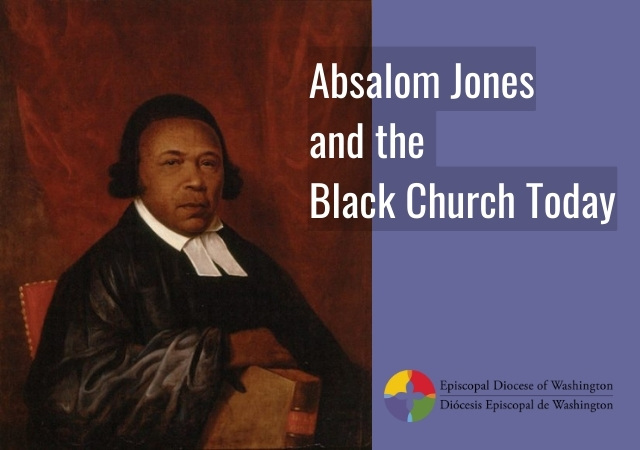
The life and legacy of The Reverend Absalom Jones is a testament to the resilience of the human spirit, his faith, and his commitment to the causes of freedom, justice and self-determination.
From the website of The African Episcopal Church of St. Thomas
On February 13, The Episcopal Church commemorates the life and ministry of Absalom Jones, the first African American to be ordained in The Episcopal Church.
On January 29, Diocesan Convention passed a resolution that directs our collective energies toward the revitalization and empowerment of Black churches and Black parishioners in the Diocese of Washington.
I am persuaded that these two events are related. The church Absalom Jones founded in Philadelphia is one of the most vibrant Black Episcopal Churches in the country. I pray that Absalom Jones’ spirit, faith, and commitment will guide our work.
For those who don’t know his story, Absalom Jones was born into slavery in Delaware on November 6, 1746. While enslaved, he learned to read. When the family that enslaved him moved to Philadelphia, he was able to work evenings and keep his earnings for himself. In 1770 he married Mary Thomas, an enslaved woman, and he purchased her freedom so that she and their children might be free. 14 years later, he obtained his own freedom through manumission.
With his friend Richard Allen, Absalom Jones organized the Free African Society. Both Jones and Allen were also preachers at St. George’s Methodist Church, a mixed-race congregation. As the Black membership grew, White elders responded by segregating worship, requiring that blacks sit in the balcony.
One Sunday morning, as Absalom Jones was praying in a front pew, an usher attempted to forcibly remove him. Jones resisted removal, finished his prayers, and walked out of the church. All the Black members followed and together they formed a new congregation. Richard Allen chose to establish an independent Black church, what would become a new denomination, the African Methodist Episcopal Church (AME). Jones remained as leader of what became The African Episcopal Church of St. Thomas. In 1802, Jones was ordained an Episcopal priest.
Absalom Jones’ ministry was one of compassion, political advocacy and institution building. He was a compelling preacher and community organizer. He helped establish two schools. He and Richard Allen, at the request of Philadelphia’s mayor, rallied Black residents to care for the sick and dying during a yellow fever epidemic. He and others petitioned the U.S. Congress to end the African slave trade. The present day congregation of St. Thomas’, Philadelphia celebrates his feast day each year with great pride, as do many Episcopal churches and dioceses around the country.
The history of Black congregations in The Episcopal Church, including the Diocese of Washington, is complicated, marked by racism and Black self-determination. Many were established right after the Civil War, some with support of White congregations, others on their own. More were planted in the years of Jim Crow and strict housing segregation, when Black people were not allowed to live in most neighborhoods and the more affluent parts of small towns.
When housing laws changed, many of the founding families of Black congregations moved to communities with greater educational and economic opportunity. Resulting White flight re-established segregated worship as formerly White congregations became predominantly Black. That trend accelerated with new arrivals from the African diaspora who found in our Episcopal churches the Anglican Church they were part of at home. Most of our historic Black churches are now in neighborhoods whose populations have shifted again, and as with most Episcopal churches, the membership of all predominantly Black congregations is aging.
Of course many Black Episcopalians now freely choose to worship in predominantly White congregations and vice-versa. The multicultural, multi-racial reality of our Diocese makes it one of the more interesting and complex places to do this important work of racial reckoning and congregational revitalization. Across the Diocese we are all striving to come to terms with our complicity in systemic racism and racial inequities. Martin Luther King, Jr. once lamented that 11 a.m. on Sunday morning was the most segregated hour in America. In many of our churches, that reality remains.
There were once 11 congregations in the Diocese of Washington founded by or on behalf of Black persons; 7 remain, all in Washington, DC with the exception of St. Philip’s in Prince George’s County. There are 15 additional congregations that were originally established for White Episcopalians that are now predominantly Black and multicultural.
Thus the resolution passed at Convention this January asks us to consider the lived experience and future possibilities for over 20 percent of EDOW’s congregations. There is great diversity among them, as well as gifted leaders and rich insights from which we will all benefit. They deserve our collective attention as part of the overall effort of congregational vitality. The Convention’s action will hold us accountable to this work.
The resolution calls for the creation of a task force, composed of members from Black congregations. The task force is commissioned to make recommendations to the Diocesan Council by September 2022 for the enhancement, revitalization, and empowerment of Black churches and Black parishioners.
The task force, once named, will build upon the good work of the Washington chapter of the Union of Black Episcopalians. It will address the new realities facing all our congregations and dynamics unique to the Black church. There are resources from beyond the Diocese to draw upon, including the example of the church that Absalom Jones founded.
The Diocesan Council is now accepting applications for this important Task Force. Members will be from historically Black or predominantly Black congregations. Please consider if God may be calling you or someone you know to serve. This will be exciting, challenging work in a Spirit-led moment not to be missed.

