by Bishop Mariann | Jan 25, 2024
In this final reflection on Courageous Discipleship, here is an excerpt of my address to the Diocesan Convention on January 27.
2023 is my thirteenth year as your bishop and the fifth year of our strategic plan. We are in the final two-year stretch of a journey we began in 2020, intentionally investing diocesan resources in mutually discerned areas of focus.
As you know from your own experience, any long-term, vision-driven endeavor goes through stages. It begins with the early enthusiasm of mountain-top clarity; then back down into the valleys of reality. What follows is a middle stage marked by setbacks and unanticipated complications. In that “messy middle,”1 your understanding of what’s possible changes. It can be a discouraging time, and tiring, because you’re working hard with little to show for your efforts. You might even want to quit. But if by grace and with perseverance you keep going, a new energy can emerge, as your steady efforts gain momentum. You’re working just as hard as before , but now, at last, you see the fruit of your labors.
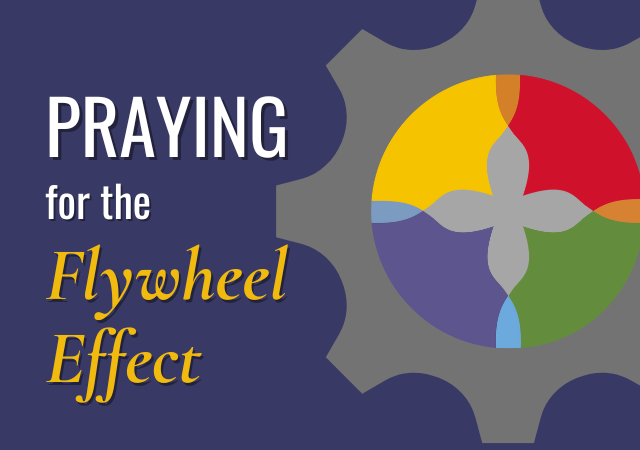
Author Jim Collins calls this shift in energy and momentum “the flywheel effect,”2 borrowing from the image of turning a massively heavy metal disk on an axle, one rotation at a time. In the beginning, it takes all your effort to turn the flywheel one rotation, and the second time is just as hard, and the third. But as you continue pushing, the weight that once held you back begins to work in your favor. The amazing thing is that there isn’t one moment or thing you did that alone can account for the shift—the breakthrough comes through the cumulative result of countless small steps.
In Scripture, this same process is described as the fruit of faithfulness, the virtue of perseverance. What’s more, a spiritual transformation takes place within us as we walk by faith toward a vision that initially we were not capable of fulfilling through our efforts alone. By the grace of God, we become people who are now capable of doing what was once impossible. It takes more than courage to keep going; this is work of the heart.
The Scripture passage that keeps coming to me as I prepare for Convention is from the Gospel of Luke. It’s a simple introductory sentence to a parable, to make sure that we don’t miss its meaning.
Then Jesus told his disciples a parable about their need to pray always and not to lose heart.
Luke 18:1
The story that follows is of an unscrupulous judge worn down by a persistent widow who keeps badgering him for justice against her enemy. I love the fact that Jesus tells an outrageous story as a way of encouraging us not to lose heart, to “guard our hearts,” as is written in the Book of Proverbs, “for everything we do flows from them.”
Then I began to explore other places throughout the Gospels where Jesus speaks directly to our hearts. In the Gospel of John, he says to his disciples on the eve of his arrest, “Do not let your hearts be troubled. Believe in God; believe also in me.” There were lots of things to be troubled by that night, as there are for us today. Jesus doesn’t promise the disciples, or us, an escape from trouble. What he promises is that in him, there is a deeper well from which to draw, a peace surpassing understanding, a love that is the antidote to anxiety and fear.
Elsewhere Jesus warns against what he calls “hardness of heart,” an image found throughout Scripture to describe what happens when we withdraw into ourselves. Hardness of heart is a survival response, a way we try to protect ourselves from the pain of a broken heart. Here Jesus seems to be saying that our hearts will break in this life, that they need to break sometimes, or we risk turning to stone. Looking at the pain so many must endure, Jesus’ heart breaks too. In our broken hearts, united with him, lies the hope for this world.
The theme of our Convention is Courageous Discipleship, an acknowledgement that these are days which call for courage in nearly every sphere of life, and what we have in common is our commitment to follow Jesus. To be a courageous disciple is to follow Jesus wholeheartedly, with the goal of becoming more like him—loving as he loves, forgiving as he forgives, being merciful as he is merciful, and joining him in caring for others and healing our world.
It’s astonishing how much trust Jesus places in his disciples to carry out his ministry. From reading the gospels, we know that the first disciples weren’t exactly up for the task, and frankly, neither are we when we rely on ourselves alone. Brother Curtis Alquist of the Society of St. John the Evangelist reminds us that Jesus calls us to be his disciples not because we’re amazing. God’s grace is what’s amazing, being made perfect in our weakness.
As a diocese, we’re turning the flywheels toward what we believe is God’s preferred future of vitality and greater capacity for ministry. We have every reason to be hopeful that in the next two years we will see the momentum shift and experience the fruit of faithful efforts. In the meantime, we entrust our hearts to Jesus.
If there’s one thing I know about the Diocese of Washington is that we have an outsized impact for good in this world. For that reason, I’m convinced that growth in capacity for ministry is God’s preferred future for The Episcopal Church, not for the sake of budgets and buildings, but for the lives Jesus’ love can touch as we give the Spirit more to work with through us.
Thus I am grateful to renew my commitment to a life of courageous discipleship alongside you. I pray that you are inspired to do the same. If your flywheel feels too heavy, remember that you’re not alone. We’re in this heart work together.
1Scott Belskey, The Messy Middle: Finding Your Way the Hardest and Most Crucial Part of Any Bold Venture
2Jim Collins, The Flywheel Effect

by EDOW | Jan 4, 2024
We’re excited to announce that the 2024 Diocesan Convention will welcome special guest James Fawcett, head of the Being With, a 10-week course exploring Christian faith and life at St. Martin-in-the-Fields parish in London’s Trafalgar Square. Fawcett, whose ministry of 20+ years has focused on young people, will be the preacher at Saturday’s Convention Eucharist and will help to facilitate the Friday evening program.
James Fawcett’s personal biography includes the line, “I am passionate about enabling the local church to share faith as well as positively impact their communities in meaningful, inclusive, creative, and safe ways.” Bishop Mariann comments, “I am so pleased that James has accepted our invitation to be a part of our Convention, helping us to explore the theme of Courageous Discipleship. From our first meeting, I was struck by James’ warmth and easygoing depth. He is someone who inspires people by taking their discipleship perhaps even more seriously than they have taken it themselves.”
Friday night is the part of Convention where we are able to explore the convention theme more deeply and create a more intimate setting, set apart from the required business of Saturday. This year’s event will be participatory, with a significant component of sharing in small groups with trained facilitators.
While not a replica of the “Being With” course, our Friday night experience will give us a taste of the style and method of the course and the space for sacred togetherness that it creates. Participants will come away from the event with renewed inspiration and capacity to share their faith stories and invite deep sharing from others. “Being With” will be one of several approaches to deepening discipleship at the congregational level that will be available for EDOW members to explore over the course of the coming year.
All in the Diocese are invited to participate in Courageous Discipleship: Deepening Our Lives of Faith on Friday, January 26 from 6:30-8:30 p.m. Register here
by Bishop Mariann | Dec 14, 2023
The Light shines in the darkness, and the darkness did not overcome it.
John 1:5
Nearly 20 years ago, the associate rector of the church I served in Minneapolis proposed that we offer a service in Advent for those grieving the death of a child. We put candles throughout the sanctuary, arranged for beautiful music, and did everything we could think of to create an environment where mourning families might experience God’s presence in their pain.
The following Advent we expanded the circle to include all those grieving the death of any loved one. The next year we expanded further still, to encompass all manner of grief. Thus we took our place amid a growing movement in Christian communities that make space in Advent for grieving hearts.
I give thanks that several EDOW congregations are offering such services as a source of solace for those for whom Christmas is a painful time. For some, it is the only service that they can bear to attend. For others, it’s a relief to be with others for whom no explanation is needed for their tears. For all of us, it’s a reminder that Jesus is not afraid to make his home in our grief, and that what we celebrate at Christmas is large enough to hold the full range of human experience.
We don’t need a special service to acknowledge that sorrow and joy are intrinsically linked at Christmas. Given the suffering of this world and the grief we may carry, it can be hard–if not impossible for some–to join in the season’s festivities. There are times to dramatically scale back the exuberance, as Palestinian Christians in Bethlehem understandably have done this year in solidarity with those suffering in Gaza.
From the beginning, Christians have insisted that in the darkest times–and especially in those times–the light of Christ still shines. The light may seem to flicker like a candle in the wind; for a time, it may lie beyond our sight. But it’s here. He is here. The stories of Jesus’ birth in the most precarious of times and humblest conditions are meant to help us trust his presence in the places we feel least equipped to receive him, and for us to show up where love is needed most.
There’s an intentionality about celebrating Christmas that opens us to receive gifts of peace, joy and hope that we might otherwise miss. Just as the Sabbath comes each week, no matter if we have completed our work, Christmas comes each year, no matter our circumstance. Theologian Howard Thurman, himself no stranger to suffering, exhorts us to find space at Christmas for those fleeting moments of penetrating beauty and meaning when
the commonplace is shot through with new glory, old burdens become lighter, deep and ancient wounds lose much of their old, old hurting. A crown is placed over our heads that for the rest of our lives we are trying to grow old enough to wear. Despite all the crassness of life, despite all the hardness of life, despite all the harsh discords of life, life is saved by the singing of angels.1
Where might you go to hear the angels sing for you and all who suffer?
I also think of Christmas as a time to join with God in the holy work of shielding joy. Much of the season’s joy is vicarious–doing what we can to embody peace, hope, and love for others. Not only are we to cherish and savor joyful moments, but also to protect them, let them be the gift that they are, the means through which God comes to us in love.
Perhaps it’s as great a gift at Christmas to delight in another person’s happiness as it is to be in solidarity with another in their grief. Enjoy every minute my mother will say to me as I prepare to spend the week after Christmas with my children and grandchildren, even as she must remain in her small assisted living apartment, far from family, As I do, I will hold her in prayer, grateful for her generous love and sincere desire for me to be happy in ways now denied her.
To live as if the promises of Christmas are true–that God is with us, that Jesus makes his home in our world as it is and our lives as they are–is an act of courageous faith.
I pray that you may receive a palpable experience of Jesus’ loving presence with you this Christmas and join in ways of embodying his love for others.
I pray that we might be given ears to hear the angels sing their song of good news and great joy for all people. For to us is born a Savior, who is Christ the Lord.
1Howard Thurman, Deep Is the Hunger (New York: Friends United Press, 1970)

by Bishop Mariann | Dec 10, 2023
Comfort, O comfort my people, says your God. Speak tenderly to Jerusalem, and cry to her that she has served her term, that her penalty is paid, that she has received from the Lord’s hand double for all her sins.
Isaiah 40:1-2
The beginning of the good news of Jesus Christ, the Son of God. As it is written in the prophet Isaiah, “See, I am sending a messenger ahead of you, who will prepare your way; the voice of one crying in the wilderness:’ Prepare the way of the Lord, make his paths straight.’” John the baptizer appeared in the wilderness, proclaiming a baptism of repentance for the forgiveness of sins. .. He proclaimed, “The one who is more powerful than I is coming after me; I am not worthy to stoop down and untie the thong of his sandals. I have baptized you with water, but he will baptize you with the Holy Spirit.
Mark 1:1-8
If I were to ask how you define what it means to be a Christian, what would you say? More specifically, how would you define what it means to be a believer, a word sometimes used to distinguish between nominal Christians and those for whom faith is central to their life? Where would you start?
An understandable place to begin would be to talk about what Christians believe—or are supposed to believe—about God and about Jesus, as God’s son. If we were to start with the meaning of Christmas, we might say that it’s when we celebrate the decisive moment in history when God chose to be with us by becoming one of us. Jesus was born, as we all are, in great vulnerability. As a man he showed us how to live and how to love, by the way he lived and loved. And gave us a glimpse into what God looks and longs to relate to us. He died a terrible death at human hands, both as an act of solidarity and an example of sacrificial love. What happened after his death, what we call resurrection, or rising from death to a different kind of life, is what we celebrate at Easter. In his rising, Jesus assures us that nothing can separate us from God, not even the worst that can happen to us, the worst that we can do to ourselves or one another, and not even death itself. And that his spirit is with us always, to the end of time.
I happen to believe all those things, or I certainly try to. Most days I succeed. At the same time, as I consider what it looks and feels like to be a person of faith, I wonder if we might start from a different place—not so much about what we believe and more about where we place our trust.
On the topic of faith, and what constitutes faith, the Rev. Dr. Sam Wells, an Anglican priest in the Church of England, writes this:
When we think faith is all about belief, we risk beating ourselves up for not being able to hold together all the mysteries and contradictions and far-fetched ideas. But that’s not what Christianity is really about. The Christian faith is really about trust . . . It’s about facing the unknown and seeing Jesus turn around, offer us his hand, and say, “We’re going to walk across the unknown together.”1
If faith is more about trust than belief, then the opposite of faith isn’t doubt, all that we wonder about and don’t quite believe, but rather, anxiety. In anxiety, we are more likely to act and make decisions according to butterflies in our stomach, the weight on our shoulders, or the vague sense of panic that gets caught in our throats.
Anxiety is as contagious as a cold, and we’d have to be made of stone not to be affected by it. I suspect that each of us could name at least one or two things that we’re anxious about at the moment, where we lack faith, defined not in terms of what we believe about God, but rather as our desire, and our intentional effort, to trust God.
It’s hard to trust God to help us in the places where we feel worried or at a loss. Especially, we might say to ourselves, when we have all these doubts about God, when we don’t know God particularly well, or how to reconcile the conflicting claims made in God’s name. How can we give anything to God if we aren’t sure God is there or willing to receive it?
Those are tough questions, but in the end, I’m not sure that they matter as much as we think. What matters is our willingness to let go, to stop trying to hold everything together ourselves and surrender the idea that it’s up to us to make everything work out the way we think it should.
What matters in a life of faith is our willingness to let God in.
And what does that look like?
The image that often comes to my mind is that of an unclenched fist, releasing into the universe all that we’ve been holding so tightly. And after we let go, there comes a time of waiting. Putting our trust in God involves a lot of waiting—for a sign, a word, a sense of direction, a glimmer of insight to mark our path. This season of Advent in the Christian year is meant to give us a spiritual container filled with images and metaphors and stories and songs that can help us in our times of waiting, whenever and however they come.
The earliest Christians were clear that their new life was less about right belief and more about following a path, a way to God that had been made known in Christ. The first name for Christians, the Bible tells us, was simply that: “People of the Way,” and the way was one of trust. We’ve just heard a reading from the Gospel of Mark, the first biblical account of Jesus’ life to be written, and it begins with the exhortation, “Prepare a way,” hearkening back to the ancient prophet Isaiah who also spoke of God making a way, clearing a road for those who were in exile to return home.
Preparing the way almost always involves what in biblical language is known as repentance. Repentance is a big part of Christian path, something John the Baptizer will never let us forget.
One meaning of the word repentance is to turn away from sin, turn away from that which makes us less than who we are, and it evokes a sense of sorrow for all the things we regret that we’ve done or left undone. We need to come to terms with the parts of ourselves we’d rather avoid.
There are other ways to think of repentance. For example, Brother Curtis Almquist of the Episcopal Religious Order of St. John the Evangelist, recently posted these words on Facebook: “You may find, when facing a decision, that you feel completely in the dark. Back up into the light. Go back to where you could see clearly enough, and pick up the trail again there. God gives us as much light as we can bear.” Almquist then quotes the song of Zechariah, John the Baptizer’s father, who Scripture tells us burst into song when his son was born: ‘In the tender compassion of our God, the dawn from on high shall break upon us… to guide our feet into the way of peace.’ The dawn of God’s tender compassion and guidance for you will come,” he assures us. “Wait for it. Watch for it.”
Repentance also asks us to acknowledge the limitations of our sight. “Go beyond what your mind can see,” might be another way to understand what it means to repent. “Live not by your lights alone, but by the light of God. Trust what you cannot see.”
This week, as part of your Advent practice, consider picking some area of your life that is causing you to be anxious, and every day ask God to guide you. You might pray something as simple as, “Dear God, or Dear Jesus, please show me your way. Show me your way for our family; show me your way for our marriage; show me your way in my work; show me your way for my health.” Once you’ve prayed this prayer or something like it, all that’s left is to be still and wait. Wait for whatever comes to you that feels different to you than your anxiety. If nothing comes, perhaps this is a time to do nothing, or to continue waiting until the path becomes clear.
It’s not easy to truly let go and be open to whatever God might have to say. Speaking for myself, I sometimes resist asking for God’s guidance, because I don’t really want to hear what God might say. I want what I want, and am not particularly open to something else. Yet trusting God would have us do what we resist—–-make our concerns and desires known to God, ask for God to show us His way, and wait for the wisdom and love of God to guide us.
There are two approaches to this kind of trust we might consider. The first is starting with the smaller things, the concerns that weigh heavily on our hearts, but in the larger scheme of things aren’t matters of life and death. I am one to fret about small decisions, and it takes considerable spiritual energy for me to remember that I need not carry the weight of them alone. These are precisely the areas where I do well to practice putting my trust in God, asking for guidance from God, acknowledging to the people around me that I don’t know what is best to do or say, and to ask for their insights. Then, there is the waiting time. If nothing comes to me by the time I need to make a decision, I go with the best that I’ve got and dare to trust that God is okay with whatever I decide. But whenever I’m given some sense of direction or guidance, I do my best to follow it, trusting that if I’m hearing God totally wrong, there will be a course correction along the way.
The second approach to trusting God is more dramatic, because quite honestly, it’s the only path left to us when we have tried everything in a situation of great difficulty and have failed, or when we’re facing something so big that we know at the onset that we don’t know what to do. Now we trust in God because there is no other choice. I daresay that we’ve all been there at one time or another—in the hospital, or when relationships are in crisis, or when we’re faced with a sudden, unwelcome change or an enormous decision with the potential to forever change our lives. We’ve been there, I suspect, when our loved ones have made foolish decisions or are in danger and we don’t know how to help, or when we’ve done something really stupid and harmful to ourselves and others and we don’t know what to do next. Then we surrender and trust in God, if you can call it that. It feels more like dying.
In both approaches, both small and large, there are some guideposts along the way. The most striking thing to me is that we are rarely given the entire plan, or the big picture, the comprehensive strategy. We might catch glimpses on occasion of the longer road before us, but more often than not, trusting God feels like doing what we can see to do today, without knowledge of tomorrow. A theologian I admire, Ann Ulanov, once said, “When trusting God, you rarely get to choose among options. Rather you take the one thing that is before you, and only after you’ve taken it, do you see what to take next, and only after you’ve taken that, will the next thing become clear.”
The psychologist Carl Jung wrote much the same thing in a letter to someone who had asked him for advice: “Your questions are unanswerable,” he responded, “because there is no single, definite way for the individual which is prescribed or would be the proper one. But if you do with conviction the next and most necessary thing, you are always doing something meaningful and intended by fate.”
Doing with conviction the next and most necessary thing is another way of trusting God to illuminate our path. It helps us to move forward without getting too far ahead of ourselves, or ahead of God.
Another guidepost on the way of God for our lives is the gift of peace that the Apostle Paul wrote about. And it is a gift, surpassing understanding, that cannot be evoked on command but rather comes to us. In my experience it doesn’t last long, but when it comes it enables me to accept the ambiguities and uncertainties of my life, and carry on. It’s not something I could ever say to another person in a stressful or suffering time. don’t worry, be at peace. But when God says it, and we feel peace washing over us, or witness that peace washing over another, that’s an experience to cherish and hold onto, and to ask for.
In the everydayness of life, we may never know for sure what is best to do. Yet God has a hold on everything, both small and large. God is there in the ebb and flow of it all. If Christ’s coming to be with us means anything at all, surely it means that God’s love in this imperfect world can be trusted.
I leave you with one final word, one that serves well as a mantra of trust. It’s taken from an old hymn entitled Lead Kindly Light. I first heard it from a bishop as he announced to his diocese that he was stepping down from his position because of a terminal cancer diagnosis. He had always been a man of faith, but now he spoke of what it meant to trust in God from a deeper place. He did so using the refrain of this hymn: “Lead Kindly Light. Lead Thou me on. I do not ask to see the distant shore. One step enough for me.”
1The Better Part of Faith
by Bishop Mariann | Nov 30, 2023
When Mary had been engaged to Joseph, but before they lived together, she was found to be with child from the Holy Spirit. Her husband Joseph, being a righteous man and unwilling to expose her to public disgrace, planned to dismiss her quietly. But just when he had resolved to do this, an angel of the Lord appeared to him in a dream . . .
Matthew 1:18-20
Now Advent begins, this brief and beautiful Christian season with its invitation amid the heartache of this world for us to cast our gaze toward the day when God “will wipe every tear, and death will be no more.” (Revelation 21:3-4) Yet perhaps because that promised future is so beyond our imaginings, Advent also hearkens back, as we will pray this Sunday, to when “in this mortal life God came to visit us in great humility.”
As followers of Jesus, we live our mortal lives in between past and future, in the only time we’ve been given. The spiritual practices associated with Advent help ground us where we are now, for they are about attentiveness–paying attention, watching for how God might come to us, or, like an unborn child, is already here in ways we cannot as yet see.
I love the biblical stories associated with Advent, for each person chosen to take part in the great miracle of Jesus’ birth is a study in courage. Elizabeth and Zechariah, the elderly couple who give birth to John, the one who will prepare the way for Jesus. Mary, the young woman who consents to bearing the Christ Child. Joseph, her betrothed, who accepts the baby to be born as his own. The wise ones from a distant land who begin a long journey, following a distant star. Each receives a divine message that no one else hears; still, they decide to trust it enough to walk by its light.
I find myself particularly drawn to Joseph this year, the man who will raise Jesus as his son. We know so little about him, yet he is an icon of matter-of-fact faithfulness. Surely devastated by the news of Mary’s pregnancy, in kindness he resolves to break off their engagement quietly. But when an angel speaks to him in a dream, he changes his mind. According to the Gospel of Matthew, an angel would come to Joseph on three separate occasions, and each time he would rise and do as the angel instructed.
Like us, Joseph can only glimpse the larger purpose of what’s being asked of him. All he knows is that he and Mary are to parent the child whose existence evokes fear among the most powerful in the land. He receives bits of insight through his dreams, just enough for him to do the next, most necessary thing to protect his family.
Joseph’s example of trust and courage is an encouragement for us, as we pray for clarity and guidance. I also love the idea of God speaking to us in our dreams, that luminous place of consciousness we cannot control or fully understand.
Our sleeping dreams are such a mystery–confusing, at times frightening, yet often so wonderful we reluctantly wake from them. My 92-year-old mother reports having the most vivid dreams now, filled with memories of her childhood and family members who have long since died. She wakes from them filled with joy, and longing for home.
Our waking dreams are equally mysterious. They hold the losses we grieve, the desires of our hearts, and all that we hesitate to say out loud. My spiritual director, a Jesuit priest, encourages me to know my heart’s desire and offer my dreams to God. While their fulfillment is not promised, the fact that they are mine matters to God.
This Advent, I wonder if courageous discipleship might involve taking our dreams seriously. I wonder how God might speak through them, with words of encouragement, consolation, or, as in the case of Joseph, explicit instruction. What might it look like for us to offer our dreams to God, listen for whatever bits of insight and instruction we receive, and trust enough to take the next step in faith?
In preparation for our diocesan conversations about courageous discipleship, I’ve been reading the works of the Rev. Sam Wells, vicar of St. Martins-in-the Fields Anglican Church. St. Martin’s introductory course to the Christian faith, Being With is one we plan to highlight for EDOW congregations. I came across an article Wells wrote entitled The Better Part of Faith. The entire article is worth your Advent reading, but for today I leave you with these hopeful words that harken back to Joseph’s steadfast faith:
When we think faith is all about belief, we beat ourselves up for not being able to hold together all the mysteries and contradictions and far-fetched ideas. But that’s not what Christianity is really about. The Christian faith is really about trust . . . It’s about facing the unknown and seeing Jesus turn around, offer us his hand, and say, “We’re going to walk across the unknown together.”
May God bless us in our dreams and give us the courage to walk with Jesus toward what lies ahead.

