by Steve Seely | Mar 2, 2023
Over the course of this year, we will be talking about the many ways that the deacons in the diocese are working with their parishes on behalf of the beloved we meet. Archdeacon Steve launches the series with an explanation of belovedness.
In Paul’s letter to the Colossians (3:12), Pauls says this, “As God’s chosen ones, holy and beloved, clothe yourselves with compassion, kindness, humility, meekness, and patience.”
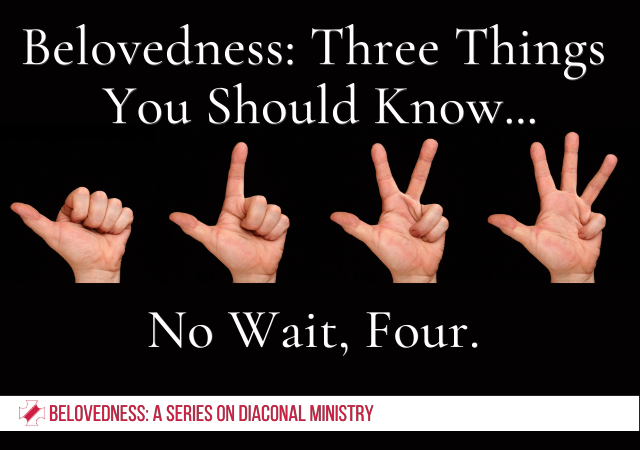
There are three things you should know about belovedness…no wait, four.
Thing number 1 – Who are God’s chosen ones? The answer to this is… we are God’s chosen ones. All of us. It is not limited to the folks Paul addressed in his letter. It is not limited to any defined person or group. We are all God’s chosen ones and God’s beloved.
Thing number 2 – The definition of beloved: a much loved person.
Thing number 3 – Belovedness: the state or condition of being beloved.
While it is not unique to ordained deacons, belovedness is the primary lens in which deacons look at the world. All are beloved, especially those in any kind of need. That need may be material. It could be a need for someone who is willing to listen and hear a person’s story. Or in a situation where the “beloved” needs an ally; a friend to help or a voice that will be heard on behalf of those with little or no voice. In their ordination vows, deacons promise to “look for Christ in all others, being ready to help and serve those in need.”
But you might say, “Wait a minute, that sounds familiar!” And you are right. You see, in our Baptismal Covenant after being asked, “Will you seek and serve Christ in all persons, loving your neighbor as yourself.”
We reply, “ I will, with God’s help.”
The vows are very similar to each other, aren’t they? And since they are, here is…
Thing number 4 – Those who are beloved–the ones Paul talks about–is everyone. And this state of belovedness is the lens through which deacons look at the world. But that same lens is really shared by us all. It is right there in the promises we make every time there is a renewal of our Baptismal Covenant.
Sometimes, like in this article, belovedness means taking care of our planet so that it is here for generations to come. Sometimes, it will show up as the collective engagement of deacons and their parishes working in singular focus for greater impact. Always, it will be in the context of taking steps in love and care of the beloved children of God.
You are invited along! Where is your passion? Where is the place where what you care about meets the world’s needs? Bishop Mariann invited us at Diocesan Convention in January to “take the next faithful step.” If you do not know where to begin, ask a deacon to help you find a place to start and take that next faithful step with you. And if your parish does not have a deacon, email me and I will work with you.
With you on the journey,
The Venerable Steve Seely, Archdeacon

by EDOW | Mar 2, 2023
Sometimes God turns you into a happy robot. At least that’s what I thought when “Saplings for Sacraments” beamed into my brain last fall. By that time, I had served as the deacon at St. Dunstan’s, Bethesda, for almost two years and on the diocesan Creation Care Task Force for ten months. For as long as I could remember, I had loved trees; I was famous for sharing a third of my small place with an enormous fig. God had called me, I was certain, to care for the Earth, given all its beauty and vulnerability. But when and how?
Then, everything came together–as it does when the Creator is up to something. There I was in a church surrounded by trees, next to the Capital Crescent Trail and within the Little Falls Watershed. My rector, the Rev. Patty Alexander, was as moved as I was by the sorry state of the planet. Finally, one day in October, Abbott McCartney of St. John’s, Lafayette Square, invited other members of the task force to attend an international webinar on the brand-new Anglican Communion Forest. I had free time that afternoon, so I attended.
We had four baptisms scheduled for November and December. With help from the Little Falls Watershed Alliance, I got four native-tree saplings for free to give to the newly baptized or their sponsors and printed up tree-care instructions based on my time as a volunteer with Casey Trees. The cedar, magnolia, and maples didn’t look like much; three of them were leafless sticks. But the expression on the teen’s face was priceless when I introduced her to her new green-ish friend. Saplings for Sacraments—one way to grow the worldwide Forest—was born. More trees for other sacraments will follow, God willing.
There are lots of reasons to plant trees and ways to participate in the Communion Forest. See the links above, the “On Planting Trees to Celebrate Special Occasions” resolution of the 2023 Diocesan Convention, and this great list of resources on the diocesan website.
The Rev. Mary Sebold
Deacon, St. Dunstan’s Episcopal Church, Bethesda

by EDOW | Nov 11, 2022
By the Grace of God and the people consenting
The Right Reverend Mariann Edgar Budde
Bishop of Washington
will ordain
to the Sacred Order of Deacons
in Christ’s One Holy Catholic and Apostolic Church
Jessica Amber Ault
Rosa Luisa Briones
Sally Ann Ethelston
Martha Lynn Jenkins
Alethea Smith Long-Green
Francisco de Jesús Serrano
Thomas Roy Sinclair
Melissa Jo Sites
Nancy Starr Stockbridge
Adela Vasquez
on Saturday, November 12, 2022
The Feast of Charles Simeon
10:00 a.m.
at the
Cathedral Church of St. Peter and St. Paul
3101 Wisconsin Avenue, NW,
Washington, District of Columbia
Your prayers and presence are requested.
Clergy: Red Stoles
Please click this link to watch the livestream
by EDOW | Oct 13, 2022
A diferencia de apenas unos años atrás, cuando teníamos apenas un pequeño grupo de diáconos sirviendo en congregaciones y ninguna estrategia para formarlos, la comunidad de diáconos en la Diócesis de Washington cuenta ahora con muchos más diáconos y continúa creciendo con 10 diáconos más que serán ordenados por la Obispa Mariann, con la ayuda de Dios, el 12 de noviembre. ¿Por qué es esto importante? Porque los diáconos sirven de una manera única en la Iglesia. Ellos son enviados por los obispos a servir en congregaciones con el propósito principal de actuar como puentes entre la iglesia y el mundo. Los diáconos deben comunicar las esperanzas, necesidades y preocupaciones del mundo a la iglesia y empoderar a esta, al pueblo de Dios, a responder a estas necesidades.
Los cánones de la Iglesia Episcopal identifican a los diáconos de una diócesis como una comunidad de diáconos, y da poder a los obispos diocesanos a crear un consejo de diáconos para ayudar a los obispos y archidiáconos a ayudar, dar ánimo y proveer continuo desarrollo a los diáconos.
Al inicio del año, la Obispa Mariann le pidió a la Archidiácono, la Venerable L. Sue von Rautenkranz, que comenzara el proceso de formar un consejo de diáconos para nuestra diócesis y establecer los parámetros de este. Según las mejores prácticas en toda la Iglesia, la configuración actual de nuestros consejos diocesanos de diáconos incluye seis diáconos activos sirviendo en clases, con la posibilidad de que cada uno sirva por un segundo término. Dos diáconos sirven como co-presidentes y un diácono retirado sirve como consejero del consejo, mientras que el archidiácono actúa como conexión del equipo de trabajo diocesano. La configuración del consejo debe incluir laicos y sacerdotes.
El trabajo inicial del Consejo de Diáconos incluirá estas tres áreas:
- Desarrollar un manual para los diáconos.
- Planificar e implementar el retiro anual de diáconos.
- Preparar un reporte a la diócesis sobre la adopción de una compensación mínima para los diáconos, para que puedan participara de los beneficios del Fondo de Pensiones de la Iglesia, siguiendo el trabajo que han realizado otras diócesis.
Con el tiempo, el Consejo de Diáconos expandirá su trabajo para incluir dar consejos a la obispa sobre ubicaciones, políticas relacionadas con el retiro de diáconos y las posibilidades de educación continuada. Todas estas áreas ayudará a conectar y organizar mejor a los diáconos y a servir mejor a las congregaciones de la diócesis en el trabajo de justicia, especialmente en las áreas del cuidado de la creación, la reconciliación racial y los ministerios con migrantes y refugiados.
by EDOW | Oct 13, 2022
In contrast to just a few years ago, when we had a bare handful of deacons serving in congregations and no strategy for forming new ones, the deacon community in the Diocese of Washington now counts in the double digits and continues to grow with another ten to be ordained, God willing, by Bishop Mariann on Saturday, November 12. Why is this important? Because deacons serve a unique role in the Church. They are deployed by a bishop to serve in congregations with the primary purpose of acting as a bridge between the church and the world. Deacons are to communicate the hopes, needs and concerns of the world to the church and to empower the church, the people of God, to respond to those needs.
The canons of The Episcopal Church identify the deacons of a diocese as a community of deacons and empower the bishop of a diocese to create a council of deacons to help the bishop and archdeacon support, encourage, and provide continuing development of the deacons.
Earlier this year Bishop Mariann asked The Venerable L. Sue von Rautenkranz, Archdeacon, to begin the process of forming a deacons council for our diocese and to set up the parameters of the council. Based on best practices learned from around the Church, the current configuration of our diocesan Deacons Council comprises six active deacons serving staggered terms with the possibility of each serving a second term. Two more deacons serve as co-chairs and one retired deacon serves as an advisor to the council while the archdeacon acts as staff liaison. Future configurations of the council may include lay people and priests.
The initial work of the Deacons Council will fall into three main buckets:
- Develop a handbook for deacons.
- Plan and implement an annual retreat for deacons.
- Draft a report to the diocese regarding the possibility of adopting minimum compensation standards for deacons so that they may participate in the benefits of The Church Pension Fund, following the path a number of other dioceses have begun walking.
Over time, the Deacons Council will expand its work to include advising the bishop about deployment, policies regarding the retirement of deacons, and continuing education possibilities. All of these areas of focus will help to connect and organize the deacons to better serve their congregations and the diocese and to further the work of justice, especially in the areas of creation care, racial reconciliation, and immigration and refugee ministry.

