by EDOW | Feb 17, 2022
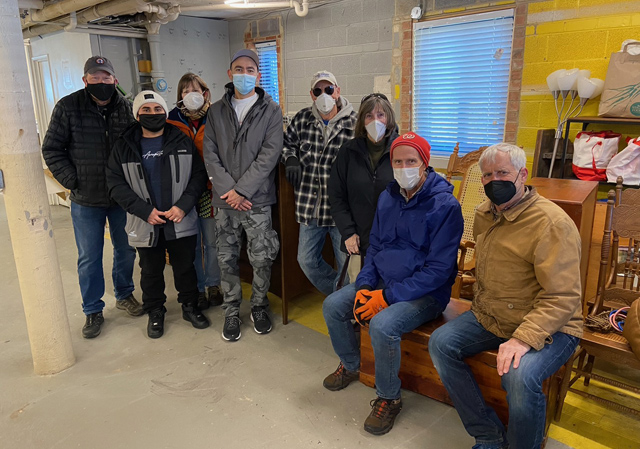
Some of the volunteers from All Souls, DC, St. John’s, Lafayette Square and St. Mary’s, Arlington, helping to furnish an apartment for an Afghan refugee family
After a month of preparation and hard work, a cross-city and cross diocese partnership welcomed an Afghan refugee family on February 16th. All Souls and St. John’s Lafayette Square from the Diocese of Washington and St. Mary’s in Arlington from the Diocese of Virginia joined together to settle an Afghan father and mother and their three small children into a three-bedroom apartment the churches have rented and furnished for the family.
While the parishes all have past experience supporting refugees, leadership in each parish liked the idea of a partnership approach, given the amount of ongoing support the family will require–from language, education, and self-development resources to health and human services, to legal, financial, and other assistance–to be successful.
Embry Howell, who leads the work at All Souls and sought out partners, said “All Souls had successfully partnered with two DC parishes in 2016 to support an Afghan family, so we wanted to replicate that success. We were delighted to find such amazing and willing partners in St. John’s and St. Mary’s.”
Dana Martin, Senior Warden at St. Mary’s agreed, saying, “We liked the idea of adding this to the other ministries in our parish. It’s remarkable how well the partnership is working. Back in my corporate days I’d call it synergy. Now I think it’s better to call it the Holy Spirit.”
Gay and Bob Pasley, longtime stalwarts at St. John’s whose college friendship with Embry led to the parishes’ connection agreed. “We’re so happy to share all we’ve learned over the years. Each parish brings a lot to the table.” Jessica Sanchez of the same parish added, “St. John’s had a whole storage locker stuffed with items we were able to use to furnish the apartment.”
Patty Hammond of St. Mary’s shared that it’s been fun to see how every member of the “Tri Parish Refugee Support Circle” as it’s called, has brought their own skills to the table, hers being her former life as a teacher and her connection to Episcopal Migration Ministries.
Interim Rector at All Souls Parish, the Rev. Dr. Julianne Buenting, stated her support for the project this way: “I’m just as thrilled about how this encourages our own spiritual transformation at All Souls as I am about our following the biblical imperative to welcome the stranger. The Holy Family was once a refugee family. We need to remember that.”

by Bishop Mariann | Jan 13, 2022

The Jericho Road
You see, the Jericho Road is a dangerous road. . . The question is not: if I stop to help this man in need, what will happen to me? The question is: if I don’t stop to help the sanitation workers, what will happen to them?
– Dr. Martin Luther King, Jr., Memphis, April 3, 19681
Every January in anticipation of the Martin Luther King, Jr. holiday I read portions of King’s writings and historical studies of what we now call the Civil Rights Era. It is a well that never goes dry.
This year, as part of a larger writing project on how we learn to be brave in the decisive moments in our lives, I’ve been drawn to the last week of King’s life. In particular, I wanted to better understand what compelled him to lend his support to a seemingly intractable power struggle between the African American sanitation workers of Memphis and white city leaders who refused to acknowledge the inhumane working conditions and starvation wages the workers had endured.
I’ve also been pondering King’s understanding of “redemptive suffering,” the idea that suffering, freely embraced, can have healing and transformative power, not necessarily for oneself, but for others. King looked to the cross as God’s definitive answer to human suffering, and he felt called, as did the Apostle Paul, to share in the sufferings of Christ for purposes beyond his own life.2
The spring of 1968 was, by all accounts, a chaotic time in the nation and the movement for civil rights and economic justice. King himself was struggling with exhaustion, depression, and a constant sore throat from his non-stop schedule of speaking engagements. Once the darling of mass media, King was now excoriated in the press for his stance against the Vietnam War. A rising generation of Black and student leaders were increasingly dismissive of non-violence as a strategy for social change, given the intractable violence of the forces against Black Americans and their demands for justice. While King never wavered in his commitment to non-violence, he was repeatedly accused of inciting violence wherever he went. His inner circle of leaders were at odds with each other and with him. Moreover, the director of the F.B.I., J. Edgar Hoover, was on a personal mission not only to discredit King, but to destroy him and all that he stood for.
What’s striking to me about this crucible time is King’s humanity, and the toll of all the pressures he was up against. He often faltered. Yet at critical moments, God gave him the capacity to draw from the depths of his own conviction, sense of destiny, and solidarity with Christ in order to speak to those looking to him for hope.
The night before his death, King, citing illness and fatigue, initially chose not to attend the mass meeting to rally those planning to march through the city of Memphis the next day. But when his colleague Ralph Abernathy saw the crowd’s disappointment, he summoned King from his hotel room. Arriving after 9 p.m, King rose to address several thousand people who had come out in a driving rainstorm. He spoke for nearly an hour, without notes, of what he knew to be true for himself and for our nation.
Near the end of what would be his last public speech, King invoked the parable of the Good Samaritan as his rationale for being in Memphis. He pondered aloud all the reasons why two religious leaders would pass by a man wounded on the side of the road without stopping to help, while a man of a despised race would choose otherwise. No doubt they had justifiable reasons not to stop, with which we could all identify.
King had his own theory:
It’s possible that these men were afraid. You see, the Jericho road is a dangerous road, winding, meandering and conducive for ambushing . . . And so the first question the Levite asked was “If I stop to help this man, what will happen to me?” But then the Good Samaritan came by and he reversed the question. “If I do not stop to help this man, what will happen to him?” That is the question before you tonight.3
King saw in the sanitation workers’ courage and solidarity what he wanted to invoke and across the nation–a moment of poor people willing to stand with dignity and peacefully demand full inclusion in American society, including the right to secure safe working conditions and a living wage. He cast his lot with them, for their sake, and for us all. “Let us move on in these days of challenge to make America what it ought to be,” he told them. “We have the opportunity to make America a better nation.”
54 years since King’s death, in a time when so many of us are exhausted, stressed, and rightfully worried about the future of our country, I pray that we might draw strength and courage from King’s example and his words. We, too, will often falter. But in ways large and small, we have the opportunity to make our communities, this nation, and our world a better place.
Amid all that your life demands, I pray that you may experience, as King did, God giving you grace to draw from the depths of your convictions, sense of destiny, and relationship with Christ to offer what others are counting on from you. God only knows what it costs for you to make your offering. I hope you feel God’s gratitude.
In one way or another, we are all walking the Jericho Road. How we respond to the people we encounter matters more than we will ever know. As we make our way, may God give us strength to persevere in hope, and to trust, no matter the outcome, that our efforts to love, show up, and bear some of the suffering of this world will help bring about what King called the Beloved Community, God’s dream for us all.
~~~
1Quoted in Going Down Jericho Road: The Memphis Strike, Martin Luther King’s Last Campaign, Michael K. Honey. (New York: W. W. Norton & Company, 2007).
2Mika Edmondson, The Power of Unearned Suffering: The Roots and Implications of Martin Luther King, Jr.’s Theodicity, (Lanham: Lexington Book, 2017).
3Martin Luther King “I See the Promised Land,” in A Testament of Hope: The Essential Writings and Speeches of Martin Luther King, Jr., James M. Washington, editor. (HarperSanFrancisco, 1986), pp. 285-6.

