by | Jan 5, 2023
Tell Me the Truth About Racism is a story that frames racism through the lens of Christian faith for children aged 5-12. Leaders Will Bouvel and Jen Holt Enriquez, first built the foundation of this work in Lent 2021 to teach to children at churches in the Episcopal Diocese of Chicago. Soon thereafter they began training other Christian formation leaders to do this work in their own churches.
Tell Me the Truth About Racism is respected throughout the church and received a Becoming the Beloved Community grant from the Episcopal Church. The entire training is 7 sessions. This 2-hour workshop, sponsored by the Episcopal Diocese of Washington is an opportunity to learn more about the training and to discern if it is a good fit for your community.
The workshop takes place at Diocesan Church House on Tuesday, January 17, 2023 from 11:00 AM to 1:00 PM. Lunch will be provided. The event is free and open to all. Registration is required. You can register on the learning hub here or at learn.edow.org.
by EDOW | Sep 26, 2022
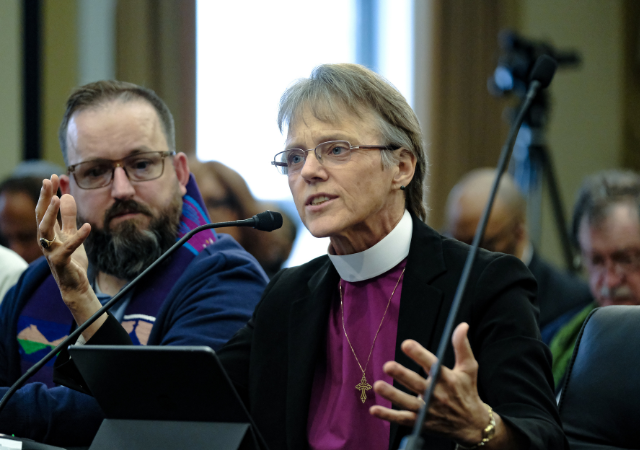
Poor People’s Campaign Congressional Briefing
September 22, 2022
Statement from the Rt. Rev. Mariann Edgar Budde
Bishop of the Episcopal Diocese of Washington
My name is Mariann Budde and I serve as bishop of the Episcopal Diocese of Washington, a geographic region of our denomination which encompasses all of the District of Columbia and four of the most populous Maryland counties.
Within this region are some of the most affluent communities in the nation, and some of the poorest. There are children who attend the finest schools that money can buy, and others consigned to schools that are understaffed and woefully under-resourced. Some families live in luxury; others in rat-infested apartments and, in the rural areas, in homes with no running water or electricity.
This region boasts of some of the finest restaurants and grocery stores, which everyone in this chamber has enjoyed, and yet food insecurity is pervasive not only among those who are homeless and unemployed, but also among the working poor. In one such program run out of one of our churches, 1100 families depend weekly on distributions of food; in another, located in what appears to be an affluent neighborhood, hundreds of people line up each week for an allotment of two grocery bags. Most who seek this assistance work are working more than one job, yet do not earn a living wage.
Every day, we as clergy must decide whom we will serve. And I daresay, so do you.
The economic disparity in our nation, that has shockingly increased over our lifetimes, is the root cause of nearly every one of our society’s seemingly intractable problems. It is the result of public policy decisions made under the undue influence of those who stand to benefit most from that disparity.
We are not naive. Those who benefit from the policies as they are would prefer, and work hard, to keep those consigned to poverty silenced and invisible. But this movement exists to ensure that they will not be kept silent–and neither will we.
We are here to remind you of your sacred duty as elected officials of this democracy.
Specifically, we are here to speak in one voice, asking you to take a position before the midterm elections on three critical issues: voter suppression, designed to keep those most adversely affected by economic disparities out of our political process; legislation to ensure a living wage for those who work hard each day and often through the night, and still do not earn enough to meet basic needs, and to simply to extend the policies proven to have lifted millions of families out of poverty–namely the child income tax credit.
Why on earth would we consign families to poverty again, when a change in policy and resource allocation had such a life-affirming outcome? It is not cruel; it is short-sighted.
We are asking you to be brave. We are asking you to lead, to address the shameful disparities that public policies and laws have created, and that public policies and laws can correct.
Thank you.
by EDOW | Jul 7, 2022
In April, Governor Greg Abbott of Texas announced that his administration would charter buses to “bring migrants released by federal agents north to Washington….[to] be dropped at the doorstep of federal lawmakers.” In response, several faith communities in DC have stepped up to serve as spaces of respite following the long bus rides, working alongside not-for-profits that provide medical care, food, housing, transportation, and bus and plane tickets to the migrants next location. Over the month of June, the Church of the Epiphany, with the help of some of our sister Episcopal congregations, has been host to over 250 migrants.
Our guests arrive via private transport from Union Station to the church in need of immediate access to a bathroom and WiFi. The first arrivals each day tend to appear between 6:30 and 7:00 a.m. They are infants, children, elderly, men, women–all weary and calmly preparing for the next leg of their journey. Some speak Spanish, but other languages we hear are Portuguese, French, even English. We don’t always know how many guests we will host each time, so flexibility has been a necessity.
In the beginning, we provided what was asked for: toys for the kids, bathrooms, food to eat, directions to the store. It was an easy way to be of service, a form of outreach our parish has undertaken in response to calls for help any number of times over the years.
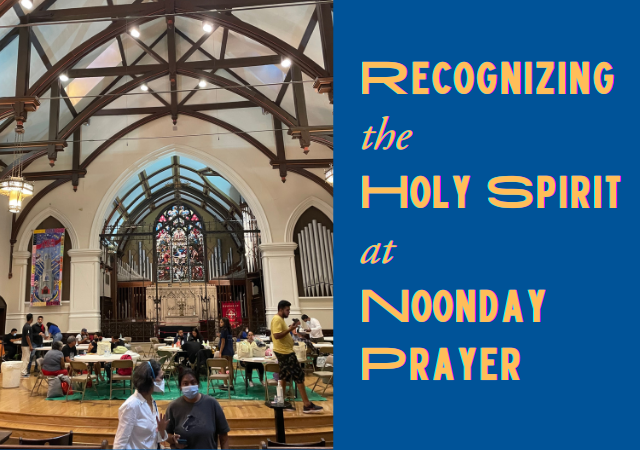
It has long been the custom of Epiphany to host weekday services. One day recently, I was preparing to pray with some regular visitors who entered the church with the expectation of a noonday service, but the sanctuary was filled with our migrant neighbors. It seemed natural to invite all present to pray together, but knowing that many of our guests were tired, and in the process of transitioning to the next stop, I did not think many would respond to the invitation.
I left the sanctuary to grab the readings for the day and my Spanish language Book of Common Prayer. Upon returning to the sanctuary, I was surprised to find that 50 migrants had gathered, silenced the children, and were anxiously awaiting the opportunity to pray.
Seeing how many were gathered I hesitated, wondering if my limited Spanish language knowledge would be adequate to meet the need, yet a sense of purpose and certainty settled upon me. With the help of a Spanish-speaking volunteer from Washington National Cathedral we prayed together, offered a homily, and praised God.
As a space of respite throughout the week, Epiphany provides an opportunity to walk the labyrinth, participate in worship, and hear music. Yet, it hadn’t occurred to us that one thing that would be welcomed by the travelers is corporate worship.
Despite the language barrier, and the fatigue from traveling on a bus for 25-33 hours, we had a spirited and beautiful worship experience. People were so thankful to be able to pray the Lord’s Prayer together. All the voices together, Spanish, English, rang throughout the sanctuary. Everyone walked away filled with the spirit, you could see all moving with a bit more joy in their step.
We did nothing fancy or extraordinary AND the Holy Spirit made her presence known to us. That day, we started as strangers and departed as siblings under God.
The Rev. Glenna Huber
Rector, Church of the Epiphany, DC