

Ordination to the Diaconate
A service of Ordination to the Diaconate for Transitional Deacons.
Clergy planning to attend, please register at the link provided.
A service of Ordination to the Diaconate for Transitional Deacons.
Clergy planning to attend, please register at the link provided.
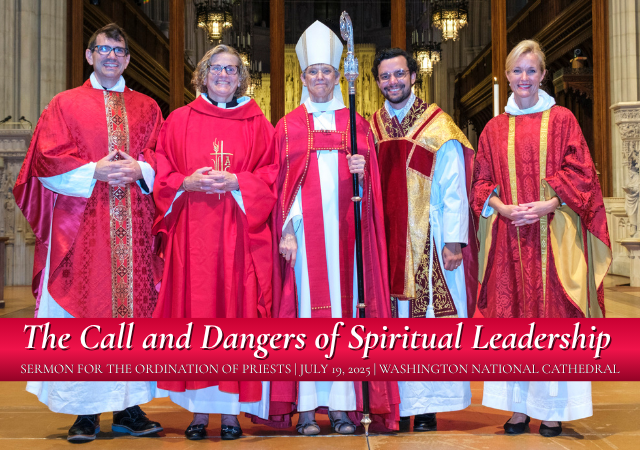
So Moses said to the Lord, ‘Why have you treated your servant so badly? Why have I not found favor in your sight, that you lay the burden of all this people on me? Did I conceive all this people? Did I give birth to them, that you should say to me, “Carry them in your bosom, as a nurse carries a sucking child, to the land that you promised on oath to their ancestors”? Where am I to get meat to give to all this people? For they come weeping to me and say, “Give us meat to eat!” I am not able to carry all this people alone, for they are too heavy for me. If this is the way you are going to treat me, put me to death at once—if I have found favor in your sight—and do not let me see my misery.’ So the Lord said to Moses, ‘Gather for me seventy of the elders of Israel, whom you know to be the elders of the people and officers over them; bring them to the tent of meeting, and have them take their place there with you. I will come down and talk with you there; and I will take some of the spirit that is on you and put it on them; and they shall bear the burden of the people along with you so that you will not bear it all by yourself. So Moses went out and told the people the words of the Lord; and he gathered seventy elders of the people, and placed them all around the tent.
Numbers 11:11-17, 24
Now as an elder myself and a witness of the sufferings of Christ, as well as one who shares in the glory to be revealed, I exhort the elders among you to tend the flock of God that is in your charge, exercising the oversight, not under compulsion but willingly, as God would have you do it—not for sordid gain but eagerly. Do not lord it over those in your charge, but be examples to the flock.
1 Peter 5:1-4
After this the Lord appointed seventy others and sent them on ahead of him in pairs to every town and place where he himself intended to go. He said to them, ‘The harvest is plentiful, but the laborers are few; therefore, ask the Lord of the harvest to send out laborers into his harvest. Go on your way. See, I am sending you out like lambs into the midst of wolves. Carry no purse, no bag, no sandals; and greet no one on the road. Whatever house you enter, first say, “Peace to this house!” And if anyone is there who shares in peace, your peace will rest on that person; but if not, it will return to you. Remain in the same house, eating and drinking whatever they provide, for the labourer deserves to be paid. Do not move about from house to house. Whenever you enter a town and its people welcome you, eat what is set before you; cure the sick who are there, and say to them, “The kingdom of God has come near to you.” But whenever you enter a town and they do not welcome you, go out into its streets and say, “Even the dust of your town that clings to our feet, we wipe off in protest against you. Yet know this: the kingdom of God has come near.” ‘Whoever listens to you listens to me, and whoever rejects you rejects me, and whoever rejects me rejects the one who sent me.’ At that same hour Jesus rejoiced in the Holy Spirit and said, ‘I thank you, Father, Lord of heaven and earth, because you have hidden these things from the wise and the intelligent and have revealed them to infants; yes, Father, for such was your gracious will. All things have been handed over to me by my Father; and no one knows who the Son is except the Father, or who the Father is except the Son and anyone to whom the Son chooses to reveal him.
Luke 10:1-11,16,21-22
Please pray with me:
We offer our gratitude to you, O God, for the claim you have placed in the hearts of these four of your beloved that has led them to accept the vocation of priesthood in our church. We also give thanks for all who have encouraged, sustained, and loved them throughout their journey to this moment. It is good for us to be here. Amen.
Good morning and welcome to all, physically present and online. What a gift to be together for this wondrous occasion.
Speaking on behalf of all of us, let me acknowledge our gratitude to Eric, Tiffany, Tracey and Mark. Thank you for accepting the calling God has placed on your lives. As we have walked together toward this day, thank you for allowing me to know something of your hearts. I’ve witnessed how your relationship with Christ—and the support of those who love you—has seen you through many dangers, toils and snares, given you an evolving and clearer sense of vocation, and continually challenges you to grow in stature and in grace.
And here we are.
In the Scripture passages and hymns you collectively chose for this day, you’ve given us clues as to your understanding of spiritual leadership. Like Moses, you know this ministry isn’t for the faint-hearted or easily discouraged, and that like him, there is a tendency among clergy to imagine that everything depends on us, when, in fact, the mantle of leadership belongs to many. Like the Apostle Peter, writing at the end of his life, you know that the quality of our leadership is intrinsically tied to our character and capacity to accept suffering. Like Jesus, sending out the seventy in pairs, you know that much of what a leader does is equip and encourage others and that, like the seventy, we often don’t really know what our work is—and what it will cost—until we’re sent out to do it.
In the time I have here, I’d like to explore a few dimensions of spiritual leadership that I have learned. As a way into what I have on my heart to say, please dwell with me for a moment on the words Jesus prays at the end of the gospel passage you have placed before us:
I thank you, Father, Lord of heaven and earth, because you have hidden these things from the wise and the intelligent and have revealed them to infants; yes, Father, for such was your gracious will. All things have been handed over to me by my Father; and no one knows who the Son is except the Father, or who the Father is except the Son and anyone to whom the Son chooses to reveal him.
Let me read that last part again:
No one knows who the Son is except the Father, or who the Father is except the Son, and anyone to whom the Son chooses to reveal him.
Faith itself is a mystery and a gift—a costly one at times, but a gift nonetheless. As Jesus says in another context, “You did not choose me, but I chose you.” (John 15:16) The relationship begins on Jesus’ side, not ours. That’s true not merely for those of us wearing white collars around our necks, but for all.
Those of us called to faith will spend our entire lives attempting to understand and give words to this mystery and to live our lives by it. Our efforts will always be imperfect.
To seek understanding, we will use titles, metaphors and statements of belief, all incomplete, yet all have their place in the life of faith. To live by this faith, we will strive, again, far from perfectly, to pattern our lives on Jesus as he is revealed to us in Scripture and the breaking of the bread. Yet faith itself remains a mystery.
While we will never fully understand the mystery of faith—and the more emphatic we are in our certainty the more we prove the point—we can know it. Never completely, for as the Apostle Paul writes, faith is like looking into a dark mirror, where we can see only in part, know only in part, the One who sees us and knows us completely. Nonetheless, once we’ve known even a glimmer of it, it’s hard to unknow the mystery of faith.
Faith in the sense I am speaking here is not entirely synonymous with belief, at least in the ways we profess belief, as you did when you stated that you believe that the words of the Old and New Testaments contain everything necessary for salvation.
The kind of faith I am speaking of is more like a longing, which is how the journalist David Brooks recently described his own faith journey. St. Augustine described it as a restless heart. The late pastor and author Tim Keller spoke of faith as a love for God, or a longing for God, that isn’t contractual; it isn’t dependent on anything we might gain or lose on this side of death or the other.
Knowing God in this way, or longing for God, isn’t the same as being loved by God. Jesus’ coming to us makes it infinitely clear that God’s love is unconditional—it’s always there, for everyone. We can’t earn it; we can’t lose it, it doesn’t matter if we accept God’s love revealed to us in Jesus, because God is love. Bidden or unbidden, it is there, for all of us.
Knowledge is different. However fleeting, knowledge is the fruit of an actual conscious encounter; it grows through the ebb and flow of an acknowledged relationship. Even to speak of it requires great humility, and every possible caveat, so that we are clear to ourselves and others how limited our knowledge is of the ultimate source of all love, truth, and goodness that we inadequately call God.
But this knowledge is the fire spiritual leaders are called to keep alive, by tending to the disciplines that keep us open to conscious encounter, nurturing the relationship that by grace we have been invited into, and taking responsibility for our side of it by growing in self-awareness and maturity.
It all sounds so spiritual, doesn’t it? Now there’s a danger that can lead to the perfectly understandable yet mistaken assumption that faith is only for the the holy people—you know, the ones who speak of God in soft tones and are really good at praying on the spot when asked to say grace at meals; those obviously more religious than the rest of us, and certainly not caught up in the messiness of relationships, the grit of the real world, the 24/7 news cycle, and the rough and tumble reality of most people’s lives.
You know as well as I that that kind of thinking is deadly in spiritual leaders, and unfortunately only one of many forms of elitism we will be tempted by in our work.
For our calling is precisely to take our place, as Jesus did, in the real world, in the complexities and intricacies of human existence, the corrosive reality of sin, both personal and systemic, the grandeur of human goodness and our occasional brilliance, the magnitude of suffering, the wonder of love, and all that conspires to persuade us and others that there is, in fact, no other realm but this one, and that faith is but wishful thinking projected onto a universe devoid of meaning.
Most importantly, to recognize that we are not immune to any of it. We experience what others are going through, which in our particular moment includes, for some, loss of employment or significant income, vicarious grief for those whose lives have been upended, the dizzying effect of global and national news that grows more surreal each day, alongside the seeming normality of life, which continues on as if nothing in the country or world is changing—graduations, weddings, evenings out, babies born, loved ones struggling with illness or relationships—not to mention the embarrassments caused by lapses in judgment or distractions, like the time I recently swore out loud, rather loudly, in this very Cathedral, after presiding at a children’s chapel, no less, because I tripped, fell and sprained my ankle as I tried walking and texting a message my phone at the same time.
Which means that our vocation as spiritual leaders is to embrace the full catastrophe of human existence—our own and those with whom we privileged to serve, and to take seriously the daily demands of those people who look to us to solve all manner of problems, or to make things happen, or at the very least, to show up, and put all other concerns aside, in order to focus on what they need in the urgency of now. And to have an appropriate sense of humility, for we are also prone to the same biases, blind spots and foibles and sins as everyone else.
This is the work: to embrace the fullness of our humanity and take our place in the human family, while doing all we can to keep the flame of the mystery of faith alive, and pointing others to it. All this, while never forgetting, as the Apostle Paul reminds us, that we are like clay jars holding a great treasure, so that it may be infinitely clear that the power belongs to God and not to us.
God invites us to grow large enough inside to hold it all. As the novelist Wallace Stegner has one of his most illuminating characters say, “If we can’t hold it all, then it wouldn’t be real.” As our hearts grow to hold more and more, we are able to provide the kind of stability that is not easily shaken by circumstance or the shock of failure and disappointment, for it is honed in resilience, perseverance, and the Spirit’s capacity to work in and through our humanity.
Let me be more explicit now in the connection I am attempting to make here between the mystery of faith itself and the mystery of our vocation as ordained persons. For this vocation is more than something we choose—although our choice matters—and it draws upon more than our particular skills, gifts, and personality traits—though all those things are part of our offering to the work.
Like faith itself, spiritual leadership, and other vocations well-represented among those gathered here, is something that chooses us. It has a claim on us that we come to accept—and as the Apostle Peter reminds us, we are not at our best whenever we do so grudgingly, although we all have our days.
The vocation of priesthood routinely asks of us more than we can give on our own, for it beckons us and our people beyond where we are now toward a horizon of as yet unrealized possibilities. But that’s the point of it, for the calling is also rooted in a deeper source of strength, wisdom and possibility than what you or I have on our own.
Now there may be moments when any of us have brilliant clarity, the perfect strategy to move something forward, just the right words to say at the right time—all on our own. But that is not the kind of leadership I have known most of the time. Mine is more like the inadequacy Jesus’ disciples felt when all they had to feed a hungry multitude was a few loaves of bread and some fish, but Jesus asked for them to offer it anyway, and on that occasion their offering was, by grace, sufficient for the moment. Jesus doesn’t always make miracles from my offerings, but nonetheless, I have learned to offer what I have, who I am and what I have been gifted with, and then pay attention to what happens next.
Moreover, ours is a vocation that binds us to a community. We are always connected to other people. The rabbi who taught me the most about spiritual leadership in my early years as a priest used to say, perhaps channeling Moses in his more frustrating moments, “Leading a church—and belonging to a church, for that matter—would be easy if it weren’t for the people. But people are the reason churches exist.” He would go on, with a twinkle in his eyes, to say, “And you’re not exactly the easiest to be around all the time, either.”
In closing, I’d like you to know what I have come to believe is the most essential factor in determining the fruitfulness of ordained leadership: self-awareness.
Let me do so by way of a personal story.
In my young life, first as a teenager and then as a 20-something priest right of out seminary, I was influenced by two ordained Episcopal priests, each of whom, at a decisive moment, opened a door for me. It is no exaggeration to say that without them I would not be standing before you today. They were both brilliant, and amazing preachers; they were charismatic in distinctive ways. They took a personal interest in me, one as a surrogate father and the other as a mentor. They were beloved by their congregations. I loved them both, and they loved me. And in their own ways, both were deeply troubled men—troubled in ways that I could not make sense of, because the source of their troubles always seemed to be someone else’s fault.
When these men were at their best, we all were at our best. But when the shadows of their unintegrated lives overtook them, a pall would fall on all of us, and we didn’t know why. Some in the community ignored the dynamic that became a pattern; others downplayed it because of their love for these men. When the shadows lifted and all would be well again for a time, we tried to forget the unpleasantness we endured. The one thing we could never talk about was our experience under the pall, because each of these men refused to acknowledge its existence.
It didn’t end especially well for either of them, which was tragic to witness.
Equally heartbreaking was the lasting systemic impact their lack of self-awareness had on the communities they served. I learned by watching them that there is an organic, often unconscious connection between a leader’s self-awareness and personal maturity to the health of the community they serve. That self-awareness and personal maturity involves owning and holding before God our own wounds and brokenness, having people in our lives who love us enough to tell us the truth, and taking responsibility for our shadows so that others need not live under them.
This is not just true for ordained leaders. This dynamic is at play in all leaders, from parents to presidents. The more authority with which we are entrusted, the greater our positive impact can be, and the more damage we can do when we lack self-awareness, humility, and systems to hold us accountable.
Eric, Tiffany, Tracey and Mark, would you please stand?
You have been given the gift of faith. God has called you to the ministry of priesthood, a calling affirmed by the communities in which you serve. It is a paradoxical call, at once setting you apart and yet firmly placing you among others, whom you are to love and serve and strengthen in faith. You are fearfully and wonderfully made, called to be yourself and bring your full self to this work, and also to acknowledge and take responsibility for the fullness of your humanity, so that others need not bear the burden that belongs to you. You are to grow in compassion, wisdom, and attentiveness to living Christ, and fully embrace the ambiguities and complexities of this life.
You need not be perfect, which is a good thing, for you never will be. You are called to be faithful, tending to the fire of faith and all of life. It is beyond what you can do on your own. But you are not alone. You are among us. And the One who calls you is also the One who will sustain, guide, and strengthen you. Remember that as no stream can rise higher than its source, you can only lead to the extent that you follow the One true shepherd, who knows you and loves you, who knows and loves us all.

By the Grace of God and the people consenting
The Right Reverend Mariann Edgar Budde, Bishop of Washington
will ordain
Eric Bailey
Tiffany Ann Hamilton Clark
Tracey Hancock Forfa
Mark Randall James
to the Sacred Order of Priests
in Christ’s One Holy Catholic and Apostolic Church
Saturday, July 19, 2025 at 10:00 a.m.
Cathedral Church of St. Peter and St. Paul
3101 Wisconsin Avenue, N.W.,
Washington, District of Columbia
✠ ✠ ✠
Your prayers and presence are requested.
Clergy: Red Stoles
Clergy planning to process RSVP by July 12, 2025
Link to watch the liturgy
Members of the Commission on Ministry, Standing Committee and Clergy are invited to process, red stoles. RSVP here
By the Grace of God and the people consenting
The Right Reverend Mariann Edgar Budde, Bishop of Washington
will ordain
Antonio Jerome Baxter
to the Sacred Order of the Priesthood
and
Eric Bailey
Tiffany Ann Hamilton Clark
Tracey Hancock Forfa
Mark Randall James
to the Sacred Order of Deacons
in Christ’s One Holy Catholic and Apostolic Church
Saturday, January 11, 2025 at 10:00 a.m.
Cathedral Church of St. Peter and St. Paul
3101 Wisconsin Avenue, N.W.,
Washington, District of Columbia
✠ ✠ ✠
Your prayers and presence are requested.
Clergy: Red Stoles
Clergy planning to process RSVP by January 6, 2025
By the Grace of God and the people consenting
The Right Reverend Mariann Edgar Budde
Bishop of Washington
will ordain
to the Sacred Order of Deacons
in Christ’s One Holy Catholic and Apostolic Church
Dawn Regina Booth
Diana Ferne Azalee Edwards
Miriam Felipe
Mary Alcuin Kelly
Annemarie Brigid Quigley
Donna Ann Stinchcomb
on Saturday, October 26, 2024
The Feast of Alfred the Great
10:00 a.m.
at the
Cathedral Church of St. Peter and St. Paul
3101 Wisconsin Avenue, NW,
Washington, District of Columbia
✠ ✠ ✠
Your prayers and presence are requested.
Clergy: Red Stoles
Clergy planning to process rsvp
by October 15, 2024
© 2026 Episcopal Diocese of Washington
Lovingly made by Worship
Times, Websites for
Ministries
Edit
Your
Website
