by Bishop Mariann | Jul 11, 2024
Do not be overcome by evil; but overcome evil with good.
Romans 12:21
On July 8, the Episcopal Diocese of Jerusalem announced that one of its most important ministries, the Al Ahli Hospital in Gaza City, was compelled to close by the Israeli army. The Israeli Defense Force ordered the evacuation of all in the hospital’s vicinity and began drone attacks, forcing vulnerable patients and medical staff to leave the compound. On July 10, the IDF ordered the evacuation of all civilians remaining in the entire city, telling them to go to designated “safe zones,” that are already severely overcrowded from previous displacements.
Throughout the Israel-Gaza war, diocesan hospitals and clinics have provided urgently needed medical care and shelter. The witness of the Diocese of Jerusalem is one of compassion, an unceasing call for peace, and a firm determination to overcome evil with good.
We of the Diocese of Washington have supported the Diocese of Jerusalem for years, with a particular focus on the Al Ahli hospital since the war began. The news of its closure is devastating amid a population in desperate need of care and safety.
Archbishop Hosam Naoum writes: We protest the closure of our hospital in the strongest possible terms. In a time of warfare and great suffering it is essential that emergency healthcare services are maintained to treat the injured and the dying. We appeal to the Israeli forces to permit us to continue our sacred ministry of medical care and healing. We plead for an end to the targeting of civilians and all vulnerable people and demand all parties agree to an immediate ceasefire.
The Al Ahli Hospital staff has responded with characteristic resilience. Several months ago, they opened a clinic in the city of Rafah, 35 kilometers south of Gaza City, and they are now redirecting resources and personnel there.
As a diocese, we will continue to support the heroic ministry of the Episcopal Diocese of Jerusalem.
As your bishop and colleague to Archbishop Hosam, I add my voice to the outcry throughout the Anglican Communion against the closure of Al Ahli Hospital. The targeting of medical facilities and staff is a clear violation of international humanitarian law. We grieve the never-ending challenges the hospital staff have endured, including multiple airstrikes, the detention (and torture) of medical staff, and this most recent evacuation order. Moreover, I will continue to urge our government to curtail its sale of weapons to Israel used against civilians in this war.
Thank you for continuing to pray for and support these suffering servants, and for all those longing for an end to this nightmare. May peace come to the war-torn land and its people. May evil be overcome by good.
by Keely Thrall | Jul 9, 2024
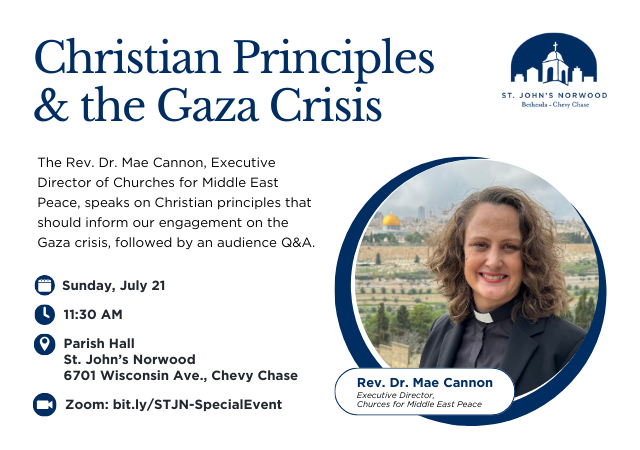
The Holy Land Committee of St. John’s Norwood invites you to hear the Rev. Dr. Mae Cannon, Executive of Churches for Middle East Peace (CMEP), speak about the Christian principles that should inform our engagement in the Gaza crisis. Her talk will be followed by a time for audience Q&A.
The session will take place on Sunday, July 21, starting at 11:30 am, in the Parish Hall of St. John’s Norwood in Chevy Chase. It will also be accessible via Zoom.
Rev. Cannon possesses a deep intellectual understanding of the scriptures and the commitment to lead in accordance with scriptural principles to address conflict and injustice. She has published several books on social justice activism, including Social Justice Handbook, Just Spirituality, and A Land Full of God.
St. John’s Norwood is a local church partner of CMEP and the Episcopal Church is a board member denomination.
We welcome all to attend! Please share the word with any family or friends who may be interested in peace—in its holistic meaning of well-being and completeness for all—in Israel and Palestine.
by Bishop Mariann | Mar 21, 2024
As a Christian leader preparing to preside at services that commemorate Jesus of Nazareth’s last week on earth, I am haunted by suffering. On Sunday, churches in the tradition I serve will read one version of Jesus’ crucifixion at the hands of the Roman Empire. Next Friday, we will read another. Both are devastating in their detail of human cruelty and what that cruelty does to a human body.
In the greatest of paradoxes, the earliest Christians soon interpreted those horrific events as an expression of God’s unfailing love. They demonstrate God’s solidarity with human suffering and willingness to forgive the worst of human behavior. Even more powerfully, with the resurrection of Jesus, we are assured death does not have the final word. In the resurrection, we believe in life after death—and not just beyond the grave, but for the death experiences throughout our lives.
I live by these faith convictions. On Easter, I will preach this good news to the best of my ability.
Yet there remains at the center of our faith the devastating reality of an innocent human being suffering at the hands of other human beings. “My God, why have you forsaken me?” Jesus cries from the cross—a cry surely heard throughout our world. All too often we are the ones who forsake the suffering.
Why are human beings so cruel to one another?
And why do we feel so helpless to do anything to stop it?
Like many Christian leaders, I have remained largely silent on the war between Israel and Hamas. After an initial condemnation of the brutality of Hamas’s attacks on October 7 and a plea for a measured retaliatory response for the sake of innocent Palestinians, I have refrained from public statements.
Until today.
I’ve remained silent in part because I haven’t wanted my words to be used as a weapon against people that I love, or to speak simplistically of complex realities that I do not fully understand. I’ve resisted the call to take my place on one side of this conflict against the other, because I am persuaded that there are truths on both sides that must be held together and higher truths to which all are called. Moreover, distortions of the truth, historical ignorance, and outright lies are swirling all around us whose only purpose is to cloud our understanding.
I am well aware that I will never fully understand the nightmare that is the daily reality for the Palestinian people, or for Israeli hostages in caves of darkness and those traumatized by the October 7th attacks. Nor can I fully appreciate the dehumanizing experiences of anti-Semitism and Islamophobia that cause such harm in this country, alongside every other manifestation of prejudice that infects our hearts. I have always condemned anti-Semitism and Islamophobia, and do so again, knowing that condemnation alone is not enough in the face of the pain they cause individuals and the harm they do to our communities.
But this I know as well:
Hundreds of thousands, if not millions, of Palestinians are on the brink of starvation. They are trapped and have nowhere to flee for safety. Neighborhoods, homes, and entire families have been destroyed. They need food, clean water, and medicine now.
The suffering of Palestinians does not lessen or justify the suffering of those who were brutally attacked on October 7. The trauma of the October 7th attacks on the citizens of Israel and Jews throughout the world cannot be minimized. There is no moral justification for the perpetrators and they must be held accountable for the atrocities they committed. And while over 130 hostages remain captive, there will be no movement toward peace. They must be returned to their homes and loved ones.
The violence, destruction and death underlying this conflict have deep roots and wide tentacles, implicating many across the globe. The trauma begetting violence did not begin on October 7. And still the fact remains that some leaders in Israel and of Hamas are willing to let an entire nation starve or be killed rather than end this war. They must be stopped. All the retaliation imaginable will not erase anyone’s pain. It only inculcates more hate.
Those of us living in a democracy have a part to play in putting pressure on our leaders to do more to stop this inhumanity. We don’t need to be experts on Middle East politics to say, What happened on October 7th was morally obscene. It is also morally obscene to inflict collective punishment on millions of people and for the world to stand by as an entire nation starves. Faced with such calamity, the biblical imperative “You shall not stand idly by” speaks to us all.
Incredibly, there are Israelis and Palestinians who have dedicated their lives to peacemaking and still dream of living in peace alongside one another in homelands of their own. Surely that dream comes from the God who shows no partiality, for whom every human is beloved. They are far from that dream, yet how long can this madness of death continue? For those of us far from this conflict, how might we see with those same eyes of peaceful longing for all human beings, and commit ourselves to that dream?
I join with all those calling for a bi-lateral ceasefire, the release of all hostages, and the free flow of humanitarian aid into Gaza where the population faces hunger and famine. The United States government surely has the means to apply greater pressure to end this war so that the work of rebuilding, repair, and healing can begin.
That is my resurrection prayer this Easter. And while so many must still walk through the valley of the shadow of death, I pray that we might have the courage not to turn away from suffering, but stand in solidarity with all who suffer, with an unwavering commitment to peace.

by Bishop Mariann | Oct 19, 2023
‘Blessed are the peacemakers, for they will be called children of God.’
Matthew 5:9
Near the end of a day when Archbishop Hosam Naoum of the Diocese of Jerusalem had invited us to join in global prayer and fasting for peace, we received the horrific news that Al Ahli Hospital in Gaza had been bombed, killing hundreds and wounding many more.
We join Archbishop Naoum in strongly condemning this crime against humanity and insisting that those responsible be held accountable. Under international law, hospitals are to be spared in times of war, as safe havens for civilians. We join Archbishop Justin Welby and others in insisting that the Israeli government rescind its evacuation orders for hospitals and other centers in Gaza.
“Gaza is bereft of safe havens,” Archbishop Naoum laments. For over two million Gazans who have no place to go, the situation is intolerable and inhumane. As Americans, we acknowledge our government’s strong support of Israel in this conflict. But President Biden must work with our military and diplomatic corps to ensure that innocent lives are protected from retaliation and that residents of Gaza no longer be denied access to electricity, water and food.
While we are geographically far from this war, it is not far from our hearts.
Many of us in the Diocese of Washington and at Washington National Cathedral have personal ties to the people and the land where Jesus of Nazareth lived, taught, healed and died. Palestinian Christians are part of our diocese. Our leaders are close friends with Archbishop Naoum, other leaders of the Church in Jerusalem, and residents of Gaza, the West Bank, and East Jerusalem. More of our people have traveled on pilgrimage to Israel/Palestine than any other place in the world.
We also have strong interfaith relationships with our Jewish neighbors and friends, classmates and teachers, colleagues and faith leaders. There are dozens of interfaith marriages among us.
The pain of watching from a distance is wrenching for all of us, compounded by a real fear for some of being in danger themselves. May we have compassion for one another, listen to each other’s perspectives, and speak our truths with conviction and love.
Supporting the Christian witness in Israel/Palestine to Jesus’ Way of Love, exemplified by leaders of the Diocese of Jerusalem and the hospitals and schools it sponsors, is one immediate way we can provide tangible aid those in greatest need in in Gaza and bolster the call for an end to the indiscriminate killing. The most secure way to send funds is through the American Friends of the Diocese of Jerusalem.
Our friend and colleague, the Rev. Sari Ateek, Rector of St. John’s Norwood Episcopal Church in Bethesda and a Palestinian American, ended his sermon on October 15 with words we share in closing:
Pray not for Arab
or Jew,
for Palestinian
or Israeli
but pray rather
for ourselves,
that we might not
divide them in our
prayers, but
but keep them both together
in our hearts.
Faithfully,
Mariann Budde, Bishop of the Episcopal Diocese of Washington
Randy Hollerith, Dean of Washington Cathedral
We’ve set up a resource page with links to additional public statements and news articles and will update it as this situation continues to unfold.