by EDOW | May 23, 2024
“Behold, I am doing a new thing; now it springs forth, do you not perceive it?”
Isaiah 43:19
In this, the season of convocations, commencements, and matriculations, we are delighted to lift up one of particular interest to the Episcopal Diocese of Washington: the graduation of the Tending Our Soil Class of 2021.
As part of our diocesan strategic plan to revitalize our churches to grow the Jesus Movement, the Diocese of Washington received a grant from the Lilly Endowment in 2020 to develop a Thriving Congregations Initiative. Our initiative, called Tending Our Soil, invited congregations into an intentional three-year process of reconnecting with their identity, discerning their mission and vision, and launching new/renewed ministries. In the fall of 2021, we welcomed our first class of 12 congregations to this process.
Over the last three years, the congregations in the Class of 2021 met monthly in their teams, attended quarterly learning labs, explored their neighborhoods, and developed strategic plans and new ministries. Some revamped their welcome ministry, some redesigned their narthex, others revisioned ministries to meet the needs of their neighborhoods, and others developed the leadership capacity of their members. These parishes were dedicated to tending their soil while also carrying on the rest of their church’s ministry. Please join us in commending their faith-filled exploration, experimentation, and hard work.
The graduating class included parishes from all corners of the Diocese. We are honored to recognize the following congregations:
-
- Ascension, Silver Spring
- Christ Church, La Plata and Christ Church, Wayside
- Christ Church + Washington Parish
- Good Shepherd, Silver Spring
- St. Dunstan’s, Bethesda
- St. John’s, Beltsville
- St. John’s, Olney
- St. Matthews, Hyattsville
- St. Nicholas, Darnestown
- St. Paul’s, K St.
- St. Timothy’s, DC
- Transfiguration, Silver Spring
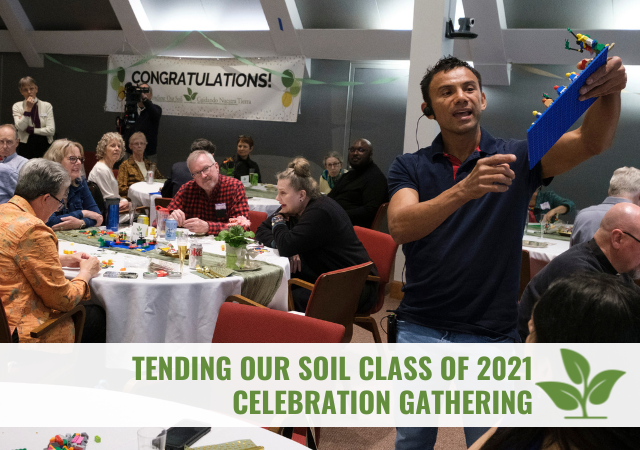
We celebrated the Class of 2021 on May 11 at Washington National Cathedral with a delicious lunch, followed by Lego Serious Play with the Rev. Dr. Gayle Fisher-Stewart, speeches by the Rev. Jenifer Gamber (former TOS Project Director), Bishop Mariann, and our coaches. The Rev. Canon Anne-Marie Jeffrey presented survey results showing just how transformational the TOS program has been for our congregations. We concluded the day with the presentation of certificates for each of our congregations.
Congratulations to the Class of 2021!
The Tending Our Soil revitalization initiative continues with the Classes of 2022 and 2023 proceeding on their own three-year paths. We invite your prayers for their work in the coming year.
by EDOW | Aug 3, 2023
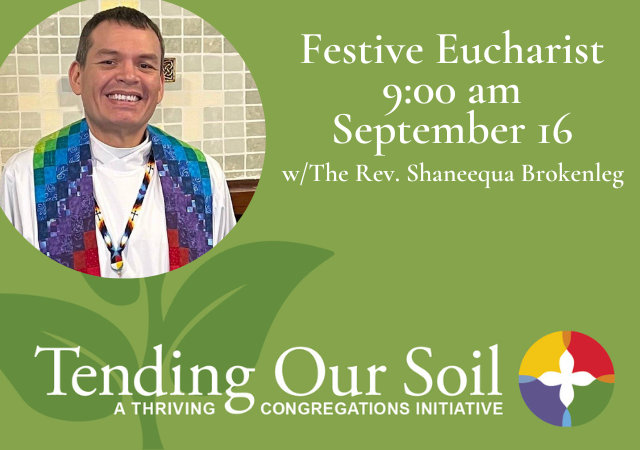
The final class of the Tending Our Soil Thriving Congregations Initiative will kick off in the sanctuary at St. Luke’s, DC at 9:00 a.m. on Saturday, September 16 with a festive Eucharist with Bishop Budde presiding and the Rev. Shaneequa Brokenleg preaching. Our liturgy for the day will include prayers and songs written by Rev. Brokenleg.
The Rev. Shaneequa Brokenleg joined the presiding bishop’s staff in January 2020 as the staff officer for racial reconciliation in the Office of Reconciliation, Justice, and Creation Care. In this role she partners with parishes and dioceses across the country to train and teach the Becoming Beloved Community curriculum.
An epidemiologist in her previous career, Rev. Brokenleg’s call to priesthood offered an opportunity to unite her professional and spiritual life. She is a member of the Lakota tribe and is a Winkte, a sacred healer. Her current work on racial reconciliation draws on her skills and approaches she used on reservations and in native communities, partnering to bring tools and resources, while listening deeply to the needs of the community.
We are thrilled to welcome Rev. Brokenleg to the diocese as she preaches a message sure to inspire us all. Please join us!
Read more about the TOS Class of 2023 here.
by Allen Fitzpatrick | Jun 22, 2023
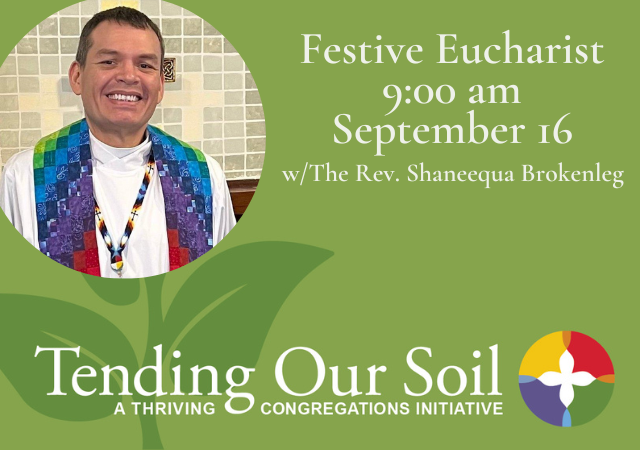
The Tending Our Soil Class of 2023 kicks off with a festive Eucharist at 9:00 a.m. on Saturday, September 16 at St. Luke’s, DC, with the Rev. Shaneequa Brokenleg, Staff Officer for Racial Reconciliation at The Episcopal Church, preaching, and Bishop Mariann presiding. All are welcome to attend!
Learn more about the Rev. Shaneequa Brokenleg
Learn more about the Tending Our Soil Class of 2023
by EDOW | Jun 22, 2023
We are excited to announce the participating congregations for the third and final class of Tending Our Soil: All Souls (DC), Christ Church (Chaptico, MD), Grace (Georgetown), St. Luke’s (DC), and St. Philip’s (Laurel, MD). The Class of 2023 joins the other two classes to make for a total of 27 congregations in journeying through a process that seeks to cultivate the changed soil of our congregations so that God’s love might grow in our time and place.
The Class of 2023 kicks off with a festive Eucharist at 9:00 a.m. on Saturday, September 16 at St. Luke’s, DC, with the Rev. Shaneequa Brokenleg, Staff Officer for Racial Reconciliation at The Episcopal Church, preaching, and Bishop Mariann presiding. All are welcome to attend!
We invite you to read the brief biographies of the congregations below to get to know the Tending Our Soil Class of 2023:
All Souls, DC
Rector: Currently in transition
All Souls was founded in 1911, as a mission church of St. Alban’s; our building, originally built in 1914, has grown through the years, including by the addition of an administration wing in 1951 and an accessible addition with an elevator in 2015. Our liturgical style can be summed up in our tagline, “Traditional Worship, Progressive Thinking.” Our congregants appreciate solemn, profound worship experiences. We used a form of Rite I for many years but have more recently worshiped using Rite II. We also offer individual healing prayers led by lay ministers each month and a convivial coffee hour each Sunday.
All Souls uses a volunteer choir with paid section leaders. We supplement Anglican hymns with American church music; we also lift up spirituals and gospel music in particular both as a sign of our commitment to diversity, equity, and inclusion and because we love the art forms. Outreach is an important component of life at All Souls, and our endowment fund enables us to develop ministries beyond what is possible through our annual operating funds. We make outreach grants to projects and organizations that demonstrate alignment with some aspect of our mission, and that offer opportunities for our parishioners to participate in their work.
Significant recent outreach projects have included support for a parish in Cuba, as well as participation in a multi-parish group helping to settle refugee families from Afghanistan. Parishioners volunteer at a number of local organizations, like Christ House and Samaritan Ministry. We also host outside groups, including a Scouts BSA troop for girls, Axios, and Front Runners. We are now in the midst of replacing the roof of our main church building as well as its HVAC system; in addition, after an interim period, our Vestry has begun the search for a new Rector.
Christ Church, Chaptico
Rector: The Reverend Peter Ackerman
Christ Church (Chaptico) was established in the 1700s, by people who have been a part of this area since the 1600s. Francis Scott Key’s grandfather was the lead architect in the building of the worship space, and some of the Key family is buried in a columbarium in the historic cemetery that surrounds the church. During the War of 1812, when ships were able to dock right outside of the parish, the British took over the church and made it into a stable. The congregation rebuilt after that, into what stands today. The building has been labeled a historic one, and history buffs travel to visit the space and grounds. In addition to the historic church building, up the street from the church is the office and parish hall, and a rectory.
The congregation is fluid and faithful. With post-Covid and a new rector, we are still finding our new normal in identity. Many parishioners are people with homes in the area, often retirees, and many who still live on family property that has been here since the church was established. Though pastoral in size, the parish retains the positive aspects found in a family identity. Because the parish is in a rural area, their history has had the congregation living out its identity as a neighborhood parish and worship space.
At this time of our history, we look to be a vital member of our community, known as “the church that does…?” Facing the same diminishing numbers and finances that most parishes encounter, our hope is that Christ Church will continue to be a place where gathered worshippers place God above the machinations of the world.
Grace Church, Georgetown
Rector: The Rev. David Wacaster
Grace Church is the only religious institution in lower Georgetown. As such, outreach to the community, particularly lower Georgetown, is a vital ministry of Grace Church. Grace Church houses and supports the Georgetown Ministry Center (GMC), an outreach program to the unhoused and disenfranchised of the community. The GMC drop-in center provides private counseling space as well as a shower and a washer and dryer for use by GMC guests and clients. Grace Church also provides a spiritual refuge for everyone living and working in the Georgetown area regardless of their religious affiliation. Visitors to Grace find a warm welcome, wonderful music, a heartfelt faith, and a beautiful greenspace open to the public.
St. Luke’s, DC
Rector: The Rev. Kim Turner Baker
The year 2023 marks the 150th anniversary of St. Luke’s Episcopal Church. For many years after St. Luke’s was founded, it was one of the leading historically Black churches in Washington, DC in civil rights, Black liberation, education and economic equity, and social justice reform.
St. Luke’s, the first separate Black Episcopal Church in the District of Columbia, was organized in 1873 by the Reverend Dr. Alexander Crummell. After the Civil War, an increased interest in The Episcopal Church became apparent among the people of color in the District of Columbia. From 1873 to 1879, the original congregation of St. Luke’s was part of St. Mary’s colored mission. St. Mary’s Chapel was started by St. John’s Church in 1867 and remained under its supervision and support until May 1927, when it became a separate Parish.
Less than a year after beginning work in Washington, Dr. Crummell reported having more than 50 communicants and three Sunday services. These worshipers immediately supported his idea to build a significant independent church. By August 1875, the members, Rector, and friends in the Diocese had raised funds to purchase three lots on 15th Street N.W. Mr. Calvin T.S. Brent, the first Black architect of the District of Columbia, was engaged to draw the plans for the church.
The Bishop of Maryland laid the cornerstone on November 9, 1876. On Thanksgiving Day, November 1879 the members of St. Luke’s celebrated the first service in their new church. In this year of celebration and introspection, we, the present members of St. Luke’s, recommit ourselves to being more like our forefathers and mothers and living into our legacy to shake things up and get into some “Good Trouble;” and to develop allies, deepen networks, and work to end injustice however and wherever it manifests.
St. Philip’s, Laurel
Priest-in-Charge: The Rev. Robert Bunker
St. Philip’s Parish was founded in 1848. The 175 year-celebration will occur in fall, 2023, under the leadership of the Rev. Robert Bunker. The historic parish has struggled and flourished in its life cycle. Under the leadership of the late +Jane Holmes Dixon (1986-1992), and in a context of a growing Laurel population, the parish grew; key ministries began: Laurel Advocacy & Referral services, a Community Thanksgiving Dinner, and Camp St. Philips (a week-long summer day camp for children and youth)—all with an outreach view in the community. With some changes, all these outreach ministries continue today. In the past three years, a new seasonal food outreach ministry for local families began under lay leaders, garnered huge parish support, and grew into a monthly Food Pantry, run out of the “Little Chapel” (a small building on the back of the property) that had previously been long unused by the parish.
In the past thirty-seven years, St. Philip’s grew from a primarily white congregation to a diverse one. Although there have been historical times of conflict, congregants have lived together mostly in peace, with the help of strong clergy/lay leadership, a solid context of worship practice, and intentional prayer within liturgical settings.
The struggles now are with larger context—how to build a new way of doing Church post-Covid, and in a context of highly secular culture. St. Philip’s desire is to hold its long, historic tradition with respect, while building a new vision for future generations.