
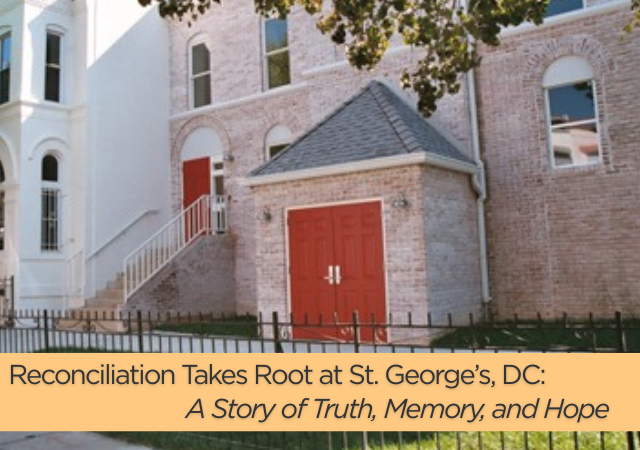
Reconciliation Takes Root at St. George’s, DC: A Story of Truth, Memory, and Hope
Repair and reconciliation do not begin with institutions—they begin with people willing to remember, to tell the truth, and to trust that God can bring new life from what was broken. At St. George’s, DC, that faithful work of remembrance has been unfolding for years, connecting the parish’s past to its future and opening new possibilities for healing within the Episcopal Diocese of Washington.
St. George’s, DC Tells Its Story
A historically Black Episcopal congregation, St. George’s, DC has made a sustained commitment to preserving and honoring its history. Through an extensive oral history project—now archived at the DC Public Library—and a new documentary film, parish leaders and members have reclaimed stories too often overlooked. These stories bear witness to endurance, faith, and God’s abiding presence across generations, even amid displacement and injustice.
More than a historical record, the documentary is an act of proclamation—naming what happened, honoring those who came before, and reminding the Church of its call to justice, peace, and love.
A History That Must Be Named
One chapter of that history includes the destruction of a thriving Black parish at Fort Reno in Tenleytown. In 1930, the property was taken by eminent domain to build a school for white students. At the time, the parish that would become St. George’s was a mission congregation of St. Alban’s. Later, St. Columba’s received title to the property from St. Alban’s when St. Columba’s became a separate parish from St. Alban’s.
Although St. Columba’s promised to share the condemnation award, nearly all the funds were retained, denying the newly reestablished congregation critical financial support.
This harm reflects the racial inequities that shaped both church and civic life in Washington, DC. Naming this truth is not about assigning blame to the present, but about refusing to let silence have the final word.
Choosing Repair, Together
In recent years, St. Columba’s undertook its own historical reckoning, examining how the parish benefited from this injustice. That work led to the creation of the Beloved Community Fund and, in 2025, a four-year, $165,000 financial commitment to St. George’s as an act of repair and reconciliation.
For these parishes, this commitment represents both acknowledgment of harm and the beginning of a new relationship grounded in honesty and respect. Additionally, both churches see this as a new opportunity to invite a relationship of deeper shared partnership and ministry.
A Sign of Hope for the Diocese
This parish-level partnership reflects the kind of faithful, local response that gives shape to the diocese’s broader reparations work. The story of St. George’s reminds us that reconciliation is not abstract. This work is relational—rooted in truth-telling, sustained by courage, and guided by the Holy Spirit.
An Invitation to Witness – POSTPONED DUE TO INCLEMENT WEATHER
The premiere screening has been postponed due to the anticipation of inclement weather. We will update this post with a new date/time once they have been determined.
You are warmly invited to the premiere screening of St. George’s documentary film, The Little Church on the Corner, on Sunday, January 25, at 2:30 p.m. in Perry Auditorium (7th floor) at Washington National Cathedral. Bishop Mariann Edgar Budde, diocesan leaders, and partners in Black ministries and racial justice will join the parish for this important moment of remembrance and hope.
Come to witness a story rooted in faith—and to see how God continues to make all things new.
