by Steve Seely | Jun 20, 2024
In this continuing series on Belovedness, we highlight the ministry of deacons in the diocese. This time, we hear about welcoming the stranger.
Three years ago, during the withdrawal from Afghanistan and the arrival of refugees into the United States, answering a call to humanity, our diocese formed the EDOW Refugee Response Team. The team and many other people in our diocese and communities, both lay and ordained, responded to the call for humanitarian help. This ministry laid important groundwork and became a foundation for our being able to help more recently those arriving by the busloads sent by our southern states.
Deacon Nancy Stockbridge chairs the Refugee Response Team but she does not do the work alone. Parishioners and deacons from parishes across our diocese have come together time and time again to help. If you turn to page 304 in the Book of Common Prayer, in our Baptismal Covenant, you find the phrases where we promise to proclaim the Good News of Christ by word and example, seek and serve Christ in all persons, and strive for justice and peace respecting the dignity of every human being. We promise to do this with God’s help. The Refugee Response Team, with God’s help and the help of many in our churches, is answering the call to these promises. Read Nancy’s article, Assist Accompany, Advocate — A Ministry of Welcome to learn more.
This fall, we will form a new cohort for anyone discerning or following God’s call to ordained diaconal ministry. The date of the Deacon Discernment Workshop is Saturday, October 5, 2024.
Do you feel God calling? Is the Spirit tugging at your heart? If so, it may be that you are being called to this ministry.
If you would like to talk about this or want more details, contact Archdeacon Steve Seely.
Read more detailed information about the Diaconal Ordination Process.
by Rudy Logan | Jun 5, 2024
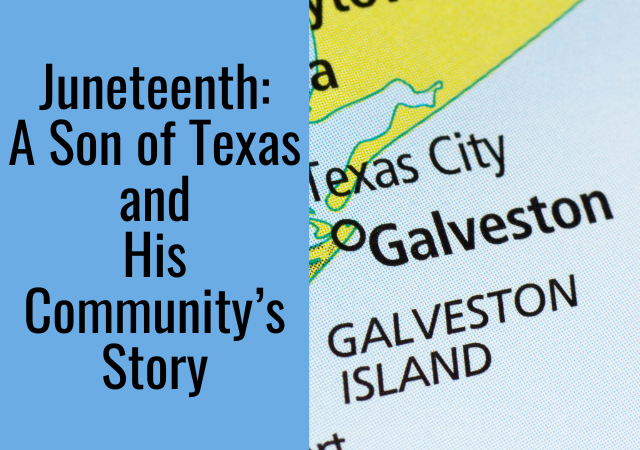
Keith Allen is a member of Grace Episcopal Church Silver Spring. His family is from Barrett Station, Texas where he grew up celebrating Juneteenth with his family. He is an actuary, who also uses various platforms to advance diversity, equity and inclusion initiatives. Rudy Logan, Missioner of Equity and Justice, recently sat down with Keith for an interview. Keith and his ancestors’ stories shine a light on Juneteenth’s impact from 1865 to the present-illustrating the inextricable links between community, freedom and the risk of faith. Recountings of family separation, sharecropping and Black Texans creating new communities in the wake of emancipation have shaped Keith, his generation and forebears’ principles, journey and belief in a brighter future.
RL: Considering your family’s deep roots in the state of Texas, are there any known ancestors of yours who can share or who passed down oral histories around the origin of Juneteenth?
KA: Juneteenth was a really big deal for my family. And myself, obviously, for a variety of reasons. Actually, Juneteenth was probably bigger than July 4th for us. So we had parades and celebrations and just a variety of things that you may have researched…the events, the clothing, the pageantry of it all and what have you. We experienced that in my family.
And one of the things, I guess, that, you know, was pushed upon me, or at least made important to myself, was being proud of the fact that we came out of a situation where, you know, a lot of people didn’t want us to thrive. Obviously, Juneteenth for Texans meant that we finally found out that we were freed as a people as black people, and it happened in Galveston two years after the Emancipation Proclamation. You know, my personal family background goes back to sharecropping days. My grandfather was a young boy, and his parents and grandparents were still in the sharecropping phase, just starting out. They went through a time when it was difficult, and they had to find their way through the time period, especially in Texas, which is a difficult place. You know, from the stories you’ve heard, and just in general, I could tell you a bunch of stories about things that I’ve experienced, things my parents experienced, things my grandfather experienced, but I’m sure they would be similar to stories you’ve heard in the past. Me, personally, a lot of that made me who I am today. It comes from my family background. It’s a strong family; it’s a large family, and there’s a lot of support. Today, I find myself in a career that doesn’t have very many black people and that definitely does not have many black men―actuarial science. I attribute that to the work ethic that was instilled in me when I was a young boy by my parents and my grandparents, which comes from the pride of our heritage.
KA: The reality for our family was we came from a really small rural town called Raywood, Texas. It’s right in between Houston, Texas and Beaumont, Texas, about halfway in between a lot of farming, a lot of hard work, you know, there’s cotton picking going on, and there were all those things that were still going on from a slave’s perspective in that small town. My mother’s father, James-the patriarch of our family, had ten brothers and sisters, and they worked on the farm. So from that, you know, between my aunt, my mom-in their generation, there’s about 47 first cousins. From my generation, we have well over 200 cousins, so when I say I have a large family, that’s what I mean.
RL: Juneteenth is a critical moment, considering how it finally delivered the promise of freedom albeit delayed to communities in Galveston Bay, Texas and the surrounding communities. It signals good news traveling, and that good news is freedom and the journey that all entails. So, what does freedom mean to you in the context of Juneteenth?
KA: I take it back to my family’s history; as I mentioned, we started in Raywood, Texas-a rural town with a lot of farming, and then we moved to what I would call an actual town called Barrett Station. Barrett Station was formed directly from a descendant of someone who heard the news of emancipation (Juneteenth). Harrison Barrett is the namesake of this town. And his family is the family that started this town, because a slave heard from the whole Galveston report, there’s an article in the paper where they reported that slaves were free. It’s an excerpt, I forget the general’s name, I’m sure you can find it. But as soon as the slave found out about it, he walked up, he left, and started a community.
My family moved from Raywood, Texas; my grandfather moved from Raywood, Texas, and started his family in Barrett Station, because at the time, you know, we were moving out of the rural aspect of our family, you know, with the cotton…he wanted something different for his family-wanted things to be better for his children, and moved to Barrett Station, where you had the one school for all the black students, my mom went to that school. You know, that’s a generation away, that’s my mom. She then went to a historically black college for a couple of years. Texas Southern University. Juneteenth had a direct impact on my family, because we know the opportunities that it led to for us. My grandfather ended up working at the Exxon chemical plant. My mom worked at that same plant as a construction worker. She wanted better for her kids. So that allowed us to go to college, complete college, and become successful in society’s eyes.
RL: Juneteenth celebrations within your community in particular sound empowering because of the ways that they invited everyone to participate in some kind of way, whether it was to make the floats, make food, and to build community and be amongst one another. How can Juneteenth be a great departure point for people to think about the broader history of race within the United States?
KA: It was stories, stories. So everybody had a story, right? Because, you know, put yourself back in that time, you’re talking mostly 70s, 80s. So you’re coming out of the civil rights movement. Before that, you know, you had the emancipation proclamation, you know, all of the things, basically, from the 1860s, to the Civil Rights era, everybody had a story about their family history, and what Juneteenth basically meant. And they continue the story, you know, you’d hear a story about someone’s family, who when Juneteenth happened, they went to Louisiana, and tried to find their relatives, because think about it again-going back to the mindset—you’re a slave, you get free, your brothers and sisters have been on other plantations, you don’t have those relationships. For years, a lot of the time had been about people trying to find their family. And so the stories you get, were stories like that, like, such and such went to Louisiana to go find their sister, and they spent several months trying to get their family together, and then they might move back to Texas- that kind of stuff. So those kinds of stories impact you as a kid.
RL: What is it that you feel Juneteenth teaches us? What kind of lessons does it leave us with in terms of, you know, grit, resilience, struggle in fighting-taking that freedom and making justice a reality?
KA: Well, for our culture, a lot. Again, going back to what I said, with the belief, you get to that point, where Juneteenth occurs, and you start believing that things can happen. It’s very powerful. This belief is always very powerful. Talking about life, sports, anything-belief gets you so much further than being subjugated. When you’re a slave, you are told what to do, you are told how to do it, and told when to do it. I believe that, that puts you further behind than people who had the freedom to imagine how to do things, you know, believing in what they can do believing in themselves.
So from that perspective, I think for our culture, for our race, it was significant-it allowed us to flourish, if you look at what we have accomplished since that time, in sports, in business and all the different aspects of what this country offers us from economic perspective-all the achievements we were able to make since then. It’s something that this country needs to really look at and do some reflection on because you look at some of the things going on today—with people coming across the border, how they’re being mistreated and just how a certain percentage of the population thinks and treats others. You really wish they could learn from the past. doesn’t seem to me that it happens enough. So I really wish that the majority of people could interpret Juneteenth as a holiday to represent what can be done when you let people believe.
KA: I really enjoyed this. If you have any other questions further on down the road, reach out.
RL: I appreciate that. Thank you, sir. I’m sure our audience will come away from this conversation with deeper insight about Juneteenth, and how the lived experience of June 19, 1865 via our enslaved forebears has been passed down through the generations-inspiring dedication, community togetherness and belief in one’s self, their community and a liberating kind of faith, which you and your family story demonstrate.

by EDOW | Jun 5, 2024
At first glance, this title might look like the beginning of a random word salad, but these words do make sense together. For starters, a Jubilee is an occurrence known and celebrated by many different cultures and religions (every 40 or 50 years depending on how you count a generation). However, it also has a uniquely African American connotation based on Leviticus 25:9-10.
“Then have the trumpet blown on the tenth day of the seventh month. Have the trumpet blown throughout your land on the Day of Reconciliation [Atonement]. You will make the fiftieth year holy, proclaiming freedom throughout the land to all its inhabitants. It will be a Jubilee year for you: each of you must return to your family property and to your extended family.” (Leviticus 25:9-10, CEB)
If any people understood the concept of freedom, it was the Israelites who’d left Egypt under the guidance of Moses, and with his siblings’ help. Understandably, in 1865 newly freed African Americans had a distinct appreciation for the stories in Exodus and Leviticus.
What did freedom mean to a people who had not been free for generations?
I imagine that there is a very specific kind of beauty in learning that one is no longer enslaved. The freedom to wake up when you want, dance and sing when you feel like it and not for a slave owner’s entertainment. To come and go as you please, marry whom you choose, raise your children, worship God in ways that are meaningful to you. Work at what your capabilities allow.
What do you do with freedom in this context? Where do you even start? Does a mother decide to learn to read, or does she go immediately in search of her children who were sold away to the deep south? Does she even have any money to make a trip like that possible? Does a husband set out to find his wife who had been given away to a family up North? Or does he set about working as hard as he can to build a life and stay put in the hopes that she returns to him? This uncertainty was a situation ripe for exploitation. And in post-Civil War America, that is what happened to most of the Freedmen—who ended up in sharecropper/tenant farmer situations.
It has been nearly 160 years since the end of the Civil War. And yet we still see the exploitative effects of those four centuries of enslavement in almost every aspect of American public life. By most metrics, African Americans overall have less generational wealth, less education, less access to good healthcare, live in environments more negatively affected by climate change, pay higher mortgages (even when the rates are already sky high), have worse encounters with law enforcement, the list goes on.
So what does any of that have to do with reparations in the Episcopal Diocese of Washington? Is there a through line from the legacy of slavery (with its concomitant issues of anti-Black bias, white supremacy, exploitation, etc.) to EDOW’s own racial history, to EDOW’s Black parishes in DC and Maryland. Does the Episcopal Diocese of Washington bear any responsibility for the lasting legacy of slavery? Maybe a better question is: Did EDOW profit at any point—directly or indirectly—from either the Transatlantic slave trade or the American domestic slave trade? Were some parish founders and Vestry members slave owners? Did EDOW’s wealthy parishes intentionally build churches in areas with enforced racial covenants? Is evidence of financial disparity in EDOW’s Black and White churches also evidence of injustice? If EDOW itself is not technically responsible for the still-existing collateral damage of the past, is it accountable? And if accountable, how is any kind of restitution to be made? To whom? This is at the crux of reparations. It is an honest attempt to recognize, repent, and repair–to lead to reconciliation.
The work of our Committee on Diocesan Reparations has been conducting research and gathering information to help answer those very questions. The Rev. Peter Jarrett-Schell’s presentation at Convention in January outlined the differences in EDOW’s majority Black and predominantly White parishes. The Episcopal Diocese of Washington believes it does have a responsibility to repair the breach in ways that are meaningful as it relates to race and justice.
We hope that you’ve answered the call and used this past year to really delve into your parish history and see where those intersections of race and justice occur, for better or worse. As we’ve said before, this isn’t about shaming or humiliating anyone or trying to make anyone feel bad. For too long, we’ve swept too much of the true history of our parishes (and by extension our diocese) under the rug because it didn’t fit the neat and happy narrative we wanted to portray. It is time out for that.
Let’s not be afraid to be honest about our history. It doesn’t make you, your parish, or past parish elders bad people. I think God would be less pleased if we try to hide / sanitize / whitewash things when we are in this current era of complete truth-telling. Let’s use this as a true opportunity to form real relationships with each other. To acknowledge where we may have fallen short and pledge to do better. No one expects it to be easy, but what we do hope is that you can draw the through line for yourself and recognize that while none of us may be personally responsible, we are all accountable. And for EDOW, accountability means reparations.
This brings us to Juneteenth, this newest American Federal holiday. What is it about exactly? For a little historical context, the origins of Juneteenth date back to June 19, 1865, when the U.S. Army spread the message to 250,000 enslaved people in Texas (the state that had become the last bastion for slavery during the final days of the Civil War), that they were free. Slaves in the other parts of the Confederacy had been freed by the Emancipation Proclamation.1 Very soon afterwards, African American communities organized local festivities to celebrate and remember the significance of that day. The celebrations continued year after year and spread across the country. That celebration brings us back full circle to the word “Jubilee”. And of course, that conjures up family (a la Leviticus). I like to think those early Juneteenth celebrations were all about family and reconnecting with loved ones.
In 1980, Texas became the first to make Juneteenth a state holiday. Shortly after, other states followed suit, along with organizations and businesses across the nation hosting events and educational opportunities dedicated to commemorating the significance of this day.
In 2021, President Biden proclaimed Juneteenth a Federal holiday.2
So how is a holiday that is very specific to one group celebrated by everyone, regardless of ethnicity? That’s actually pretty easy.
Everyone can celebrate Juneteenth by:
- Updating the family tree.
- Taking photos and/or videos of elderly relatives.
- Recording the stories of the elders.
- Compiling those stories into a family movie.
- Digging through attics and basements of the older members of your family.
- Uploading your finds (things like wills, bills of sale, inventories, diary entries, etc.) to free sites like WikiTree, Ten Million Names Project, etc. Those documents may be “embarrassing” to you, but to Black genealogists looking to make family connections, they could be an absolute goldmine. Genealogy is social justice on a very personal level.
Next year, 2025, will be the 160th anniversary of the end of the Civil War. It is essentially a Year of Jubilee and EDOW has elected to celebrate with a meaningful reparations initiative.
Gigi Nelson is the chair of the Education Working Group of the Diocesan Committee on Reparations and attends the Episcopal Church of the Atonement in DC. She is also the author of For The Culture: A Genealogy Handbook For The Cool Kids.
1Slavery ended in Washington DC on 16 April 1862, when President Lincoln signed an act abolishing it. He issued the Emancipation Proclamation on 1 January 1863. It did not end slavery in border states loyal to the Union. (Note: By 1804, all the Northern states abolished slavery, but emancipation itself was not always immediate.)
2This was the first new Federal holiday since Martin Luther King Jr. Day in 1983.
by Keely Thrall | May 31, 2024
The Racial Justice and Equity Committee of St. John’s Norwood invites you to a screening and discussion of the documentary Bloodlines of the Slave Trade. It will take place in St. John’s Parish Hall on Sunday, June 9, starting at 11:30 a.m., and will be accompanied by a light lunch.
The film examines the lives of two people whose only connection is a genetic link to John Armfield, one of the most notorious slave traders of the 1830s. Rodney Williams, who is Black, and Susanna Grannis, who is white, each trace their roots back to their distant ancestor, detailing the diverging paths their lineages took. While their relationship to this past is fundamentally different, and they never meet in the film, they both share in the telling of the domestic slave trade and the ongoing reverberations of slavery. The trailer for the documentary is available here.
The Rev. Gayle Fisher-Stewart, PhD, a priest in the diocese, will lead a discussion following the screening and answer questions about the project.
If you cannot attend in person, please join us via Zoom.

by Bishop Mariann | May 15, 2024
Dear Friends of the Diocese of Washington,
I write to share news of a transition on the diocesan staff.
Rudy Logan, Missioner for Equity and Justice, will be leaving the Diocese of Washington at the end of June. Rudy’s partner has accepted a tenure-track professor position at the University of Texas, and they will be moving to Austin this summer.
Rudy has served the diocese for nearly two years as primary staff support for several key diocesan initiatives and leadership teams, including the Committee on Diocesan Reparations, the Creation Care Committee, and the Refugee Response Team. He has also been instrumental in our advocacy efforts for gun violence prevention and alternatives to incarceration and support for returning citizens. His quiet demeanor, deep faith and probing intellect has guided us well in our efforts to fulfill our baptismal promise “to strive for justice and peace among all people, and to respect the dignity of every human being.”
We are working on a transition plan that includes advertising for an interim Missioner for Equity and Justice in the coming weeks. Our hope is to identify someone within the diocese and already engaged in this vital ministry who would consider accepting the call to serve in this capacity.
We give thanks for our time with Rudy, his commitment to working collaboratively for greater impact, and his faithfulness to Jesus’ call to strive for justice.
Faithfully,
Bishop Mariann

