by Bishop Mariann | May 15, 2024
Estimados Amigos de la Diócesis de Washington,
Les escribo para comunicarles la noticia de una transición en el personal diocesano.
Rudy Logan, Misionero para la Equidad y la Justicia, dejará la Diócesis de Washington a finales de junio. La pareja de Rudy ha aceptado un puesto de profesora titular en la Universidad de Texas, y se trasladarán a Austin este verano.
Rudy ha servido a la diócesis durante casi dos años, como principal apoyo de personal para varias iniciativas diocesanas clave y equipos de liderazgo, incluyendo el Comité de Reparaciones Diocesanas, el Comité de Cuidado de la Creación y el Equipo de Respuesta a los Refugiados. También ha desempeñado un papel decisivo en nuestros esfuerzos de defensa de la prevención de la violencia armada, las alternativas al encarcelamiento y el apoyo a los ciudadanos retornados. Su conducta tranquila, su fe profunda y su intelecto indagador nos han guiado bien en nuestros esfuerzos por cumplir nuestra promesa bautismal de “luchar por la justicia y la paz entre todos los pueblos, y respetar la dignidad de todo ser humano.”
Estamos trabajando en un plan de transición que incluye la contratación de un Misionero interino para la Equidad y la Justicia en las próximas semanas. Nuestra esperanza es identificar a alguien dentro de la diócesis y ya comprometido en este ministerio vital que considere aceptar el llamado a servir como misionero interino.
Damos gracias por el tiempo que hemos pasado con Rudy, por su compromiso de trabajar en colaboración para lograr un mayor impacto, y por su fidelidad a la llamada de Jesús a luchar por la justicia.
Fielmente,
Obispa Mariann
by Keely Thrall | Apr 24, 2024
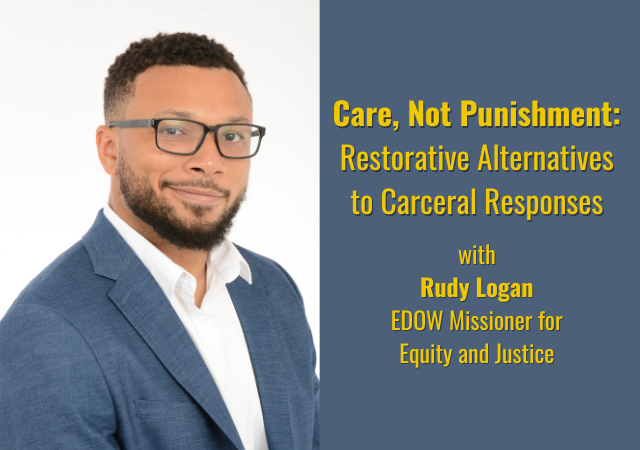
Join the Episcopal Church of the Ascension Gaithersburg Equity & Justice Committee for a presentation by Rudy Logan, the Episcopal Diocese of Washington’s Missioner for Equity & Justice. Rudy supports the diocese’s work on reparations, migrant justice, creation care, and gun violence prevention.
Rudy will discuss pressing criminal justice and public safety issues in Montgomery County, Maryland. He will locate his personal experience within the historical context of policing, incarceration, and social transformation. He will explain the ways that arrests and incarceration have been established as the default response to social issues. Drawing on theological and spiritual resources, he will call us to action as followers of Jesus to bring about robust restorative change. He will also describe the mission and direction of the diocese’s equity and justice work. Rudy’s driving motivation is to create a world where we maximize everyone’s opportunity to flourish and live abundantly well.
Hear him on Thursday, April 25, at 7:00 pm via Zoom.

by Rudy Logan | Mar 14, 2024
My father was a correctional officer and deputy sheriff in Maryland for several years before I was born. Growing up, he would say that prison is the closest thing to “hell on earth,” as he instructed me on navigating racist policing and legal systems I might encounter directly as a Black youth in America. This idea became ingrained in my consciousness. His way of describing prison communicated theological undertones I couldn’t dismiss or take lightly. I understood at a deep level that prison wasn’t an ideal place for me—or anyone else.
Through my experiences in prison ministry, the New York Court System as an intern, returning citizens outreach, my studies and advocacy, I have learned that my father wasn’t far off in his assessment of prison. Sadly, for many “hell” doesn’t start in prison, but in neighborhoods subject to decades of disinvestment and neglect.
Public safety cannot be divorced from accountability measures when harm is committed. Yet our current way of responding to harm and holding people accountable has far too long revealed racist tendencies. Surely, it is time to imagine new infrastructures that center care, equity and revitalization of structurally abandoned communities.
As a person of Christian faith, I ponder what Jesus Christ might say to the death-dealing conditions of prisons and structural violence haunting us today. In the Apostle’s Creed, it is mentioned that Jesus descended into hell between the period of his death and resurrection. While there are exhaustive debates regarding this descent (that I won’t delve into), it illustrates a moment where Jesus goes to those in bondage, relegated to “hell”, and frees them from damnation—offering them salvation from death in the process. I’d like to think that Jesus’ descent offers us a guide for how to engage with the violence of the incarceration system and inadequacies in public safety that send our dispossessed neighbors to “hell.”
If you are willing to follow Christ into hell to save others from damnation and premature death, you don’t have to look far. One issue among many regarding incarceration in Washington, D.C. and Maryland is solitary confinement.
The origins of solitary confinement in the U.S. have theological roots. In 1829, Quakers and Anglicans conceived of Eastern State Penitentiary (Pennsylvania) as a place where “solitude” would offer prisoners the space to commune with God, find forgiveness and penance, hence the term “penitentiary.” The penitentiary was intended as a humane alternative response to the existing brutal incarceration systems, but wound up merely serving as punishment by another name, dishing out cold isolation and deprivation. In the late 1800’s1, the U.S. Supreme Court assessed increasing clinical evidence showing that solitary confinement had severe psychological ramifications on incarcerated persons. Unfortunately, this “hell” of another name still exists across the country and in our local context.
Today, D.C. Jail officials express that they no longer place people in solitary confinement; however, this isn’t the case. According to a Bureau of Justice statistics report, D.C. places people in solitary confinement at three times the national average. According to the Maryland Department for Public Safety and Correctional Services, Maryland state prisons incarcerated 15,807 people and placed 11,953 people in solitary or other restrictive confinement. Given the psychological, physical and spiritual toll of solitary confinement on a person and its long-term adverse effects, Maryland has a health emergency on its hands. The Maryland Alliance for Justice Reform and Maryland Episcopal Public Policy Network have been working hard to address the cruelty of solitary confinement and its effects that are fundamentally counter to rehabilitation
As followers of Jesus, we can save people from the “hell” of prisons, and in this case–solitary confinement. We can do this in D.C. by supporting the Erase Solitary Confinement Act of 2023 (ERASE). In Unlock the Box’s campaign to end solitary confinement you will find a template and instructions for how to communicate your support of this bill to your D.C. Council member.
In Maryland, contact your state representative in the Maryland General Assembly and voice your support for ending solitary confinement. Here is a sample script you can use.
1History and Health Consequences of Solitary Confinement (Public Health Post) and Timeline: Solitary Confinement in U.S. Prisons (NPR)
by Keely Thrall | Feb 13, 2024
In the wealthiest nation in the world, nearly half of the population is poor or low-wealth. There are approximately 140 million people in the U.S. who are living in poverty or are just one emergency away from it.
But it doesn’t have to be this way.
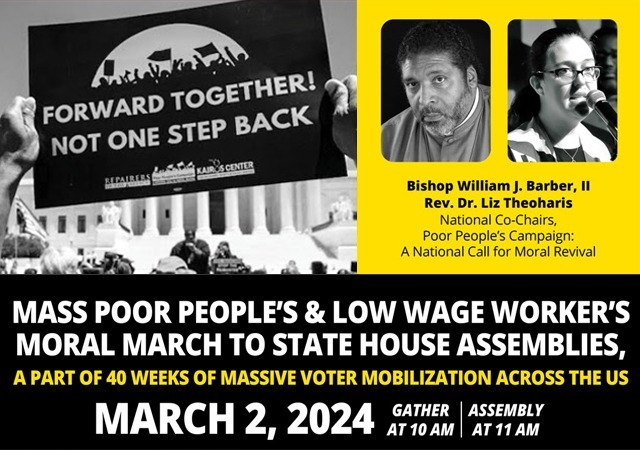
On Saturday, March 2, in DC and Annapolis and at state capitals all across the nation, supporters of the Poor People’s Campaign will be marching to lift up the issues of poor and low wealth people. It is part of a 40-week campaign to mobilize the United States’ approximately 85 million eligible poor and low-wealth voters–along with their allies–for the 2024 election.
Be an ally!
For more information on this important event, visit https://www.poorpeoplescampaign.org/march2/