by EDOW | Nov 7, 2024
As a professional archivist, I have always taken special interest in those persons who tend to fall through the cracks of history—those who exist in the shadows of or have been discounted from the historical record. Yet even for an “archives rat” like me with a passion for pouring over old records, accepting the commission from Diocesan Council of researching the early parishes of our diocese and their involvement with slavery during the colonial and antebellum eras of Maryland history, filled me with equal parts anticipation, excitement, and trepidation.
What would the records reveal about our diocesan history? More specifically, what would the records tell us about the eight root parishes* of the Episcopal Diocese of Washington (EDOW) and their involvement (if any) with chattel slavery.
With courage in hand and a deep breath, I dove into the work.
The result is BINDETH UP OUR WOUNDS: Enslavement in the Roots of the Episcopal Diocese of Washington in Colonial and Antebellum Maryland, 1692-1864. Focused primarily on the history and interaction of the eight “root” parishes of the Diocese of Washington with the free Black and enslaved population during this time, the report pulls from extant historical records of those first eight parishes (located in the counties of Charles, Prince George’s, and St. Mary’s and initially part of the Diocese of Maryland). These are not exhaustive parish histories. However—depending on rector and parish—they are a more complete record of the Black population, enslaved persons and free, than any extant records of a governmental or other entity that I have seen.
So, what did I discover? Here are a few examples:
In only three instances does it appear that a parish held, or was gifted, enslaved persons. What happens to them after their brief mention in vestry minutes is unknown. The record is silent.
Of the 48 original vestrymen elected in 1692 from the eight root parishes (6 vestrymen per parish), 20 held enslaved persons at the time of their deaths, a total of 307 enslaved persons, on average 15 enslaved persons per vestryman. Many priests also held enslaved persons.
The most controversial rector during the colonial era was the Rev. Mr. Richard Brown (?-1789) of King and Queen Parish, St. Mary’s County. Governor Horatio Sharpe writing to Hugh Hammersley, Lord Baltimore’s secretary, in June 1768 related, “ . . . Brown was lately accused of murdering one of his Enslaved & actually fled thereupon to Virginia where he remained several Months till his Son who could be the only positive Witness against him could be ship’t away thence to Scotland so that the Coroner’s Inquest tho’ Circumstances were very strong against him wanted Proof sufficient to charge him with Murder, as this added to his Behaviour on many other occasions made his Parishioners consider him as a very bad Man none of them will even yet attend Divine Service at his Church about which indeed he is said to be extremely indifferent.” Brown was never charged or convicted of the murder.1
Did the clergy and parishioners of these root parishes question the institution of enslavement during the Colonial and Antebellum eras?
While it is apparent from the surviving written record that the church cared for the souls of enslaved persons, offered them the rites of the church without exemption, the discussion of slavery, the condition of enslaving persons was not high on the list for Sunday sermons or a frequent topic at Convention. As William Daniel, Maryland lawyer, politician, and abolitionist noted in 1864, “It is true that the Episcopal church, as a church, has held rather aloof from the subject [slavery and freeing the enslaved persons] until within a few years past. But now she too has come up boldly and taken her stand side by side with her sister churches.” It was not until the passage of the Maryland Constitution of 1864 that enslavement was made illegal.2
One of the most evocative moments I encountered was while researching the records of All Faith’s, Mechanicsville.
Specifically in the records of the Rev. Mr. James W. Hoskins who sympathetically termed his Black parishioners as, “this usually neglected race.” In October 1856 he began a new parish register. He then goes on to note every parish communicant, both Black and White, free, and enslaved persons. His handwriting is exquisite, and even now the registers have the faint smell of woodsmoke, perhaps hinting at hours spent beside a warming fire updating the parochial records. As the smell of that smoke carried me back in time, I sent up a prayer of thanks for his efforts, and a prayer of hope that the work we as a diocese are about will dispel darkness and promote healing and repair.3
Bindeth Up Our Wounds can be downloaded here. I give thanks to the Diocesan Council for their support of the research and writing of this report and to all who helped in this yearslong endeavor. May Christ continue to walk with us on our path to remembering, reckoning with, and making amends for our diocesan history of participation in anti-Black racism.
Franklin A. Robinson, Jr.
Parishioner, St. Thomas’, Croom
*The “root parishes” are those parishes established in 1692 that transferred from the Diocese of Maryland to the Diocese of Washington when it was created in 1895.
1Archives of Maryland Volume 14, page 506-507, letter Sharpe to Hammersley, June 22, 1768.; AMD Volume 61, page ixx, xlvii, Maryland State Archives (MSA).
2Archives of Maryland (AMD), Volume 102, Volume 1 Debates, Proceedings of the Constitutional Convention 1864, pages 632-633.
3The extant records show that James W. Hoskins was not an enslaver. All Faiths Parish, register 1856-1870, MSA.; Convention Journal of 1859, page 71, Episcopal Diocese of Maryland (EDOM).
by EDOW | Oct 23, 2024
As the election season begins to wind down one might take a moment to reflect on the tenor that has been a consistent part of the campaign.
I can’t help but wonder: If this country collectively had done the hard, faithful work of remembering, repenting, and reconciling around the historical harms against indigenous and Black people in the America’s, would this year’s political landscape be so fraught? Maybe America would know how to respect and appreciate the generational challenges faced by indigenous and Black people that are a direct result of practices that resulted in the profiting from genocide and enslaved labor.
Parts of The Episcopal Church are uncovering the painful ways in which its leaders and congregations participated in, and profited from, anti-black and anti-indigenous policies and practices. Multiple dioceses are looking at ways to repent publicly, and make amends, including remuneration for unpaid labor, return of stolen land, and actions that express in word and deed reconciliation. This is the work that the church should be engaged in. Helping shape a narrative of repentance for harms that have contributed to generational trauma and wealth inequity.
Reparations is the act of remembering, repenting, and reconciling. These are words that are laden with theological significance. Scripture points us to the act of remembering—remember the covenant (Genesis 9:15), remember the sabbath (Exodus 20), remember the acts of God (psalm 77). We also must remember those times where we have fallen short of who God has called to be. In Israel there is a museum dedicated to the remembrance of Holocaust victims. At the exit of the museum, Yad Vashem, are the words of Baal Shem Tov (founder of Hasidism), “Forgetfulness leads to exile while remembrance is the secret of redemption.” And it is redemption that Christians are promised. In his letter to the church in Rome, Paul writes, “We know that all things work together for good for those who love God, who are called according to his purpose (Romans 8).” As Mordecai told his cousin Esther, “God will save the people, but maybe you were called to use your power, position, and voice to make change happen now.”
The Gospel mandate calls the faithful to follow a Jesus who pushed his followers to act outside of their comfort zones. Jesus reminded those who were on the journey with him that he was calling them to take up their cross. To proclaim, at times, things that would be hard to say and hear. Jesus reminded his followers to seek forgiveness for their sins and return to God. People of faith follow a Jesus who, throughout his ministry, called his disciples to embrace counter cultural practices. We are all to be faithful, responsive, counter cultural, justice seekers who help make the love of God known to all people. It is not possible to fully respect the worth and dignity of every human knowing that our church sits on land that was taken, or that our church was built by unpaid labor, or that the proceeds from the selling of land or church buildings went to secure the legacy of White congregations. It is with repentance and a change of heart that we will illuminate the path towards redemption.
Christians are called to model behaviors that recognize the face of God in all people. Making reparations is one way the church can model faith-based values that include the actions of remembrance, repentance, and reconciliation. Ultimately, Jesus calls his followers to love as he loved. To share the love of God and participate in the creation of Beloved Community.
Reparations is one more step in the process of loving all our neighbors as ourselves.
The Rev. Glenna Huber
Chair, Policy Working Group, Committee on Diocesan Reparations
Rector, Church of the Epiphany, DC
by EDOW | Oct 9, 2024
As the lead congressional staffer for over 20 years on H.R. 40, the Commission to Study and Develop Reparation Proposals for African Americans Act, I am not new to conversations about restorative justice and reparations. However, I must admit to approaching the Diocesan reparations dialogue with some trepidation. Over the years, I have seen how these conversations can go wrong, ending in disappointment for all those involved. I hope for more from my church, especially in light of the three anti-racism resolutions passed at the 2006 triennial church-wide General Convention.
Like other historical institutions in our nation, I believe that the Episcopal Diocese of Washington has the responsibility of reflecting on its relationship to the transatlantic slave trade and repairing the related and continuing harms associated with that peculiar institution. Formed in 1895 during the rise of Jim Crow segregation that infected both the state of Maryland and the District, the Diocese undoubtedly had to contend with the rising tide of racism and how it impacted those under its care. In addition, this Diocese has its own history of overt acts of racism that are worthy of shame and impact the present day. For those reasons, I welcome the Healing Histories conversation which is focused on unearthing that history to allow us to reflect and find ways to heal our community.
At the Healing Histories: A Reparations Dialogue event on September 28th, we experienced the sadness of people confronting painful history, the optimism of trying to make a change, and the anxiety that an institution dear to our hearts would let us down. In my experience, every person with the courage to take a hard look at the shame that slavery continues to create for our nation and its institutions has similar reactions. I hope that people of good faith will heed the words of the prophet Isaiah to become “repairers of the breach” and engage in the difficult conversations necessary to put this Diocese on the path to healing.
The conversations last week were uplifting, but they ultimately ended on a cautionary note. It is one thing to have a conversation, and even an apology, but something else entirely to take concrete steps to repair an injury. Reparations at any level will require a financial commitment by the Diocese. As we approach our Diocesan Convention, it is of vital importance that we understand the necessity of taking bold financial steps to invest in solutions to heal the historical and present-day harms of racism found within our church. Remember — a commitment was made in 2006 at the church-wide convention. Since that time, our predominantly and historically Black parishes have continued to suffer disproportionately, and some are at risk of extinction despite their best efforts. We are long past the days when prayers and kind words are enough — We Can’t Wait…
Keenan Keller
St. Patrick’s Parish
by Anna B. Olson | Sep 19, 2024
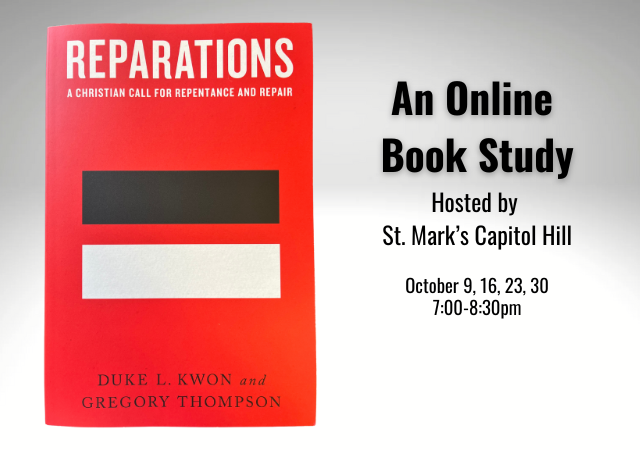
The group will study
Reparations: A Christian Call for Repentance and Repair, by Duke Kwon and Gregory Thompson. Participants should obtain their own copy of the book. This is a program of St. Mark’s, Capitol Hill, graciously opened up to members of the broader EDOW community. The group has limited space, but if there is sufficient interest beyond the cap, we will consider opening a second cohort in November.
Wednesday, Oct 9, 16, 23, and 30
7:00pm-8:30pm
Online: Register to receive the Zoom link.
Led by the Rev. Michele Morgan, Rector of St. Mark’s Capitol Hill
by EDOW | Sep 12, 2024
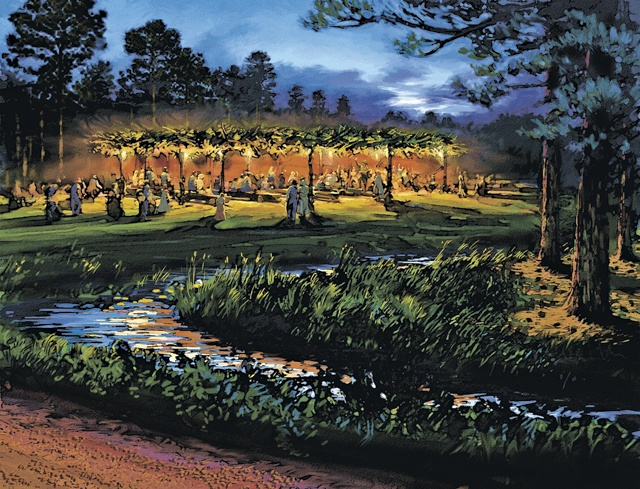
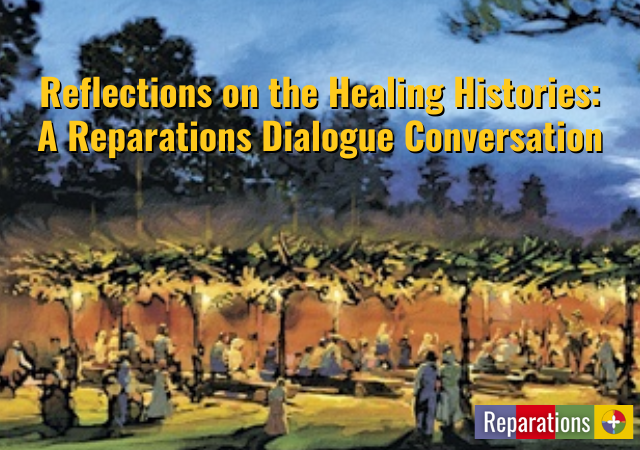
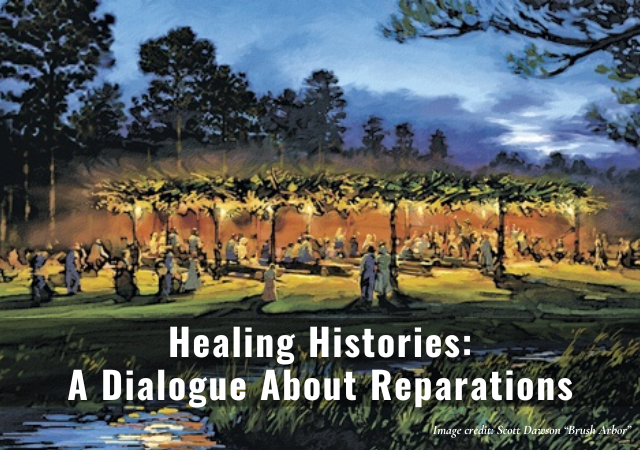
Brush Arbor by Scott Dawson
We’re coming up on the end of summer and our thoughts are turning back to work (maybe… maybe not). Either way, hopefully by now, you’ve seen the invitation to Healing Histories: A Reparations Dialogue in your parish bulletin, the reparations event that will take place on 28 September at St. Luke’s, DC Episcopal Church from 9:30 a.m. – 3:00 p.m. As we noted in “A Reparations Retrospective” last month, this gathering is intended so that Black parishioners in the Episcopal Diocese of Washington may have honest conversations with Bishop Mariann around chattel slavery and reparations.
EDOW’s Black parishioners are not a monolithic group. Experiences differ and many have extremely complicated feelings regarding reparations. Some Black Americans want to focus only on the future and leave the past squarely in the past. After all, the Civil War ended slavery in America in 1865, and no one can argue the progress that has been made since then. Others may tend to dwell in the past, precisely because it isn’t really past (to paraphrase William Faulkner’s famous quote). Still others honor the past while living in the present and focusing on what they perceive as issues that are much more important to Black people today. To add to that mix, our African, Afro-Latinx, and Afro-Caribbean members may not fully understand why reparations is even a thing at all.
And though the Committee on Diocesan Reparations has endeavored to communicate consistently and clearly at every step of this journey—from the initial work of the Reparations Task Force through to the Committee’s current work—we are sensitive to the fact there may still be those at our historically Black churches as well as other parishes with Black members who are not yet familiar with what the diocese is doing and how (or if) these efforts may affect them. Given the nature of the subject of reparations and the diversity of experiences and points of view, the Committee on Diocesan Reparations discerned it important to reach out to this group of parishioners specifically, to provide an opportunity for engagement in a setting that is a safe space for this kind of dialogue.
This event is not in the slightest a slight to anyone in the diocese who does not identify as Black. It is simply an opportunity to have a conversation with the very people for whom this may have an effect that may be different (by virtue of our cultural heritage) than the effect on the diocese as a whole. Because, given the context, we literally have skin in the game—even if just metaphorically via our ancestors.
At the gathering, in addition to time for conversations with Bishop Mariann, our presenters will dig into a little of the history of chattel slavery as it relates to the diocese (If you know me, then you already know that history is kind of my thing, but I promise not to get too carried away!.) update people on what the Diocesan Committee on Diocesan Reparations has accomplished, and hear from the policy chairs of the Policy Working Group, the Rev Glenna Huber and Ms. Erika Gilmore who will speak on the Diocesan Convention resolution proposal.
At the end of the day, EDOW is one family—somos familia! But as I said last month, sometimes it makes more sense to have a family meeting with separate members. Then you can come back together even stronger and more united. And isn’t that what we all want? A strong and truly united diocese? We can’t be afraid to speak truth to power. It’s how we grow as individuals and as an organization.
If you are a Black-identifying member of the Episcopal Diocese of Washington aged 15 or above, no matter your parish membership, you are very welcome to attend. It’s okay if you aren’t sure how to feel about any of this; but come on out. This will be a great opportunity for you to get some clarity. We’re not here to judge, just talk, listen—and learn. And besides, we’d love to meet you!
September 22 is the last day to register to join us at St. Luke’s Episcopal Church at 1514 15th St NW in DC for our get-together with the Diocesan Committee on Reparations and Bishop Mariann.
There is parking, but this is downtown DC, so we strongly encourage you to carpool, use public transportation, or a rideshare for greater convenience. If you do have questions, please don’t hesitate to reach out to reparations4edow@gmail.com.
And then, on January 24, 2025, the evening before Convention, we’ll gather the whole EDOW family together at Washington National Cathedral for a brush arbor “Service Towards Repentance”.
See you soon!
Gigi Nelson
Chair, Education Working Group
Committee on Diocesan Reparations

