by Bishop Mariann | Jan 9, 2025
Uno de los papeles más importantes que pueden desempeñar las iglesias en el labor de reparación es el cultivo de comunidades de vulnerabilidad… una forma de vivir con nosotros mismos, con Dios y con los demás, en la que nuestras heridas más profundas no queden ocultas, sino que se centren en la vida de fe.1
Te invito a hacer algo vulnerable y valiente, por amor.
El 24 de enero de 2025, en la Catedral Nacional de Washington, presidiré y predicaré en “Un Servicio Hacia el Arrepentimiento”, una liturgia para decir la verdad y arrepentirse por los daños causados en nuestra diócesis a las personas negras, desde la época de la esclavitud hasta el presente.
Como su obispa, invito a todo el clero a estar presente y, si lo desean, a vestirse de morado y procesionar en el servicio. También invito a todas las congregaciones a estar representadas, no sólo por los delegados a la Convención Diocesana, sino por todos los que deseen asistir. El servicio será transmitido en vivo para aquellos que no puedan estar físicamente presentes.
¿Por qué habríamos de expresar remordimiento, si nosotros mismos no somos personalmente culpables de los crímenes de la esclavitud, la crueldad de la segregación, las desigualdades, los prejuicios y los sesgos no examinados arraigados en nuestra cultura y nuestra iglesia?
Lo hacemos por amor.
Si bien no somos la primera generación que aborda los daños raciales de nuestra diócesis, colectivamente nos hemos permitido pasar por alto, olvidar y permanecer ignorantes de nuestra historia, una historia racial mixta y complicada con un impacto duradero. Tampoco nunca ha habido un reconocimiento público de la complicidad de nuestra iglesia en los supuestos de la supremacía blanca que justificaron la esclavitud, la segregación y otros daños del racismo.
Tal vez seas de los que no creen que esa expresión de remordimiento sea necesaria o útil. Aun así, te invito a venir, a escuchar lo que otros han soportado y a arriesgarte a sentirte incómodo, por amor.
Tal vez se encuentren entre los que han estado esperando tal reconocimiento, no sólo para ustedes, sino también para sus antepasados, que soportaron innumerables indignidades y, sin embargo, lucharon por el lugar que les correspondía en nuestra Iglesia. Tal vez hayan renunciado a esperar, legítimamente escépticos ante tal gesto después de tanto tiempo de silencio. Aun así, los invito a venir, a escuchar algunas de sus historias, su dolor reconocido, y a recibir una disculpa de su iglesia.
Podemos preguntarnos qué impacto tendrá un servicio de este tipo. ¿Se trata de una expresión simbólica de pesar o de un auténtico acto de arrepentimiento, que incluye el compromiso de abordar el impacto duradero de los daños del pasado?
La respuesta depende de nuestra disposición a mostrarnos unos a otros con un espíritu de vulnerabilidad y amor.
El servicio se está planeando con sumo cuidado como un momento de oración, canto, narración de historias, confesión y compromiso de dar pasos hacia la restitución. Daremos gracias por aquellos de nuestro pasado que, en su tiempo, acercaron nuestra iglesia y nuestro país a nuestros ideales espirituales y cívicos de igualdad bajo Dios, y nos comprometemos a hacer nuestra parte ahora.
La noche comienza con una comida compartida, a partir de las 5:30 p.m.; la liturgia sigue a las 7:00 p.m., y durará aproximadamente 90 minutos. Por favor inscríbase aquí e indique si desea cenar de antemano.
La reunión del 24 de enero es uno de los frutos del trabajo del Comité de Reparación Diocesana, un grupo creado hace dos años en nuestra Convención Diocesana. En la Convención de este año, que comienza al día siguiente, consideraremos tres resoluciones sobre reparaciones.
Tómese unos minutos para ver este breve vídeo, una introducción al trabajo del Comité. En la página de reparaciones de nuestro sitio web, también puede encontrar una amplia gama de recursos para afianzarnos en este momento.
La verdad es que me siento vulnerable mientras planificamos este Servicio Hacia el Arrepentimiento, y ciertamente al prepararme para predicar esa noche. Sin embargo, como el noveno obispo de esta diócesis, no hay lugar en el que preferiría estar. Espero que se unan a mí en ese espacio vulnerable, con las mentes y los corazones abiertos, orando para que la gracia de Dios nos guíe por el camino del verdadero arrepentimiento, la reparación y la sanación.
1Duke Kwon y Gregory Thompson, Reparaciones: A Christian Call for Repentance and Repair (BrazosPress, 2021), 189

by Bishop Mariann | Jan 9, 2025
One of the most important roles churches can play in the work of reparations is the cultivation of communities of vulnerability… a way of living with ourselves, with God, and with others, where our deepest wounds are not concealed by but centered in the life of faith.1
I invite you to do something vulnerable and brave, for the sake of love.
On January 24, 2025, at Washington National Cathedral, I will preside and preach at “A Service Toward Repentance,” a liturgy of truth-telling and repentance for harms done within our diocese to Black persons, from the enslavement era through the present.
As your bishop, I invite all clergy to be present and, if you wish, to vest (purple stoles) and process in the service. I also invite every congregation to be represented, not only by those who are delegates to Diocesan Convention, but as many who would like to attend. The service will be live-streamed for those who cannot be physically present.
Why would we express remorse, if we ourselves are not personally culpable for the crimes of slavery, the cruelty of segregation, the inequities, prejudices and unexamined biases embedded in our culture, and our church?
We do this for love’s sake.
While we are not the first generation to address racial harms of our diocese, collectively we have allowed ourselves to gloss over, forget, and remain ignorant of our history—a mixed, complicated racial history with lasting impact. Nor has there ever been a public acknowledgment of our church’s complicity in the assumptions of white supremacy that justified slavery, segregation, and other harms of racism.
Perhaps you are among those who don’t believe that such an expression of remorse is necessary or helpful. Still, I invite you to come, to hear what others have endured, and to risk discomfort, for the sake of love.
Perhaps you are among those who have been waiting for such an acknowledgment, not only for yourselves, but for your ancestors who endured countless indignities, yet fought for their rightful place in our church. Perhaps you’ve given up waiting, rightfully skeptical of such a gesture after silence for so long. Still, I invite you to come, to hear some of your stories told, your pain acknowledged, and to receive an apology from your church.
We may wonder what impact such a service will have. Is it a token expression of regret or a genuine act of repentance, including a commitment to address the lasting impact of past harms?
The answer depends on our readiness to show up for one another in a spirit of vulnerability and love.
The service is being planned with utmost care as a time of prayer, song, story-telling, confession, and a commitment to take steps toward restitution. We will give thanks for those of our past who, in their time, moved our church and country closer to our spiritual and civic ideals of equality under God, and pledge to do our part now.
The evening begins with a shared meal, starting at 5:30 p.m.; the liturgy follows at 7:00 p.m and will last approximately 90 minutes. Please register here and indicate if you would like to have dinner beforehand.
The gathering on January 24th is one of the fruits of the Committee on Diocesan Reparation’s work, a group called into being two years ago at our Diocesan Convention. At this year’s Convention, which begins the next day, we will consider three resolutions on reparations.
Please take a few minutes to watch this short video, an introduction to the work of the Committee. On the reparations page of our website, you can also find a wide range of resources to ground us in this moment.
In truth, I feel vulnerable as we plan this Service Toward Repentance, and certainly in preparing to preach that evening. Yet as the ninth bishop of this diocese, there is no place I would rather be. I hope that you will join me in that vulnerable space, with open minds and hearts, praying for God’s grace to guide us on the path of true repentance, reparation, and healing.
1Duke Kwon and Gregory Thompson, Reparations: A Christian Call for Repentance and Repair (BrazosPress, 2021), 189

by EDOW | Dec 5, 2024
“The early findings suggest that religious organizations are uniquely positioned to address the entrenched legacy of slavery and racism. Religious institutions have already acknowledged the moral requirements of repair, the theological validation of reparations, and possess the material wealth accrued from generations of social power.”
– Dr. Cane West, An Analysis of Current Reparations Programs in the United States
Since July, I have been on a deep dive around reparations within the Episcopal Diocese of Washington. My overarching takeaway is close to Dr. West’s: for me, reparations in its broadest sense is deeply aligned with being Christian within an institution that has committed demonstrable harm. As I walk alongside members of our diocese to learn about specific histories, I have come to understand reparations as an opportunity for EDOW to become more fully the body of Christ.
There is much more behind these couple of sentences than I can convey here. Suffice it to say that I am grateful for the journey. The resources shared here are for those of you who are on your own journeys with reparations — especially if you, like me, are starting from almost zero with regard to reparations in EDOW. Please read and share them. And, if you have questions, please email reparations@edow.org. We’d love to stay in the conversation together
Resources:
-
- Presentation to regional gatherings (video). Erika Gilmore and the Rev. Glenna Huber, co-chairs of the policy working group of the CDR, present the history of anti-Black racism, its connection to EDOW and EDOW’s congregations, specific examples of harms, and the recommendations for expressions of lament, a committee on reparations, and commitment of funds towards reparations within the diocese.
- Updated website. EDOW’s website (edow.org/reparations) now includes sections on the theology and definition of reparations, specific historical harms, links to a variety of educational resources, and summaries of the three resolutions submitted for convention.
- Reparations conversations with the School for Christian Faith and Leadership. The Rev. Anna Olson and Michelle Dibblee will be offering two workshops for delegates and others to explore the spiritual dimension of reparations and wrestle with skepticism and deep questions. Tuesday, January 7th, 4:00 – 5:30 p.m., or Thursday, January 9th, 7:00 – 8:30 p.m. (Same workshop both times.)
Mark your calendar and for the Service Toward Repentance at 7:00 p.m. on Friday, January 24th. Bishop Mariann will preach at this service and strongly encourages all members of convention to attend. The liturgy will include truth-telling, reckoning, and repentance for the harms done within the Episcopal Diocese of Washington, from the enslavement era through the present, to the Black community, so that we might move toward new relationships in Christ. Dinner will be provided from 5:30 p.m. – 6:15 p.m. for those registering in advance.
Michelle Dibblee
Interim Missioner for Equity and Justice
by Keely Thrall | Dec 5, 2024
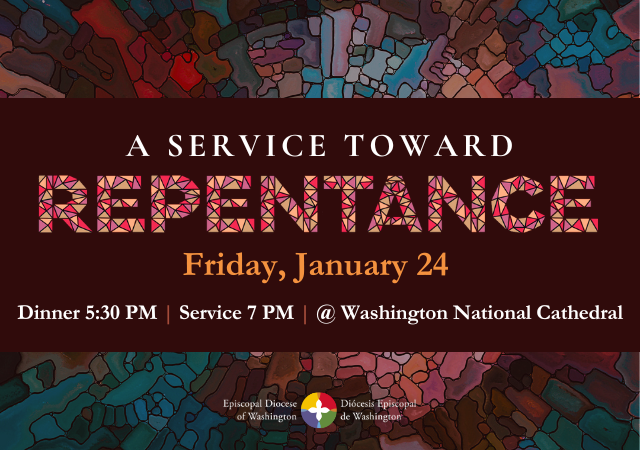
A Service Toward Repentance
Join us for a liturgy of truth-telling, reckoning, and repentance for the harms done within the Episcopal Diocese of Washington, from the enslavement era through the present, to the Black community, so that we might move toward new relationships in Christ.
Bishop Mariann Budde will preach.
The service is open to the public.
Bp. Mariann strongly encourages all clergy and lay delegates to attend this important part of the 2025 Diocesan Convention.
A simple dinner will be served from 5:30-6:15 (registration required).
The service may be live-streamed for those who are not able to be physically present here.
by EDOW | Nov 21, 2024
Several years ago I concluded that our nation must take on the very difficult work of coming to terms with slavery and the subsequent century of Jim Crow segregation. Growing up in North Carolina in the 1950s and 1960s, I experienced the results from this horrible legacy. My small hometown was completely segregated, including the schools that I attended. As a child I was able to see visibly the poor quality of the housing for the Black members of my community, and the low-paying jobs that Black people were forced to take, due to racial discrimination. While I was never explicitly taught in school, in church, or at home that segregation was wrong, I was taught a lesson of kindness and treating others as we would want them to treat us. This pattern of ethical thinking eventually translated for me when I was a college student into concluding that segregation and all racial discrimination was wrong and must end. This decision led to my working for the Student Nonviolent Coordinating Committee (SNCC) in the deep South during the civil rights movement. I absorbed the fervor of that era, and to this day singing the movement songs brings me to tears.
I grew up knowing that my ancestors had lived in the South beginning in the 18th century and that some of them served in the Civil War on the side of the Confederacy. More recently, I learned that I have Black cousins (through a fourth great-grandfather who fathered a child with the woman he enslaved). Around the same time, I became aware of the reparations process in Germany for those who suffered under the Nazi government. These types of awareness, repentance, and reparations seemed to me to be very necessary in the United States, so that our nation can experience healing from the devastating consequences of slavery and Jim Crow policies. Ultimately this may help us face the future as a more compassionate and less divided nation. While money is not always the solution to every problem, when harm can be traced, a transfer of financial assets from those who benefited (even if generations later) to those who suffered from those policies seems essential to me. On a small scale, I have contributed to the college fund for the daughter of my distant relative, as a form of personal reparations within my family.
Though it may come far in the future, ideally at some point we will create a national-level reparations policy. Until such time, we can demonstrate how such policies can be developed and implemented at a local level. If we can do this within the Episcopal Diocese of Washington, and disseminate our results widely, we can help to build momentum for similar work by other faith communities, other political jurisdictions, and—God willing—ultimately for reparations at the national level.
Embry Howell
Senior Warden, All Souls Episcopal Church
Member, Committee on Diocesan Reparations

