
by Keely Thrall | Sep 3, 2024
The Committee on Diocesan Reparations and Bishop Mariann Edgar Budde cordially invite all Black-identifying parishioners—from any parish in the diocese and especially those at our historically Black parishes—to a day of fellowship and discussion of reparations at St. Luke’s Episcopal Church in DC (which is doubling as our brush arbor*).
The Committee will present on the work we have conducted so far, including our research into what reparations might look like in our diocese and how reparations may affect you and your parish. We will also devote good time to hearing your thoughts in a safe, welcoming space. Breakfast and lunch will be served.
Register here
*A brush arbor (also called hush or bush arbor) was a secluded, sacred place, often built with tree branches in remote locations, where enslaved people could worship and meet in secret.
by EDOW | Aug 14, 2024
The beauty of August is that it tends to be the month when life seems to slow down almost to a standstill. A time when you have more moments to catch your breath and actually smell the roses and the jasmine. Many of us leave for vacations with the goal of taking a break from the usual hectic day-to-day, and refreshing ourselves with a new environment. Life these days is a lot more instant and immediate than it used to be, which isn’t necessarily a bad thing. But when summer comes, we are much more apt to allow ourselves the freedom of taking a little more time to just be instead of do.
What I love about August (aside from the fact that it’s my birth month) is that if we let it, it can be the perfect season not only to refresh, but also to contemplate and mentally adjust to the possibility (and reality) of change. As one writer put it, “When it’s a hundred degrees in the shade, it’s too hot to be anything but receptive and reflective.”
So this summer, I’m reflecting on the Episcopal Diocese of Washington’s commitment to reparations and what that means to the entire EDOW family. There are those who are firmly convinced that reparations is the right path, but differ intensely on how it should be both defined and applied. There are those who believe the exact opposite—that a reparations package is going too far and is completely unnecessary. Then there are those who are on the fence, or are unclear about where they stand, but believe that our Bishop Mariann Budde, as EDOW’s leader, is forging the path that God laid out for the diocese. And I believe God honors us as we pray for all of our leaders. There are many places in the Bible where we are directed to pray for them (and not just that they will come around to our way of thinking, but that they will actually be led by God).1
Reparations is an extremely difficult subject to wrap our collective heads around—no matter where we come from. Writing about it is harder still; because if you don’t know me or have never heard me talk about it, you may find it challenging to get a sense of who I am and how I approach this (with a lot of love and prayer). Reckoning honestly and objectively with the impacts of how our diocese benefitted from chattel slavery isn’t for the faint of heart, and the reparations committee is dedicated to engaging the entire diocese lovingly and respectfully throughout this process. To be clear, EDOW, as an entity, did not own slaves. However—as with most White organizations after the Civil War and during the era of Jim Crow—it did benefit from policies that allowed behaviors like anti-Black racism, and lifestyles like White supremacy to flourish. But if we approach reparations from the perspective that there will be winners and losers, then we’ve already lost. EDOW is one family, and this is not a zero-sum game. Restoration and reconciliation will always benefit the entire family, even if we don’t all agree on the methods—in this case, reparations.
As we examine our hearts during these quiet summer days, what comes to the surface? My prayer is that, as we listen to Spirit, we hear that still small voice. What are we being asked to do? What are we being asked to stop doing? Right now, we are in a season of change. God is doing new things throughout the world and throughout The Episcopal Church. Do you remember that old DC Talk song “God is Doing a New Thing”? Okay, I’m definitely showing my age. But I digress. My point is that God is calling all of us, as Episcopalians, but especially as Christians, to step up and represent. And that means dispelling old narratives, resolving old quarrels, putting aside old grudges, and maybe, even old ways of doing things. Jesus was a revolutionary. He shook up the status quo. Those early Christians didn’t become martyrs because they thought it was a flex. What is Spirit saying to us now? Will we listen… and (gulp) obey?
September is the season of harvest, and we’ll get back to doing (with a vengeance). But for now, while it’s still summertime and the livin’ is easy (allegedly), let’s make time to truly understand EDOW’s reparations mission. If you have questions, ask them. Invite us to your parish to talk. Come to our programs.
Speaking of programs, we have two coming up we’d like to bring to your attention. We’ve said many times that EDOW is one family. And sometimes, within a family, separate members need to have specific conversations so that the family unit comes back together stronger and more united than ever. Given the nature of the issue of the legacy of chattel slavery and collective trauma, we feel it behooves us to have a separate conversation with the Black members of this family. So while at first glance, that may appear counterintuitive, our hope is that you are able to see the bigger picture for the greater good. To that end, we’ve invited EDOW’s Black parishioners out for a day of history, education, and discussion on September 28th. The formal invitation has been shared with parish leaders and should appear in parish bulletins each week leading up to the event. (If your parish didn’t receive the invite, please contact us.) We’ll go into more depth about this event in our Diocesan Bulletin article next month.
The second event—Friday, January 24, 2025, on the evening before Diocesan Convention—is for the entire diocesan family. Planning is underway for this program which will take place at Washington National Cathedral. So stay tuned for more on that as well.
We sincerely hope to see you somewhere between now and Convention 2025.
Peace & Power,
Gigi Nelson
Education Chair for the Committee on Diocesan Reparations
11 Timothy 2:1-2: Urges believers to pray for all people in authority, including kings, for wisdom, and for peaceful and godly lives.
Titus 2:7-8: Asks that Jesus’ followers in leadership positions lead with integrity.
Psalm 22:28: Asks that leaders seek God’s will.
Ephesians 6:12: Acknowledges that there is a spiritual battle against evil forces, and that praying for those in authority can help them align with God’s will.
by EDOW | May 23, 2024
Since 2021, the Parish History of Race and Racism Team at Grace, Silver Spring, has been working to uncover details about its founders and their ties to slavery. They seek to learn and share the truth about the past to plan actions of repentance and restorative justice in the community.
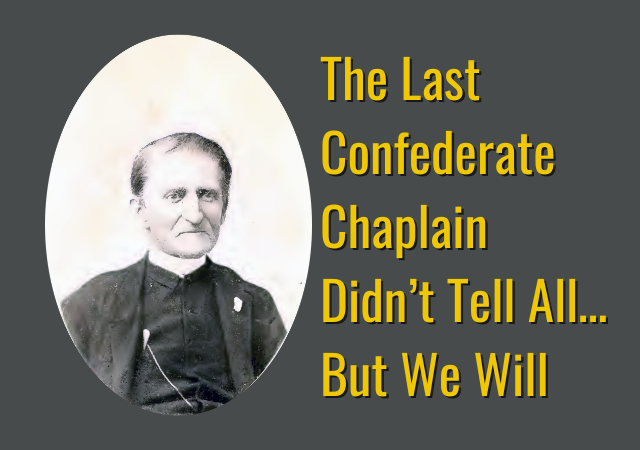
The Rev. James Battle Avirett, Grace Church’s third rector, presided over the church from 1872-1884. Under Avirett, the parish increased the size of its congregation, got a new name, started a school, became a “free seat” church, and added three mission churches. But Avirett embodied racist beliefs, strongly supported the Confederacy, and wrote The Old Plantation: How We Lived in Great House and Cabin Before the War as a vehicle to promote poisonous Lost Cause arguments about Southern life and white supremacy.
Before Grace
James Battle Avirett was born in 1835 at Rich Lands, his family’s turpentine plantation in Eastern North Carolina. His father, John Averett, enslaved 125 people, far more than nearly all other landowners in the area. The younger Avirett was ordained as an Episcopal deacon in 1861 and was then commissioned as the first chaplain in the Confederate States Army.
Avirett in Montgomery County
By 1872, Avirett was officiating at two parishes: Labyrinth (Grace’s original parish name) and Prince George’s (Christ Church, Rockville). At Grace, Avirett discontinued the requirement that congregants rent their pews, establishing the parish as a “free seat” church. (There is no indication that these free seats were available to Black congregants, who likely would have still been relegated to the balcony.)
In his efforts to grow The Episcopal Church in Maryland, Avirett arranged to open two additional church congregations, which became St. Mary Magdalene in Wheaton and St. John’s, Norwood in Bethesda, respectively. In 1874, he added a third mission: St. Mark’s (Fairland), on what is now route 29. That same year, he resigned from his position at Christ Church, Rockville.
Confederate Soldier Interment
While Avirett was expanding the reach of Silver Spring parish, he was also facilitating a popular Lost Cause plan: reburying Confederate soldiers. In 1874, Avirett arranged to move the remains of 17 Confederate soldiers from their resting place near Fort Stephens in Washington, D.C., to Grace’s cemetery. As reported in the Washington, D.C. Evening Star, “friend of the ‘lost cause’ headed by Rev. J.B. Avirett, pastor of Grace (P.E.) Church resolved to gather up the remains and remove them to the above named church yard for interment.” These soldiers had no connection to the church or its parishioners.
After the reburial ceremony, attended by a large and appreciative crowd, Alexander Yelverton Peyton Garnett—a former Confederate surgeon and personal assistant to Jefferson Davis—gave a speech in which, as reported in the Evening Star, he “alluded to the south as ‘our people’ and Jeff Davis as ‘our President.’”
The Old Plantation and the Lost Cause
Avirett went on to serve at other parishes in Maryland, New York, and North Carolina before retiring in 1899. In his retirement, he published The Old Plantation: How We Lived in Great House and Cabin Before the War, as a (delayed) response to the portrait of enslaved people’s lives presented in Harriet Beecher Stowe’s 1852 novel Uncle Tom’s Cabin.
Avirett’s racist and apologist memoir romanticized the relationships between the landowners and the people they enslaved and presented an idyllic (fictional!) account of plantation life. The Old Plantation advanced numerous tenets of the “Lost Cause” of the Confederacy school of thought: slavery was benevolent, the Civil War was about states’ rights (not slavery), and that the Old South was a Christian land of grace and gentility.
As recent historians have shown, The Old Plantation did not simply fictionalize aspects of plantation life. Its central thesis—that the Civil War destroyed Avirett’s family’s plantation and way of life—was a lie.
Three years before the Civil War began, the Avirett plantation lay in ruins, a byproduct of the destruction of the pine forests on which turpentine production relied. As historian David Cecelski put it, “James Avirett, it turned out, had deceived his memoir’s readers just as surely as if he had chiseled another man’s name onto his own gravestone.”
At the time of his death in 1912, Avirett was recognized as the last Confederate chaplain. He was buried in his Confederate uniform, clutching a Bible in one hand and a Confederate army flag in the other. By recognizing his role both in the growth of Grace Church and as a proponent of white supremacy, our parish can tell a truer, fuller picture of our church’s history—a first step toward becoming the Beloved Community.
The full, annotated version of this history, along with an illustrated presentation and other findings from Grace’s historical research, is available on Grace’s History page.
by Keely Thrall | May 9, 2024
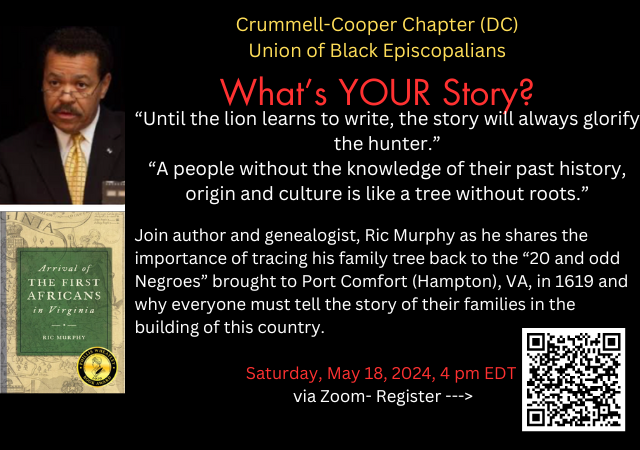
“Until the lion learns to write, the story will always glorify the hunter.”
“A people without the knowledge of their past history, origin and culture is like a tree without roots.”
Join author and genealogist, Ric Murphy as he shares the importance of tracing his family tree back to the “20 and odd Negroes” brought to Port Comfort (Hampton), VA, in 1619 and why everyone must tell the story of their families in the building of this country.
Books are being banned that provide a more complete history of this country as it relates to slavery, Jim Crow, segregation, and continued discrimination. The way to fight back is to know YOUR story and how it fits in the history of this country. Once you know YOUR history, share it with current generations and document it for future generations.
Ric Murphy is the author of several books and “tells the extraordinary story of the arrival in 1619, of a group of thirty-two African men, women and children who arrived on the shores of Virginia. They had been kidnapped in the royal city of Kabasa, Angola, and forced aboard the Spanish slave ship the San Juan Bautista. The ship was attacked by privateers, and the captives were taken by the English to their New World colony. This group has been shrouded in controversy ever since. Historian Ric Murphy has documented a fascinating story of colonialism, treason, piracy, kidnapping, enslavement and English Common Law. The Arrival of the First Africans in Virginia is a must read.”
Ric currently serves as the President General of the Society of the First African Families of English America and the former National Vice President for the Afro-American Historical and Genealogical Society. His family lineage dates to the earliest colonial periods of Plymouth, Massachusetts, and of Jamestown, Virginia.
His lineage has been evaluated and accepted by several heredity societies, including the Daughters of the American Revolution; the National Society of the Sons of Colonial New England; the Sons of the American Revolution; the Sons of the American Revolution; the Sons of the Union Veterans of the Civil War; the Sons and Daughters of the United States Middle Passage; and the Society of the First African Families of English America. Mr. Murphy was a Resident Fellow at Harvard University, Kennedy School; earned a Masters from Boston University, and a Bachelors from the University of Massachusetts.
by EDOW | Apr 25, 2024
At Diocesan Convention in 2021, the Reparations Task Force invited parishes across the diocese to undertake parish history projects to engage in the work of truth telling, to better discern how to be a more equitable and racially just diocese. In a video shown at the convention, I spoke about things to keep in mind as we move into the discovery of the historical roots of racism within our diocese.
The reality is that the historical record is messy and sometimes painful. From enslavement to Jim Crow to segregation to white flight and redlining, the struggle for human and civil rights, to immigration justice and Black Lives Matter… every parish has a connection to this history of racial injustice.
As I noted, our past can inform our future, be a lamp unto our feet, and strengthen our ongoing journey to fully realize the Great Commandment: to love our neighbors as ourselves.
In August 2022, in preparation for our Repairing the Breach symposium on reparations, I explained how to start investigating your parish’s history with racism. My recommendation is to begin with three steps: discover, verify, and share.
In step 1, Discover, you have lots of options that you can explore. Find out what records already exist in your parish. Perhaps you already have a parish history – its focus may not be on race and racism, but it may provide a wealth of data as a starting point. It’s helpful to make an inventory of the records that you have identified. And don’t forget to check in with current parishioners, to see what stories they can share. It’s important to talk with them and get their stories recorded and transcribed. In every case, be sure to get permission to share the stories from those you interviewed.
Step 2 is to Verify. Take the history that you have discovered through research, existing histories, and oral histories, and verify that information. You can use existing records within your parish, archives at the Diocese of Maryland and the Diocese of Washington, and public repositories. Many records are now available online. For example, many of the Journals of the Annual Convention of the Diocese of Maryland are available online, as are many of the Journals of the Annual Convention of the Diocese of Washington. These journals routinely include annual parish reports which shed light on your parish’s history. Similarly, you can verify what you’ve learned against online newspaper archives, many of which are free through your local library. Another great source is your county or state historical archives or association.
Step 3 is to Share. Or, in the context of Becoming Beloved Community, begin the journey through Telling the Truth to Proclaiming the Dream. Weave your discoveries into an interesting narrative that you can share with your parish through newsletter articles, adult forums, Sunday school classes, and more. At all times, remember to be sensitive to the audience you are writing for and speaking to. Engage in truth telling and refrain from truth judging. The goal is to leave your audience wanting to hear more and learn more.
Many of our parishes have long histories dating back centuries. Extend yourself grace: discovering and telling the truth will take time, so be patient and steady in your work.
The good news is that you are not alone in your work. Several parishes in the diocese have started work on their parish histories through the lens of race and racism. These parishes, along with the Diocesan Committee on Reparations, are available to journey with you and support you as you undertake this important work. Check out our Parish History Projects page on the EDOW website, where we provide the latest news and resources to support parishes throughout the diocese.
If you have questions, feel free to reach out to us at reparations@edow.org.
Franklin A. Robinson, Jr., is an archivist with the Archives Center, National Museum of American History Smithsonian, a parishioner at St. Thomas, Croom and Brandywine, Prince George’s County, and a member of the Committee on Diocesan Reparations.

