by Keely Thrall | Apr 11, 2024
Calvary Episcopal Church will host a screening of “Bloodlines of the Slave Trade” with a converation to follow.
“Bloodlines of the Slave Trade” examines the lives of two people whose only connection is a genetic link to John Arm-field, one of the most notorious slave traders of the 1830s, and an Episcopalian. The offices of his trade can be found at 1315 Duke Street, in Alexandria. Rodney Williams, who is Black, and Susanna Grannis, who is white, each trace their ancestry back to Armfield, detailing the diverging paths their lineages took. While their relationship to this past is fundamentally dif-ferent, and they never meet in the film, they both share in the telling of the horrific domestic slave trade and the ongoing re-verberations of slavery. While for a long time Susanna tried to ignore her family’s history, Rodney and his siblings would not have that privilege. Tracing the ongoing impact of this shared ancestry in each of their lives, Susanna finds it to be an awak-ening, while for Rodney it is an exploration of the ongoing damage inflicted by the slave traders. Through telling these two family histories, “Bloodlines of the Slave Trade” also traces the history the United States. As this diocese continues combing its radicalized history, in addition to the stories of the formation of parishes:
What stories lie within our people that have yet to be shared?
What traumas are present and need to be brought forth in our goal to repair the damage done by anti-black racism?
by EDOW | Feb 29, 2024
All parishes in the Diocese of Washington are encouraged to examine their histories from the perspective of race and racism. Over the next few months, we will spotlight parishes that are engaging in this work of truth telling through a racial lens.
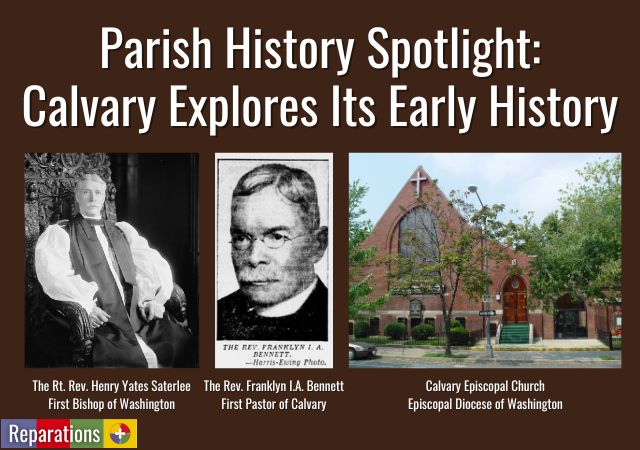
Calvary Episcopal Church is one of seven historically Black Episcopal churches in the Diocese of Washington. In 2022, three dedicated parishioners from Calvary formed a committee to begin the work of examining its history. The goal: to determine how its congregation has shaped and been shaped by the realities of race in the United States.
As they continued their research, one of the committee members remarked, “I am amazed at the forced separation of Blacks and Whites in The Episcopal Church. I did not realize how prevalent the church’s racist attitudes were towards Blacks in The Episcopal Church.”
By the end of the Civil War (1861-1865) and Reconstruction (1865-1877), more than 25,000 African Americans had moved into the city of Washington, DC. By the early 1900’s there were 90,000.
In response to this migration into the city, the 1899 Diocesan Convention adopted a resolution to establish a “Committee on Colored Work.” The purpose of this committee was to prevent African Americans from leaving The Episcopal Church to join Methodist and AME churches and to address other issues of African Americans in the diocese. These issues included their representation in the priesthood, their desire for leadership positions, substandard conditions, educational needs of parishioners, vestry formations, and a continued call for respect for African Americans as intelligent and self-governing members.
In response to these issues, the Diocese of Washington established “colored chapels” or “domestic missions” to increase the number of Black Episcopalians. Its Commission for Work among Colored People attempted to achieve several goals: gain a presence and physical foothold in “East” Washington, DC, establish a place of employment for African American priests educated in King Hall (a theological institute connected with Howard University for aspiring Black priests), and provide a parent mission to serve other missions.
To fulfill some of these goals, the Rt. Rev. Henry Yates Satterlee, first Bishop of Washington, summoned the Rev. Franklyn Isaac Abraham Bennett, then in charge of St. Andrew’s Mission School in South Carolina, to come to Washington and open a new Episcopal Mission for African Americans. In June 1901, Calvary Episcopal Church in Washington, DC, was founded as a new mission church in the Diocese of Washington.
The issues of white supremacy and segregation are embedded in the founding of Calvary. Bishop Satterlee wanted the new mission to be located in the southeast section of the city, but Rev. Bennett threatened to return to South Carolina if he was not allowed to select the location.
After a careful search, Rev. Bennett located a two-story building at 1303 H Street, NE, and negotiated with the owner to use the second floor. He then secured six months’ rent, after which he searched the basements of DC churches to find equipment for the mission. Meanwhile, meetings were held in various homes in the neighborhood.
The area in Northeast DC selected by Rev. Bennett for the mission was a neighborhood of middle-class single-family homes adjacent to the H Street business district, close to the U Street Corridor. The population in 1901 was approximately 85% white, and area churches were segregated by race.
After the mission officially opened, Calvary quickly became the center of spiritual inspiration and a source of civil and social guidance. Rev. Bennett conducted services for students at Gallaudet School for the Deaf and established classes in industrial arts, cooking, sewing, and carpentry. Calvary also established the first neighborhood kindergarten, playground, branch library, and community center.
Calvary soon outgrew its quarters and, in March 1909, Rev. Bennett led the congregation to lay the cornerstone for a larger space at 11th and G Street, NE. Rev. Bennett paid for the church rectory at no cost to the church or the diocese. Although Calvary always paid off any debts it incurred for renovations, it took 40 years for the diocese to allow “Colored Calvary Chapel” to become independent with a vestry in charge of its own church funds.
Rev. Bennett was active outside of Calvary, both in the diocese and in the District. He became treasurer of the “Diocesan Committee on Colored Work” and one of the earliest civil rights advocates in the diocese. While at Calvary, he was also assigned to the Chapel of St. Philip In Anacostia and opened the Church of Atonement in northeast Washington. In addition, he served as priest-in-charge at St. Simon’s Mission in Prince George’s County for five years (1910-1915). In addition to his clerical duties, Rev. Bennett served two terms on the DC Board of Education, was a member of the Selective Service Board, and founded the Public Interest Citizen’s Association of the northeast section of the city. He was pastor at Calvary until his retirement in 1941.
During Black History Month, we are reminded that we must continue to seek a true multiracial democracy and equitable society for all. The early struggles of Black priests and congregations are beginning to be acknowledged as the wider Episcopal Church, along with American society, seeks to respond to the Black community’s cry for self-expression, liberation, and full participation.
For more information on parish history projects in the Diocese of Washington, visit Parish History Projects: Telling the Truth About Race and Racism.
by Bishop Mariann | Jan 11, 2024
Reparations is the spiritual and material process to remember, restore, reconcile, and make amends for historical and continuing wrongs against humanity that can never be singularly reducible to monetary terms, but must include a substantial investment and surrender of resources.
— EDOW’s Working Definition of Reparations
When our diocese gathers on January 27 for its annual convention, we will hear from the Committee on Diocesan Reparations that has been charged with helping us reckon with our history of anti-Black racism since the days of chattel slavery. This courageous work includes acknowledging the legacy of benefit for predominantly white congregations and its members and taking concrete steps to make amends for harms caused to Black individuals and institutions.
In the spirit of courageous discipleship, I ask members of the Diocese of Washington to spend time on the reparations hub of our website. There you will find a host of resources, including the Committee’s Progress Report. The Committee’s task is to bring specific recommendations for diocesan reparations, including monetary investment, to Convention in 2025.
For me, the most compelling stories are those surfacing from individual parish history projects, as courageous leaders study their church’s past through the lens of race, both internally and in the wider community.
Last year, the Rev. Dr. Maria Kane wrote of what it was like for St. Paul’s, Waldorf to discuss the history of its balcony, originally built as a gallery for the enslaved and continued as segregated seating during Jim Crow:
The story of its demise in the 1950s is one for the ages… However, to have heard some long-time parishioners retell it, the balcony had nothing to do with racism and everything to do with “church growth.” To suggest otherwise was to slander the memory and good will of beloved parishioners.
Oral histories and the contextualization of the balcony’s existence in the larger narrative of America’s history and Episcopal Church culture have helped the congregation to counter the narrative of “church growth”… We’ve uncovered a thread of holy resistance connecting the resistance of the 1950s to the resistance of the church’s Civil War-era rector, who did what was otherwise unthinkable in Maryland’s tobacco-producing region at the time: preach abolition and pray for President Lincoln, an act of resistance that forced him to flee for his own safety.
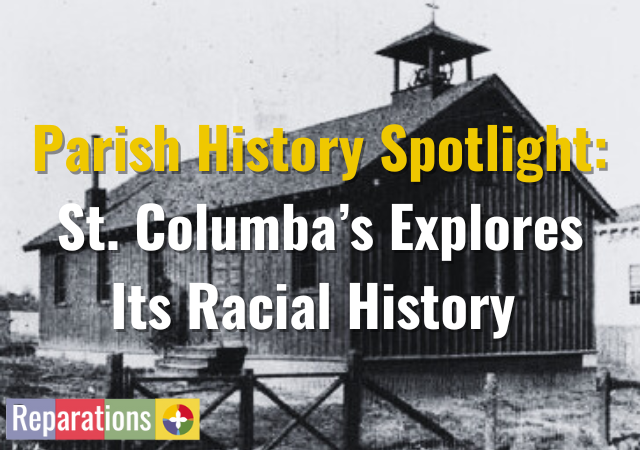
Highlighted now on the reparations history project page is a comprehensive report from St. Columba’s, Washington DC, among the largest and wealthiest congregations in the diocese. Its author, Sondra Mills, writes:
Understanding how St. Columba’s grew from a small mission chapel established by St. Alban’s parish in 1874 calls for an examination of the lasting effects of deliberate and systemic racist policies and practices in the United States since the 1700s, specifically including in Washington, D.C.,Tenleytown, and The Episcopal Church.
The report is compelling in its honesty. St. Columba’s history is closely linked to another St. Alban’s mission, St. George’s, established nearby in the Black community of Reno City. In the late 1920s, the District of Columbia began a concerted effort to confiscate the land of Reno City through eminent domain in order to build all-white schools and develop a landscaped public park. By the 1940s, all houses owned by Black families were gone and St. Columba’s was compensated for the property on which St. George’s chapel stood. The result was a more starkly racially segregated city and Episcopal Church.
St. Columba’s made no effort to save St. George’s or advocate for its Black neighbors. In subsequent years, some of its members supported segregated housing laws that kept the Wisconsin Avenue corridor of Washington off-limits to Black families. The congregation’s current commitment to reparations stems from its determination to make amends for its history.
As we prepare to celebrate the memory of the Rev. Dr. Martin Luther King, Jr., I’m mindful that we will gather for Convention in the same sanctuary where Dr. King preached the last Sunday service of his life a sermon entitled Remaining Awake through a Great Revolution. It’s important for us to remember, as New York Times columnist Esau McCaulley writes, “the kind of revolution King envisioned.”
King focused on the financial impacts of white supremacy and the need for America to make amends for its exploitation of Black labor, and gave a basic and compelling case for reparations based on the ‘debt’ this country owed its Black citizens… King’s words remind us that injustice leaves a legacy. It creates inequalities that do not simply disappear. And we need to use that knowledge to chart the long and winding path toward justice.1
It takes courage to face hard truths in a spirit of love and determination to make restitution for past wrongs. Yet as followers of Jesus, we are called to work for the realization of what King called the Beloved Community—and what Jesus called the Kingdom of God—where all God’s children are valued and all have enough to thrive and grow. We can’t change the past, but we can take responsibility for its legacy and do our part to create a new narrative for ourselves and those who will come after us.
Maria Kane reminds us, “The stories that we all tell (or don’t tell about the past) determine how we live the Gospel in the present and future. Parish history projects aren’t an exercise in shaming or disremembering. They are an act of holy “re-membering” that which is so deeply a part of all of us. They situate us in God’s larger narrative of sin… and repair and redemption.”
Thanks to all who have undertaken this courageous work. If you would like to know more, please contact us. We need you. “As the Episcopal Diocese of Washington and its parishes commit to learning truths about the past,” writes Ms. Gigi Nelson, co-chair of the Educational Working Group, “our prayer is that reconciliation, equity, and justice inform the decisions of our future.”
May it be so.
1The Kind of Revolution That Martin Luther King Jr. Envisioned