by EDOW | Apr 25, 2024
At Diocesan Convention in 2021, the Reparations Task Force invited parishes across the diocese to undertake parish history projects to engage in the work of truth telling, to better discern how to be a more equitable and racially just diocese. In a video shown at the convention, I spoke about things to keep in mind as we move into the discovery of the historical roots of racism within our diocese.
The reality is that the historical record is messy and sometimes painful. From enslavement to Jim Crow to segregation to white flight and redlining, the struggle for human and civil rights, to immigration justice and Black Lives Matter… every parish has a connection to this history of racial injustice.
As I noted, our past can inform our future, be a lamp unto our feet, and strengthen our ongoing journey to fully realize the Great Commandment: to love our neighbors as ourselves.
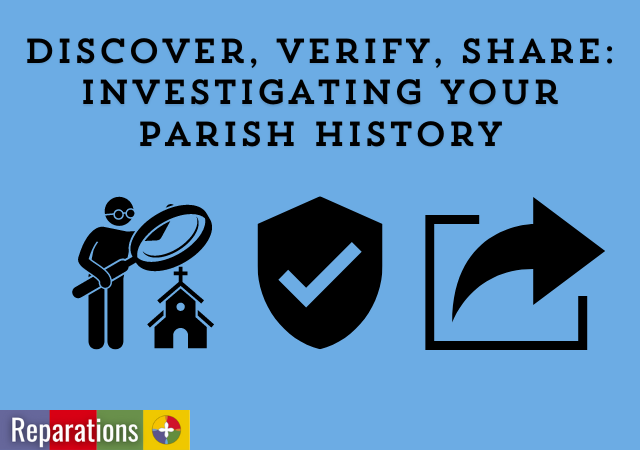
In August 2022, in preparation for our Repairing the Breach symposium on reparations, I explained how to start investigating your parish’s history with racism. My recommendation is to begin with three steps: discover, verify, and share.
In step 1, Discover, you have lots of options that you can explore. Find out what records already exist in your parish. Perhaps you already have a parish history – its focus may not be on race and racism, but it may provide a wealth of data as a starting point. It’s helpful to make an inventory of the records that you have identified. And don’t forget to check in with current parishioners, to see what stories they can share. It’s important to talk with them and get their stories recorded and transcribed. In every case, be sure to get permission to share the stories from those you interviewed.
Step 2 is to Verify. Take the history that you have discovered through research, existing histories, and oral histories, and verify that information. You can use existing records within your parish, archives at the Diocese of Maryland and the Diocese of Washington, and public repositories. Many records are now available online. For example, many of the Journals of the Annual Convention of the Diocese of Maryland are available online, as are many of the Journals of the Annual Convention of the Diocese of Washington. These journals routinely include annual parish reports which shed light on your parish’s history. Similarly, you can verify what you’ve learned against online newspaper archives, many of which are free through your local library. Another great source is your county or state historical archives or association.
Step 3 is to Share. Or, in the context of Becoming Beloved Community, begin the journey through Telling the Truth to Proclaiming the Dream. Weave your discoveries into an interesting narrative that you can share with your parish through newsletter articles, adult forums, Sunday school classes, and more. At all times, remember to be sensitive to the audience you are writing for and speaking to. Engage in truth telling and refrain from truth judging. The goal is to leave your audience wanting to hear more and learn more.
Many of our parishes have long histories dating back centuries. Extend yourself grace: discovering and telling the truth will take time, so be patient and steady in your work.
The good news is that you are not alone in your work. Several parishes in the diocese have started work on their parish histories through the lens of race and racism. These parishes, along with the Diocesan Committee on Reparations, are available to journey with you and support you as you undertake this important work. Check out our Parish History Projects page on the EDOW website, where we provide the latest news and resources to support parishes throughout the diocese.
If you have questions, feel free to reach out to us at reparations@edow.org.
Franklin A. Robinson, Jr., is an archivist with the Archives Center, National Museum of American History Smithsonian, a parishioner at St. Thomas, Croom and Brandywine, Prince George’s County, and a member of the Committee on Diocesan Reparations.
by EDOW | Mar 26, 2024
During the 2024 Diocesan Convention, the Rev. Peter Jarrett-Schell, on behalf of the Committee on Diocesan Reparations, presented findings on congregational resources by racial history and makeup. Here are highlights from that presentation. To view the recording of the presentation, see Congregational Resources by Racial Makeup/History on our YouTube channel.
In 2023, members of the Committee on Diocesan Reparations conducted an exploration of parish assets and resources through the lens of possible racial disparities. They considered both the racial history of parishes as well as their current racial demographics. For this exploration, they used financial data from the compiled 2021 parochial reports (the 2022 reports had not yet been compiled). For the racial history data, they consulted the report of the Task Force on Black Ministries as well as The Episcopal Church archives.
Overall, the financial and parish data showed that:
-
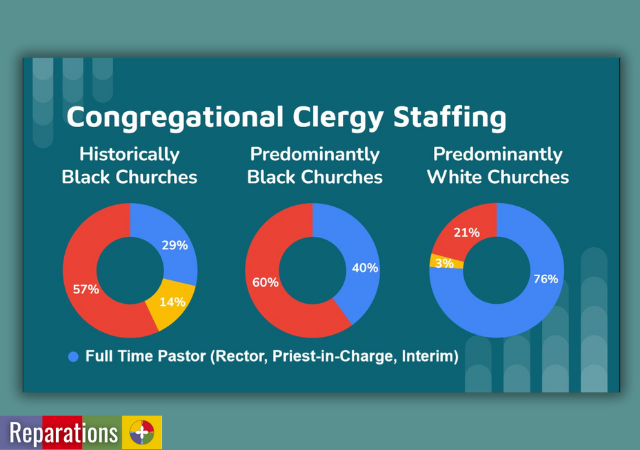
- Black congregations are understaffed and their staff are underpaid.
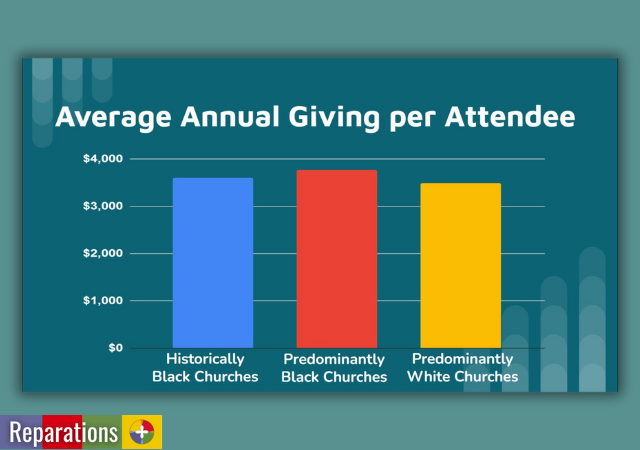
- Attendees of Black congregations donate more than attendees of White congregations.
The data also showed that:
-
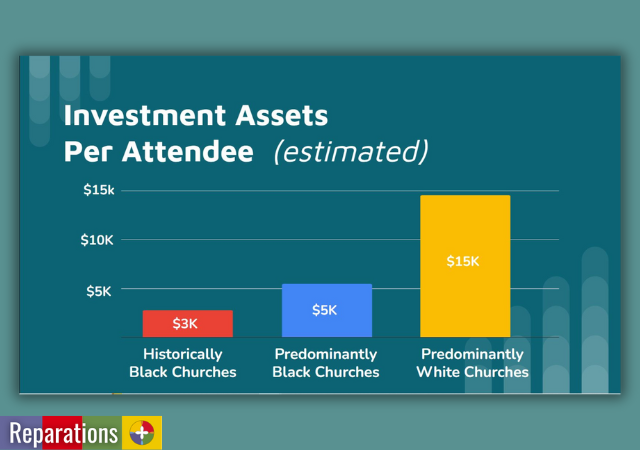
- Predominantly White congregations have almost five times the assets, per attendee, of Black congregations.
- Lower resources correlate with lower attendance.
In acknowledging the need for remedy for these disparities, Peter noted, “As Paul reminds us in his First Letter to the Corinthians, we are one body together. And when one part of the body suffers, the whole body suffers as well. When one part of the body is honored, the whole body rejoices with it. If we are not willing to address these remedies, we must question whether we are serious about the faith commitments we have made as Christians.”
Highlights of the Investigation
In line with the Committee’s charge to investigate EDOW history with anti-Black racism, the team categorized congregations into three groups:
-
- Historically and predominantly Black: 7 congregations
- Predominantly (but not historically) Black: 15 congregations
- Predominantly White: 61 congregations
The committee members also separately considered one predominantly Latino congregation (St. Matthew’s) as well as Washington National Cathedral.
As they assessed the data, they noticed a number of dramatic disparities. As Peter noted during this presentation, “all of our congregations are facing many challenges, but it is clear that we are not facing them equally.”
One of the most dramatic disparities appeared in the area of clergy staffing. While approximately one-fifth of predominantly White congregations in the diocese are in transition, a majority of both predominantly and historically Black congregations have no pastor at all.
When they looked at compensation, they noted a more than $40,000 discrepancy between the compensation of clergy serving historically and predominantly Black congregations and the compensation of those serving predominantly White congregations.
The data showed that these kinds of disparities are not attributable to the difference in the commitment and giving of parish members. In fact, attendees of historically Black and predominantly Black congregations gave more per year than attendees of predominantly White congregations.
The team noted the biggest disparities between the Black churches and White churches in the areas of investment assets and investment income. The average predominantly White congregation has about $15,000 in investment assets per attendee whereas predominantly Black congregations have only $5,000 and historically Black congregations have only $3,000.
Overall, the 61 predominantly White churches have a total of $87 million dollars of investment assets, compared with $5.6 million for the 15 predominantly Black churches and $1.5 million for the seven historically Black churches.
by Rudy Logan | Feb 1, 2024
In 1915, Historian and Journalist Carter G. Woodson traveled to Washington, D.C., to participate in the commemoration of the Emancipation Proclamation. This trip inspired him to create an organization devoted to the scientific study of Black life, the Association for the Study of African American Life and History. On February 7, 1926, Woodson established Negro History Week. He chose the month of February because it was the birthday month of two key figures in U.S. and Black history, Frederick Douglass and Abraham Lincoln. Woodson built upon rituals of celebration, as Black people had already been commemorating the birthdays of Douglass and Lincoln on the 12th and 14th of February. With Negro History Week, Woodson sought to go further than the commemoration of these two giant figures. He believed in the power of the collective as agents of social change, educators, and advocates for the study of Black life.
Woodson was a child of the enslaved and grew up toiling alongside Civil War veterans and those who were rendered illiterate due to anti-black chattel slavery. Long before he became the second Black person to earn a Ph.D. from Harvard, he knew people for whom it was criminal to read and be educated. From these roots grew the inspiration for Negro History Week and a lifelong mission to educate the Black masses and the rest of the country about the evocative and soul-stirring elements of Black history that we bear witness to today. Woodson helped catalyze a movement born out of struggle—transforming knowledge and improving race relations. Today, we observe Black History Month with the same goals in mind, seeking liberation through truth-telling, emancipatory representation, education, and social transformation.
On a personal note, the study of Black History has been a medium for educational growth and greater self-awareness, impressing upon me that I am somebody. As an undergraduate student, I was introduced to the work of Black Liberation Theology by one of my professors at St. John’s University in Queens, New York. I was exposed to the transcendent relation between what we know about the historical Jesus as a Jewish Palestinian imprisoned under Roman imperial occupation and victim of capital punishment via the Cross and the experiences of black people rendered marginalized and hung on lynching trees in Jim Crow USA.
The Cross and the lynching tree symbolize a similar terror as elaborated in one of James Cone’s seminal texts—The Cross and the Lynching Tree. Both are utilized as instruments of the dominant against the least of these to murder, provoke fear, and maintain control over subjugated groups of people. Upon learning this connection, I realized that to be Black and Christian was not irrational, given the ways in which Christian theologies had been appropriated to steal, brutalize, and displace others, but that to be Black and Christian was ideologically and spiritually consistent, given what we know about the person Christ. This is in part what the study of Black History has done for me as a Black person and follower of Jesus. Black History illuminated that lines between the secular and sacred are imaginary—that to share about Black History is to engage in an anti-racist and freedom-driven practice and spiritual call to action with structurally marginalized groups, both black and across categories of difference.
Nationally, ongoing attacks against Diversity, Equity, and Inclusion initiatives (DEI) show us that Woodson’s vision for what would eventually become Black History Month is as critical as ever. To suppress such efforts is to disappear lived realities of historically marginalized communities subject to routine and overt forms of violence. From learning about structural injustice to the strange fruit, the slave ships, segregated lunch counters, and neighborhoods, education illuminates the full depth of life and helps us chart restorative paths forward. Information—or history rather—equips us with the knowledge to speak and act with sobering clarity and purpose. This is the work of Black History Month—to lift up what has shaped us, our contexts, living within and around us so that we may activate our deepest capacity to be stewards for collective liberation.
Past and present realities illustrate how invaluable our efforts, led by the Committee on Diocesan Reparations have been to excavate our history and employ what we have learned for reparations and (re)conciliation efforts. At this moment when Diversity, Equity, and Inclusion (DEI) initiatives and Black Studies are under assault across the country, Carter G. Woodson’s vision for Negro History Week and Black History Month is essential to our journey for liberation. It confronts us with an imperative task to continue our race education work within the Diocese of Washington and to support those within our geography employing Black, race-conscious education and initiatives to advance our collective knowledge, well-being, and freedom from the lies and violent mechanisms of anti-black racism.
Black History Month is a clarion call—a reminder that the souls of Black folks and our contributions toward realizing a true multi-racial democracy and equitable society aren’t reducible to a single week or month but instead are integral parts of an ongoing struggle to realize just futures for all.
To learn more about Carter G. Woodson, the evolution of Negro History Week to Black History Month and the long history of Black educators using Black History as a framework for advancing anti-racist education, check out the following books:
by Bishop Mariann | Jan 11, 2024
Reparations is the spiritual and material process to remember, restore, reconcile, and make amends for historical and continuing wrongs against humanity that can never be singularly reducible to monetary terms, but must include a substantial investment and surrender of resources.
— EDOW’s Working Definition of Reparations
When our diocese gathers on January 27 for its annual convention, we will hear from the Committee on Diocesan Reparations that has been charged with helping us reckon with our history of anti-Black racism since the days of chattel slavery. This courageous work includes acknowledging the legacy of benefit for predominantly white congregations and its members and taking concrete steps to make amends for harms caused to Black individuals and institutions.
In the spirit of courageous discipleship, I ask members of the Diocese of Washington to spend time on the reparations hub of our website. There you will find a host of resources, including the Committee’s Progress Report. The Committee’s task is to bring specific recommendations for diocesan reparations, including monetary investment, to Convention in 2025.
For me, the most compelling stories are those surfacing from individual parish history projects, as courageous leaders study their church’s past through the lens of race, both internally and in the wider community.
Last year, the Rev. Dr. Maria Kane wrote of what it was like for St. Paul’s, Waldorf to discuss the history of its balcony, originally built as a gallery for the enslaved and continued as segregated seating during Jim Crow:
The story of its demise in the 1950s is one for the ages… However, to have heard some long-time parishioners retell it, the balcony had nothing to do with racism and everything to do with “church growth.” To suggest otherwise was to slander the memory and good will of beloved parishioners.
Oral histories and the contextualization of the balcony’s existence in the larger narrative of America’s history and Episcopal Church culture have helped the congregation to counter the narrative of “church growth”… We’ve uncovered a thread of holy resistance connecting the resistance of the 1950s to the resistance of the church’s Civil War-era rector, who did what was otherwise unthinkable in Maryland’s tobacco-producing region at the time: preach abolition and pray for President Lincoln, an act of resistance that forced him to flee for his own safety.
Highlighted now on the reparations history project page is a comprehensive report from St. Columba’s, Washington DC, among the largest and wealthiest congregations in the diocese. Its author, Sondra Mills, writes:
Understanding how St. Columba’s grew from a small mission chapel established by St. Alban’s parish in 1874 calls for an examination of the lasting effects of deliberate and systemic racist policies and practices in the United States since the 1700s, specifically including in Washington, D.C.,Tenleytown, and The Episcopal Church.
The report is compelling in its honesty. St. Columba’s history is closely linked to another St. Alban’s mission, St. George’s, established nearby in the Black community of Reno City. In the late 1920s, the District of Columbia began a concerted effort to confiscate the land of Reno City through eminent domain in order to build all-white schools and develop a landscaped public park. By the 1940s, all houses owned by Black families were gone and St. Columba’s was compensated for the property on which St. George’s chapel stood. The result was a more starkly racially segregated city and Episcopal Church.
St. Columba’s made no effort to save St. George’s or advocate for its Black neighbors. In subsequent years, some of its members supported segregated housing laws that kept the Wisconsin Avenue corridor of Washington off-limits to Black families. The congregation’s current commitment to reparations stems from its determination to make amends for its history.
As we prepare to celebrate the memory of the Rev. Dr. Martin Luther King, Jr., I’m mindful that we will gather for Convention in the same sanctuary where Dr. King preached the last Sunday service of his life a sermon entitled Remaining Awake through a Great Revolution. It’s important for us to remember, as New York Times columnist Esau McCaulley writes, “the kind of revolution King envisioned.”
King focused on the financial impacts of white supremacy and the need for America to make amends for its exploitation of Black labor, and gave a basic and compelling case for reparations based on the ‘debt’ this country owed its Black citizens… King’s words remind us that injustice leaves a legacy. It creates inequalities that do not simply disappear. And we need to use that knowledge to chart the long and winding path toward justice.1
It takes courage to face hard truths in a spirit of love and determination to make restitution for past wrongs. Yet as followers of Jesus, we are called to work for the realization of what King called the Beloved Community—and what Jesus called the Kingdom of God—where all God’s children are valued and all have enough to thrive and grow. We can’t change the past, but we can take responsibility for its legacy and do our part to create a new narrative for ourselves and those who will come after us.
Maria Kane reminds us, “The stories that we all tell (or don’t tell about the past) determine how we live the Gospel in the present and future. Parish history projects aren’t an exercise in shaming or disremembering. They are an act of holy “re-membering” that which is so deeply a part of all of us. They situate us in God’s larger narrative of sin… and repair and redemption.”
Thanks to all who have undertaken this courageous work. If you would like to know more, please contact us. We need you. “As the Episcopal Diocese of Washington and its parishes commit to learning truths about the past,” writes Ms. Gigi Nelson, co-chair of the Educational Working Group, “our prayer is that reconciliation, equity, and justice inform the decisions of our future.”
May it be so.
1The Kind of Revolution That Martin Luther King Jr. Envisioned
by EDOW | Jan 4, 2024
Last fall, Bishop Mariann Budde reached out to the leadership of the 85 congregations of the Diocese of Washington with a request.
On behalf of the Education Working Group of the Committee on Diocesan Reparations, Bishop Mariann asked for responses to a brief survey on racial justice ministries at the parish level. The survey inquired about activity in two areas: 1) how parishes are working toward a present and future of racial justice and 2) what efforts parishes have made or are making to understand our congregational and diocesan histories through the lens of race.
In response, nearly 85% of our congregations completed the survey and provided us with much-needed information to accurately assess the extensive antiracism work in progress across the diocese. We are grateful to all congregations that took part. The responses will help us identify areas where the Education Working Group can support parishes in their journeys to “strive for justice and peace among all people, and respect the dignity of every human being.”
Addressing Racial Justice in Worship and Education
From the survey results, we learned that most congregations have engaged in activities that address racial justice. This finding is particularly encouraging, given that nearly one-third of the parishes in the diocese are in active transition (do not currently have a “settled” priest).
For most congregations, these activities involve worship:
-
- 74% of congregations have reviewed the elements of their worship (such as music, prayers, and iconography) through the lens of race and representation.
- On average, congregations report hearing 9 sermons each year with racial equity or racial justice as a central theme.
Another area in which congregations have been engaged in this work is educational opportunities.
-
- 65% of responding congregations have hosted formal educational opportunities on racism in the past six years.
- Examples of these formal educational opportunities include curricula such as Sacred Ground and Becoming Beloved Community, offerings from The Episcopal Church, and Diocese of Wasington offerings such as Seeing the Face of God in Each Other and Healing from Internalized Racial Oppression.
One area for potential growth is antiracism education for children. Only 5% of congregations reported that they had provided anti-racist educational opportunities for children.
Congregational Policies and Programs
One of the questions on the survey was:
Does your parish have a ministry, committee, team, or task force that is focused exclusively or primarily on racial justice?
In response to this question, 15% of reporting congregations have established a racial justice ministry group or committee – a group explicitly and exclusively charged with a focus on racial justice and antiracism. That said, several predominantly African-American congregations reported framing racial justice ministry holistically, not as a separate function, but as an expected focus for all ministry groups and committees.
In a similar vein, 24% of congregations have established policies to promote racial equity at the parish level. These include policies dealing with hiring practices, contract set-asides, and reparations at the parish level.
Exploring Parish Histories
At the 2021 Annual Convention, the Reparations Task Force invited parishes across the diocese to undertake parish history projects to engage in the work of truth telling to better discern how to be a more equitable and racially just diocese.
From the survey results, we learned that 21% of congregations have undertaken researching their history through the lens of race and racism. An additional 8% of congregations have plans to research their history through the lens of race and racism within the next two years.
For congregations interested in pursuing this work, the Parish History Projects page on the EDOW website contains instructional videos and text, as well as contact information for the monthly meeting of our Congregational History Partners.
Next Steps
While the survey results show that congregations across the diocese are clearly engaged in good work on race and racism, they also highlight areas where we can expand our work and galvanize our congregations toward concrete actions, such as:
-
- Develop and implement antiracist education for our children’s ministries.
- Establish policies and practices that measurably promote racial equity.
- Continue to research and share parish histories through the lens of race.
The Committee on Diocesan Reparations looks forward to applying these survey findings to its work in 2024 as part of our journey toward racial justice and reparations.