by Bishop Mariann | Sep 25, 2023
Enter through the narrow gate; for the gate is wide and the road is easy that leads to destruction, and there are many who take it. For the gate is narrow and the road is hard that leads to life, and there are few who find it. Everyone then who hears these words of mine and acts on them will be like a wise man who built his house on rock. The rain fell, the floods came, and the winds blew and beat on that house, but it did not fall, because it had been founded on rock.
Matthew 7:13-14, 24-25
Good morning, friends. I’m so glad to be with the Cathedral community and our guests today, all who are physically present and you who are worshiping with us via technology. Whatever the challenges and joys of your life, I pray that you may have a palpable sense of God’s love for you as we worship and wherever in your life you could use a little mercy now.1
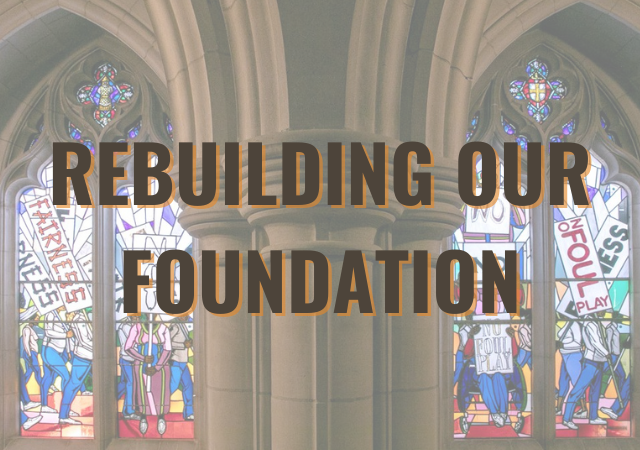
This weekend holds special significance for the Cathedral. In addition to our annual commemoration of the laying of the first foundation stone 116 years ago, we have dedicated to the glory of God the Now and Forever Windows by renowned artist Kerry James Marshall, and beneath the window, the soon-to-be inscribed poem, American Song, by the equally wondrous poet, Elizabeth Alexander.
May we never cease to give thanks for the artistic genius, careful planning, and soul-searching process that brought these stunning works into being.
Pondering the meaning of today, I was reminded of another Elizabeth Alexander poem, Praise Song for the Day that she wrote for President Barack Obama’s first inauguration in 2009 and recited from the steps of the US Capitol:
Say it plain: that many have died for this day.
Sing the names of the dead who brought us here,
who laid the train tracks, raised the bridges,
picked the cotton and the lettuce, built
brick by brick the glittering edifices
they would then keep clean and work inside of.
Say it plain: many have died for this day.
Jesus speaks to us this morning about the importance of foundations. Appropriately, the parable of the house built on solid rock is found at the end of the most concise summary of Jesus’ foundational teaching, known to us as the Sermon on the Mount (in the Gospel of Matthew, Chapters 5-7). There he tells us, and we hear it plain, what it looks like to follow Him in the way of life-changing, world-transforming love.
The Sermon on the Mount famously begins with words of blessing: blessed are the poor in spirit; those who mourn, who are merciful, and who hunger and thirst for righteousness. Blessed are the humble, the peace-makers and the persecuted.
Jesus then exhorts those who follow Him to be like the salt of the earth and light for the world; to seek reconciliation with those who have something against us; to honor our vows, whether we feel like it or not; to refrain from evil and the judging of other people.
Be on your guard, he warns us, against the corrosive love of money and the power of self deception.
Don’t congratulate yourselves for loving those who love you. No, he says, love your enemies and pray for those who persecute you.
Give generously.
Pray honestly and without a lot of words.
Be like trees that bear good fruit.
In conclusion, as we heard today, he tells us that while God’s love is universal and unconditional, following Him is, in fact, like walking through a narrow gate. It’s a hard road, he says, that leads to life. Then he says this:
Everyone then who hears these words of mine and acts on them will be like the wise ones who built their house on rock. The rain fell, the floods came, and the winds blew and beat on that house, but it did not fall, because it had been founded on rock.
So let’s consider the importance of good foundations.
In architectural design and the construction of any building, not the least of which a cathedral, the foundation is the lowest, load-bearing part of a building, typically below ground. In the broadest sense, applicable to all dimensions of life, a foundation is an underlying principle or structure upon which other aspects of life are built and sustained. We speak of the foundations of any given academic discipline or commercial endeavor, the moral foundations of a community or nation, the relational foundations of a family, the spiritual foundations of a life. Because once we build on top of our foundation we can’t see it any longer, we can easily forget that it’s there or that it matters.
Jesus’ warning is clear enough: if your foundations are like sand; they cannot hold you well. Be wise, and build your lives upon solid rock.
It’s impossible to argue against that kind of advice, and who would want to?
So when we are at the beginning of any endeavor–be it a relationship, the raising of our children, establishing the networks in our communities, or building actual physical structures, we do well to tend to the slow, painstaking, soon-to-be forgotten work of building a sure foundation. Yet we also know how tempting it is to cut corners, move too quickly, and hope that we’re not the ones around to clean up the mess when the rains come.
In fairness, I daresay that most of us do the best that we can in foundation building. And when our faulty foundations fail, as they will, we learn the hard way, as we must, what must be done to start over and rebuild a firmer foundation. Sometimes, tragically, the wreckage is too great and we can’t salvage what we’ve lost. But if circumstances are kind and God is gracious, we’re given the chance to clear the debris, save what we can, and begin again.
Those of us who have traveled around the sun awhile know that this is a pretty steady rhythm of life, this building and rebuilding of foundations, replacing faulty ones with ones that hold true. It’s certainly the story of human history, and the evolution of knowledge.
Are you with me so far?
I’d like to broaden the lens a bit further, and when we do, we see that for most of us, most of the time, we live and move and have our being on foundations that others have built–not merely the buildings we live in and the subterranean structures that support our homes and communities, but also the building blocks of our identities and communities, our churches and faith traditions, our national and increasingly global institutions.
Sometimes we realize, or discover, or are forced to reckon with the reality that part of this inherited foundation that we assumed was sound is faulty and cannot hold. We realize that core aspects of our identities and communities were built upon foundational assumptions or beliefs that at best were rooted in ignorance, or worse, lies perpetuated by those who stood to benefit from them.
To be honest, as I’ve been speaking, I’m counting on the fact that examples of what I’m describing have come to your mind, from your life, or field of work or study. That you know what it feels like to come to terms with the fact that some part of your foundation–self-constructed or inherited–could no longer hold the person you are or simply wasn’t true, that the foundation that you were taught as a child, or picked up along the way, was misguided, or blatantly, a lie.
In some instances that realization is horrifying. In others it is sheer liberation. Either way, the process of coming to terms with a faulty foundation, deconstructing it, and starting over is not an easy process. It’s disruptive and unsettling. It creates a bit of a mess, as we sort through the debris for what is worth keeping and what isn’t, find the right materials, to build a foundation, as Jesus said, that can not only hold us amid the storms, but lead to life.
Those who are part of the Cathedral community know why I’m here. This has been a wonderful weekend of celebration and we now have two powerfully, moving windows depicting the courage and tenacity of millions of Black Americans determined to claim their rightful place in this country and their rights as human beings and dignity as children of God.
But amid our celebration, we do well to take a moment to remember the windows they replaced, depicting two generals of the Confederate Army, Robert E. Lee and Thomas “Stonewall” Jackson as icons of Christian virtue–men who themselves owned slaves, betrayed their country, and fought a war to create a new country intending to preserve and expand the enslavement of Black people across the American continents.
After the Confederate windows were removed, they spent nearly a year on loan to the National Museum of African American History & Culture as part of an exhibition entitled: Make Good the Promises: Reclaiming Reconstruction and Its Legacies.
In that exhibition, the Cathedral, through our windows, represented a discredited yet powerful historical lie, perpetuated for generations and with lasting impact today, known as the Lost Cause, which extolled Confederate leaders like Generals Lee and Jackson as saintly figures, the war itself as a noble cause to preserve a noble way of life in which slavery was a benign institution that benefitted the enslaved.
The historical period known as Reconstruction–generally dated 1865-1877–was a time of breath-taking advancement for formerly enslaved Black Americans that was, in the end, violently, systematically dismantled by many of our white ancestors who were determined to maintain racial supremacy and reunite white society, North and South, at the expense of Black Americans.
It is as painful to acknowledge that period of our history as the 300 years of slavery that preceded it, for at the moment when we had the chance to rebuild this country after it was nearly destroyed in the bloodiest of wars on the best of democratic ideals enshrined our foundational documents–that all are created equal and endowed with certain unalienable rights of life, liberty and the pursuit of happiness–instead our white ancestors preserved and fortified the foundational lies of racism and white supremacy.
At critical junctures in years after the Civil War when Black Americans rose up in self-determination and resistance–most notably after both World Wars and during the Civil Rights era, monuments and windows like ours were conceived, paid for and installed all over the South and here in Washington, DC. The symbols of the Confederate cause, as we know, remain a powerful expression and rallying cause for white supremacists movements in our day. We’re not talking simply about history now. White supremacist movements are alive and growing.
This Cathedral participated in the perpetuation of religious underpinnings of racism and white supremacy, as did nearly every other white institution of its day. I daresay that for the majority of white worshippers and visitors in this Cathedral who walked by those windows, we didn’t know it. But Black worshippers and visitors–they knew. You knew. You knew what we chose not to know; and what we knew, for years, we tried not to know, or minimize. Until we couldn’t any longer.
I played a part in all that, and I apologize. I didn’t see it at first, and when I finally did, thanks to a few doggedly persistent Black leaders of this diocese that wouldn’t let me look away, and our former dean, Gary Hall, I hesitated.
One day the late Rev. Robert Hunter, alongside the Rev. Vincent Harris, sat in my office and said to me, “Bishop, will you be a compass, pointing the way, or a thermometer, only moving when heat rises?” I’ve never forgotten that.
As you know, it took two incidents of horrible racial violence in which Confederate symbols featured prominently for us to act. I’m grateful to Dean Hollerith and the Cathedral Chapter members who made the decision to remove a part of our foundation that was at odds with everything this Cathedral and the teachings of Jesus stand for. More than simply removed, the Cathedral leaders went a step further and replaced them, when the time was right, with artistic imagery telling a more complete history and acknowledging how Black Americans all along have been the ones to move us toward our ideals as a nation and a church.
So the dismantling began, which gave space for a new pillar of transformative beauty and power, built on a solid foundation, worthy of the struggle of Black Americans and our deep desire for this Cathedral to, in reality, be a house of prayer for all people. And we would have missed, what we would not have seen, were it not for the taking down of what never belonged here and replacing it with expressions of those countless ones who walked and continue to walk that road which leads to life.
Jesus was right. The road to life isn’t an easy one, especially when it requires a dismantling and reconstruction of foundations that cannot hold. But it is, as Jesus promised, and we can attest from our experience, life that awaits us. Beloved Community is one step closer to its fulfillment whenever what we thought was foundational but isn’t is taken down and replaced with what allows the human spirit to thrive.
So if any part of what you thought was foundational in your life is collapsing now, or needs to be excavated because it cannot hold and is not true, know that your God is with you, and it’s Jesus beckoning you to walk on, through that gate to the life that awaits you on the other side
And for all of us in this place, this church, we must say it plain.
Will we never forget that many have died for this day,
We must remember our history,
As we walk toward freedom,
Believe in Beloved Community
And sing sacred words, just and true.
May our lives and this place be portals where the light comes in.2
1A Little Mercy Now by Mary Gauthier
2Words from Elizabeth Alexander’s poem, American Song, inscribed at Washington National Cathedral.
by EDOW | Jul 27, 2023
En nuestra última entrada de blog, notamos que en la Convención de enero pasado, el Grupo de Trabajo de Reparaciones se transformó en el Comité de Reparaciones Diocesanas con dos grupos de trabajo: Educación y Política. En esta publicación, discutiremos los objetivos del Grupo de Trabajo de Educación con un poco más de detalle.
Las reparaciones es un tema que demanda mucho diálogo. Y con razón, porque incluso la palabra misma genera una multitud de sentimientos por una multitud de razones, tanto en los feligreses negros como en los blancos. Y eso está bien. Todos tenemos razones para sentirnos como nos sentimos. El concepto en sí no es nuevo y, como nación, finalmente estamos intentando tener en cuenta las ramificaciones de siglos de racismo sistémico e institucional contra los afroamericanos. A nivel local, nuestra diócesis se ha comprometido a explorar ese impacto en nuestro contexto particular.
Reconocemos que el racismo basado en el origen étnico ha afectado negativamente a muchos otros grupos étnicos en la diócesis. Nuestros feligreses asiáticos, latinos, nativos americanos, caribeños y africanos, y otros, han tenido experiencias variadas en la Diócesis Episcopal de Washington EDOW en maneras que no siempre fueron acogedoras o positivas. Pero hay una razón específica por la que el trabajo de este comité se centra principalmente en los descendientes africanos que fueron esclavizados y llevados a la colonia de Maryland (y más tarde al Distrito de Columbia) en contra de su voluntad y que interactuaron de alguna manera con la diócesis episcopal del área. Hasta hace poco, la relación de la diócesis con su pasado era, en su mayor parte, una versión unilateral, saneada y blanqueada. Pocos se preocuparon por profundizar más para reconstruir una verdad completa que abarque también las historias de los negros esclavizados que ayudaron a construirla y, más tarde, los hombres y mujeres liberados que la sustentaron. En la búsqueda de una mayor equidad y justicia, la diócesis reconoció la importancia de conocer nuestro pasado para poder avanzar, y se comprometió tanto con la acción como con la palabra.
Como historiador, lo primero que aprendes en la escuela de historia (admito, que no es una cosa real), pero la primera lección es que la objetividad es fundamental y no negociable. Eso significa presentar información sin opiniones, prejuicios, exageraciones, etc. Pero también significa contar toda la verdad y no dejar a un lado las partes vergonzosas, incómodas o francamente horribles. Las partes donde quizás algunas de las personas que más veneramos no siempre hicieron lo correcto. O, Dios no lo quiera, hicieron cosas realmente terribles. Esto puede ser realmente difícil: reconocer que las personas o las instituciones que admiramos cometieron errores.
Es un hecho indiscutible que pocas personas responsables de lo que sucedió en la Diócesis Episcopal de Washington antes de la década de 1950 están vivas. Es igualmente cierto que desde su fundación en 1895 (técnicamente 1608, si se cuentan los años en que las parroquias formaban parte de la Diócesis de Maryland), nuestra diócesis se ha beneficiado enormemente de las sistémicas normas racistas e institucionales que permitieron que las parroquias blancas prosperarán mientras sus contrapartes negras languidecían.
Ahora tenemos la oportunidad de corregir algunas de las políticas, prácticas y procedimientos, escritos y no escritos, hablados y no hablados, que se han mantenido durante generaciones, y hacer que nuestra diócesis sea un poco más equitativa para todos sus miembros, un poco más genuinamente justa, un poco más compasiva. Así que nos debemos a nosotros mismos y a las generaciones futuras mirar el pasado directamente a la cara, escuchar a aquellos que han sido lastimados, dañados, excluidos o marginados de otra manera, y hacer un cambio significativo.
El objetivo del Grupo de Trabajo de Educación del Comité de Reparaciones Diocesanas es presentar a las parroquias de EDOW con información histórica sobre la diócesis, dónde y cómo se cruzó con las vidas de los afroamericanos dentro de su jurisdicción, y el impacto de esas interacciones, para bien o para mal. Tal vez fue durante la esclavitud, tal vez fue durante la era de Jim Crow. Tal vez algunas iglesias se beneficiaron con legislaciones locales que perjudicaron a las comunidades negras cercanas. Tal vez algunas parroquias puedan pensar que solo hablaron sobre la idea de diversidad o multiculturalismo, o solo la adoptaron cuando las poblaciones diversas y multiculturales no incluían a los negros. Algunas parroquias ya han comenzado este trabajo de investigar sus archivos con un ojo inquebrantable y contar toda la historia. Y no, no siempre es halagador, pero es honesto.
Tal vez nada de esto cambie su postura sobre las reparaciones, donde sea que se encuentre en este debate. Y eso también está bien. Solo queremos presentarles información sobre por qué la diócesis eligió este camino y por qué es importante. Estamos en el proceso de desarrollar recursos para usted que se compartirán a medida que se completen. En los próximos meses, tendrá la oportunidad de revisar lo que hemos encontrado y esperamos que obtenga una comprensión más informada del compromiso de EDOW.
Queremos presentar esta información en una variedad de formatos: habrá folletos que puede descargar e imprimir, o leer en línea, audiovisuales que podrá ver y, eventualmente, conversaciones en persona en tiempo real para hablar sobre este tema. Queremos crear un espacio seguro para esa honestidad que mencioné anteriormente, porque a veces la honestidad da miedo. Tal vez tengamos miedo de perder un poco de nuestro brillo. O tal vez tenemos miedo de que no seamos escuchados con sinceridad. Pero sin profundizar en nuestro pasado y reconocerlo completamente (lo bueno, lo malo y lo feo), realmente no podemos esperar que comencemos a sanar, reparar la brecha por así decirlo, y convertirnos aún más en la Comunidad Amada.
Terminaré diciendo que cuando me invitaron a ser parte de este trabajo, una de las escrituras que inmediatamente me vino a la mente fue 2 Corintios 5:18: “Todo esto proviene de Dios, quien nos reconcilió consigo mismo por Cristo, y nos dio el ministerio de la reconciliación”. Este es el único lugar en la Biblia donde a cada uno de nosotros, como seguidores de Cristo, se nos da exactamente la misma tarea: el ministerio de la reconciliación.
Mientras la Diócesis Episcopal de Washington y sus parroquias se comprometen a conocer las verdades (a veces difíciles) sobre el pasado, nuestra oración es que la reconciliación, la equidad y la justicia ayuden a tomar las decisiones de nuestro futuro.
Gigi Nelson
Presidenta, Grupo de Trabajo de Educación
Comité de Reparaciones Diocesanas
Iglesia Episcopal St. Luke, Washington DC

by EDOW | Jul 27, 2023
In our last article we noted that at the Convention last January, the Reparations Task Force transitioned to the Committee on Diocesan Reparations with two working groups—Education and Policy. In this post, we’ll discuss the goals of the Education Working Group in a bit more detail.
Reparations is a subject that demands discourse. And rightly so, because even just the word itself engenders a multitude of feelings for a multitude of reasons—in both Black and White parishioners. And that’s okay. We all have reasons to feel the way we feel. The concept itself is not new, and as a nation, we are finally attempting to reckon with the ramifications of centuries of systemic and institutional anti-Black racism. On a local level, our diocese has committed to exploring that impact in our particular context.
We recognize that racism based on ethnicity has negatively affected many other ethnic groups in the diocese. Our Asian, Latino, Native American, Caribbean, and African parishioners, and others, have experienced EDOW in ways that were not always welcoming or positive. But there is a specific reason that the work of this committee focuses primarily on the descendants of those Africans who were enslaved and brought to the colony of Maryland (and later the District of Columbia) against their will and who interacted in some capacity with the Episcopal diocese of the area. Until recently, the diocese’s relationship with its past was for the most part, a one-sided, sanitized, and whitewashed version. Few cared to dig deeper to piece together a complete truth that also encompassed the stories of enslaved Blacks who helped build it–and, later, the freed men and women who sustained it. In the quest for greater equity and justice, the diocese recognized the importance of looking backward in order to move forward, and committed to action as well as talk.
As a historian, the first thing you learn in history school (okay, that’s not really a thing), but the first lesson is that objectivity is fundamental and non-negotiable. That means presenting information without opinion, bias, exaggeration, etc. But it also means telling the whole truth and not leaving out the embarrassing, uncomfortable, or downright horrific parts. The parts where maybe some of the people we revere the most didn’t always do the right thing. Or, God forbid, they did really terrible things. That can be really hard—acknowledging that the people or the institutions we look up to made mistakes.
It is an indisputable fact that few people alive today are responsible for anything that happened in the Episcopal Diocese of Washington before the 1950s. It is equally true that since its founding in 1895 (1608 technically, if you count the years when parishes were part of the Diocese of Maryland), our diocese has benefited tremendously from systemic and institutional racist norms that allowed White parishes to thrive while their Black counterparts languished.
We now have an opportunity to redress some of the policies, practices, and procedures, written and unwritten, spoken and unspoken, that have carried on for generations, and make our diocese a little more equitable for all of its members, a little more genuinely just, a little more compassionate. So we owe it to ourselves and future generations to look the past squarely in the face, listen to those who have been hurt, harmed, excluded, or otherwise marginalized, and make meaningful change.
The goal of the Committee on Diocesan Reparations’ Education Working Group is to present to the parishes of EDOW historical information about the diocese, where and how it intersected with the lives of Black people within its jurisdiction, and the impact of those interactions, for good or bad. Maybe it was during slavery, maybe it was during Jim Crow. Maybe some churches benefited from local legislation that harmed nearby Black communities. Perhaps some parishes may find that they only paid lip-service to the idea of diversity or multiculturalism—or only embraced it when the diverse and multicultural populations didn’t really include Black people. Some parishes have already begun that work of looking into their historical records with an unflinching eye and telling the whole story. And no, it’s not always flattering, but it is honest.
Maybe none of this will change your stance on reparations—wherever you may find yourself in this debate. And that’s okay too. We just want to present you with information as to why the diocese chose this path, and why it matters. We are in the process of developing resources for you which will be shared as they are completed. In the coming months, you’ll have a chance to review what we’ve found, and we hope you’ll come away with a more informed understanding of EDOW’s commitment.
We want to present this information in a variety of formats—there will be handouts that you can download and print, or read online, videos you can watch, and eventually, real-time in-person conversations to talk through this. We want to provide a safe space for that honesty I mentioned earlier, because sometimes honesty is scary. Maybe we’re afraid we’re going to lose a little of our shine. Or maybe we’re afraid we won’t be sincerely heard. But without delving into our past and acknowledging it fully (the good, the bad, and the ugly), we can’t hope to truly begin to heal—repair the breach as it were—and further become Beloved Community.
I’ll close by saying that when I was invited to be part of this work, one of the scriptures that immediately came to mind was 2 Corinthians 5:18: “All this is from God who reconciled us to himself through Christ, and gave us the ministry of reconciliation.” This is the only place in the Bible where each of us, as followers of Christ, are given the exact same task: the ministry of reconciliation.
As the Episcopal Diocese of Washington and its parishes commit to learning (sometimes hard) truths about the past, our prayer is that reconciliation, equity, and justice inform the decisions of our future.
Gigi Nelson
Chair, Education Working Group
Committee on Diocesan Reparations
St. Luke’s Episcopal Church, Washington DC
by EDOW | Jul 13, 2023
On January 28th, 2023, the Episcopal Diocese of Washington took a committed step during our Annual Convention. We voted to look at ourselves and our history to start making tangible amends for past wrongs directed towards the African American community. Following much prayer, discernment and discussion, members of the convention boldly voted in favor of the resolution, “Toward Repentance and Reparations in the Episcopal Diocese of Washington.” This vote called for the establishment of a Committee on Diocesan Reparations to further identify historical wrongs carried out within the Diocese of Washington, and craft specific solutions towards reparations for those harms. This new committee would continue the work of the Reparations Task Force of the Diocese–the group instrumental in crafting and passing the resolution.
On April 22nd, we began the next faithful step on this journey with an information session held for interested parties that also included Bishop Budde and ex officio members of the original Reparations Task Force. All gathered on a rainy Saturday in the basement of Grace Episcopal Church, Silver Spring, where experiences were shared, desired goals expressed, and working relationships developed. From this session, two working groups were formed: one to focus on education and one to focus on policy.
The Education Working Group’s focus is to “educate, encourage, and support the Diocese in preparing for, and carrying out” the developed recommendations of the Policy Working Group. This group will continue the research into EDOW’s (and individual parishes’) history with regards to slavery, anti-Black bias, and systemic institutional racism. This documentation will be collected and made accessible to all parishes of the diocese in a variety of formats.
The Policy Working Group’s charge includes, but is not limited to, investigating and making recommendations on:
- Appropriate policies and changes to promote and achieve more equitable outcomes for Black communities, Black congregations, and Black individuals when interacting with this diocese.
- Actions and goals which would be most appropriate to provide redress for harms done, including specific financial commitments and other targets.
- Administrative and/or legislative action that would be necessary to make discerned diocesan resources available for redress.
On June 11th, both working groups met for a formal kickoff meeting hosted at the Church of the Epiphany, DC. Those of committed interest gathered, and held discussions to get to know each other and better understand where our views met or diverged. We also discussed next steps, future meetings, and what resources, tools, or efforts each group may need to better accomplish these tasks.
Thanks to the previous work of the Reparations Task Force, we have valuable starting resource material to delve into to further educate ourselves and inform our steps.
The Reparations Task Force initiated this endeavor with the understanding that “Reparations is the spiritual process to remember, restore, reconcile and make amends for historical and continuing wrongs against humanity that can never be singularly reducible to monetary terms, but must include a substantial investment and surrender of resources.” It is the intention of the Education and Policy Working Groups to move forward with this in our hearts.
Erika Gilmore
Co-chair, Policy Working Group
Committee on Diocesan Reparations
by EDOW | Jul 13, 2023
El 28 de enero del 2023, la Diócesis Episcopal de Washington dio un paso comprometido durante su Convención Anual. Allí votamos para vernos a nosotros mismos y a nuestra historia y comenzar a hacer cambios tangibles con relación a lo que hicimos mal en el paso con relación a la comunidad afroamericana. Después de mucha oración, discernimiento y debate, los miembros de la convención votaron en favor de la resolución “Hacia el arrepentimiento y las Reparaciones en la EDOW”. La votación aprobó el establecimiento de un Comité de Reparaciones Diocesanas para continuar identificando los errores históricos realizados por la Diócesis de Washington, y diseñar soluciones específicas para conducir las reparación de esso daños. Este nuevo comité continuará el trabajo realizado por el Grupo de Trabajo de Reparaciones, el cual realizó una labor importante en escribir y presentar la resolución.
En abril del 2022, comenzamos el siguiente paso fiel en este camino con una sesión informativa para diferentes partes interesadas, e incluyó a la Obispa Budde y a miembros ex officio del Grupo de Trabajo de Reparaciones. Todos nos reunimos un sábado lluvioso en el sótano de la Iglesia Episcopal Grace, en Silver Spring, y allí compartimos experiencias, expresamos metas deseadas y continuamos desarrollando relaciones. A partir de esta sesión, fueron formados dos grupos de trabajo: uno enfocado en educación y otro en políticas.
El enfoque del Grupo de Trabajo de Educación “educa, anima y ayuda a la Diócesis a preparar y conducir” las recomendaciones desarrolladas por el Grupo de Trabajo de Políticas. Este grupo continuará con la investigación sobre la historia de EDOW (y sus parroquias) con relación a su participación en el esclavismo, el discriminación anti-negra y el racismo sistémico institucional. Esta investigación será compilada y será puesta a disposición de todas las parroquias de la diócesis en varios formatos.
La labor del Grupo de Trabajo de Políticas incluye, pero no está limitada, a la investigación y a hacer recomendaciones sobre:
- Las políticas y cambios apropiados para promover y alcanzar más metas equitativas para las comunidades, congregaciones e individuos negros cuando interactúan con la diócesis.
- Acciones y metas más apropiadas para proveer enmiendas al daño cometido, incluyendo compromisos financieros y otras metas.
- Acciones administrativas y/o legislativas que pueden ser necesarias para crear recursos diocesanos y ponerlos a disposición para el cambio.
El 11 de junio, ambos grupos se reunieron para el inicio formal del trabajo, recibidos por la Iglesia Epiphany, en DC. Los comprometidos con el trabajo se reunieron y tuvieron un debate lo cual facilitó su conocimiento mutuo y una mejor comprensión de sus puntos de vista y de sus diferencias. También debatimos sobre los próximos pasos, las reuniones futuras y qué recursos, herramientas y esfuerzos necesita tener cada grupo para cumplir mejor su tarea.
Gracias al trabajo previo del Grupo de Trabajo de Reparaciones, tenemos recursos materiales muy valiosos para continuar educándonos más y para tomar los siguientes pasos.
El Grupo de Trabajo de Reparaciones inició su labor con la comprensión de que “las reparaciones son un proceso espiritual para recordar, restaurar, reconciliar y hacer enmiendas a los errores históricos continuados contra la humanidad que nunca pueden ser reducidos a términos monetarios, pero que incluyen inversiones sustanciales y colocar recursos para esta labor”. Es la intención de los Grupos de Trabajo de Educación y Políticas continuar con esto en nuestros corazones.
Erika Gilmore
Co-presidenta, Grupo de Trabajo de Políticas
Comité de Reparaciones de la Diócesis

